
Final Fantasy VII Rebirth review: A disappointing journey through a world of tourist traps

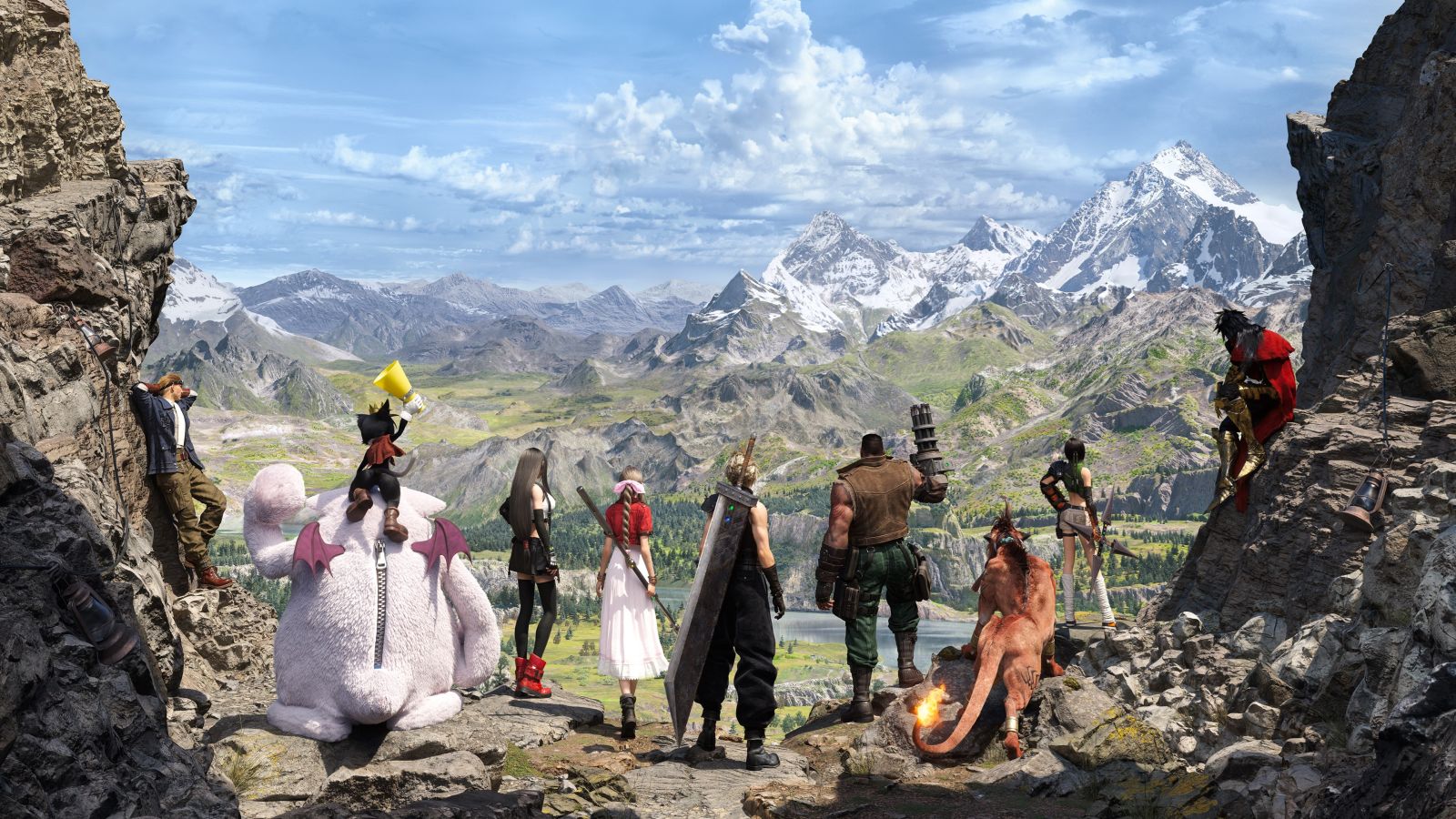
This article will contain spoilers for the original Final Fantasy VII, Remake, and chapters 1-11 of Rebirth throughout. There will be another warning later before I get into major spoilers from the last three chapters of Rebirth.
I have a confession to make: while the original Final Fantasy VII has been a game near and dear to my heart since I was 14, a game I'd started many times, I didn't complete it until I was 30. There are many games I could say similar things about. Blame ADHD, I guess. But in early 2024, with Final Fantasy VII Rebirth imminent as my most highly anticipated game of that year, it was time to finally fix this. Even with a game like FF7 that you may think you know front to back via osmosis, there's no replacement for actually sitting down and experiencing the whole thing for yourself.
So I played through the 1997 original from start to finish, hoping to eventually compare the two versions of the story in a blog post where I could nerd out over both versions of the story. After all, Final Fantasy VII Remake had beautifully recreated and expanded upon the Midgar portion of the game with a faithfulness to the original story's spirit that felt downright miraculous after decades of hit-or-miss expanded universe spinoffs and Flanderized crossover cameos. It wasn't a 1:1 remake, and I have my nitpicks, and I know not everyone's crazy about its pacing, but I had a blast with it. Rather than replacing the original, it was a new adaptation that put its own spin on things allowed me and many other fans to look at the original with fresh eyes, the two versions of the story beautifully complementing each other. A real "holy shit, two cakes" situation. I was certain that Rebirth would do the same for the rest of disc 1.
I have another confession to make: I didn't really like Final Fantasy VII Rebirth, and playing it immediately after finishing the original did it zero favors. Which is why I put off finishing it, and this post, for two years.
Don't get me wrong, there's a lot to love in Rebirth. The great voice performances really breathe new life into the cast, and Barret in particular continues to steal the show whenever the story focuses on him. Other party members who got very little screentime in the original if you chose not to use them in your party now get tons of room to shine. This game made me love Cait Sith, when I used to kinda hate the guy for being such a narc in the original! The combat system that fuses real time action with turn-based strategizing is still a joy, especially with all the new synergy moves. Queen's Blood is a phenomenal trading card minigame. The soundtrack by Masashi Hamauzu and co. is bonkers. Rebirth excels in so many ways, which is why it's so easy to find glowing reviews calling it a masterpiece. If you feel that way, I get where you're coming from. I have a love-hate relationship with this game, not a hate-hate one.
Here's the thing: this is the longest singleplayer Final Fantasy game ever made (rivaled only by FF12), and it’s also the one with the least eventful story. For the average player it's easily twice as long as Remake, and up to another hundred hours longer than that for completionists, and in that 60-to-160 hour runtime it has about half as much meaningful drama and character development, if that. I spent so many long stretches of this game waiting for anything interesting to happen. Not just pure plot progression, but any bit of writing that really grabbed me.
Despite Remake's ending freeing our heroes from the chains of fate, Rebirth remains a story about them wandering from town to town while kinda-sorta following the mysterious men in black robes in the hopes that it’ll eventually lead them to the elusive Sephiroth, as in the corresponding chunk of the original game. Events still only truly escalate at the Temple of the Ancients, which is Rebirth's final dungeon. This new telling does precious little to give the preceding series of loosely connected vignettes more of a satisfying narrative arc as a standalone release. It doesn't even add a particularly meaty new B-plot. They put Zack on the cover and opened the game with him to tease the possibility of wild changes to the story, Rebuild of Evangelion style, but he's a glorified cameo with less than an hour of total screentime spread across the game.
Instead, Rebirth is bursting with fluff. Open world busywork. Extended downtime in the main plot. Silly side quests. And, yes, many minigames. I kind of knew that would be the case going in, but I thought I'd love spending 100 hours doing wacky bullshit with this cast. I thought wrong. The specific kinds of padding added here kill any sense of story momentum and give the game and its world massive problems with tone. And even when it's adapting or building off of dramatic moments from the original, I find that Rebirth constantly finds ways to undercut its tension and intrigue and make this new version of the story worse. And this is a consistent problem even long before we get to the game's bafflingly executed ending.
Allow me to dig into the specifics of why Rebirth both failed to capture what I love about the original Final Fantasy VII and failed to really grab me as its own game.
A whole new open(-ish) world
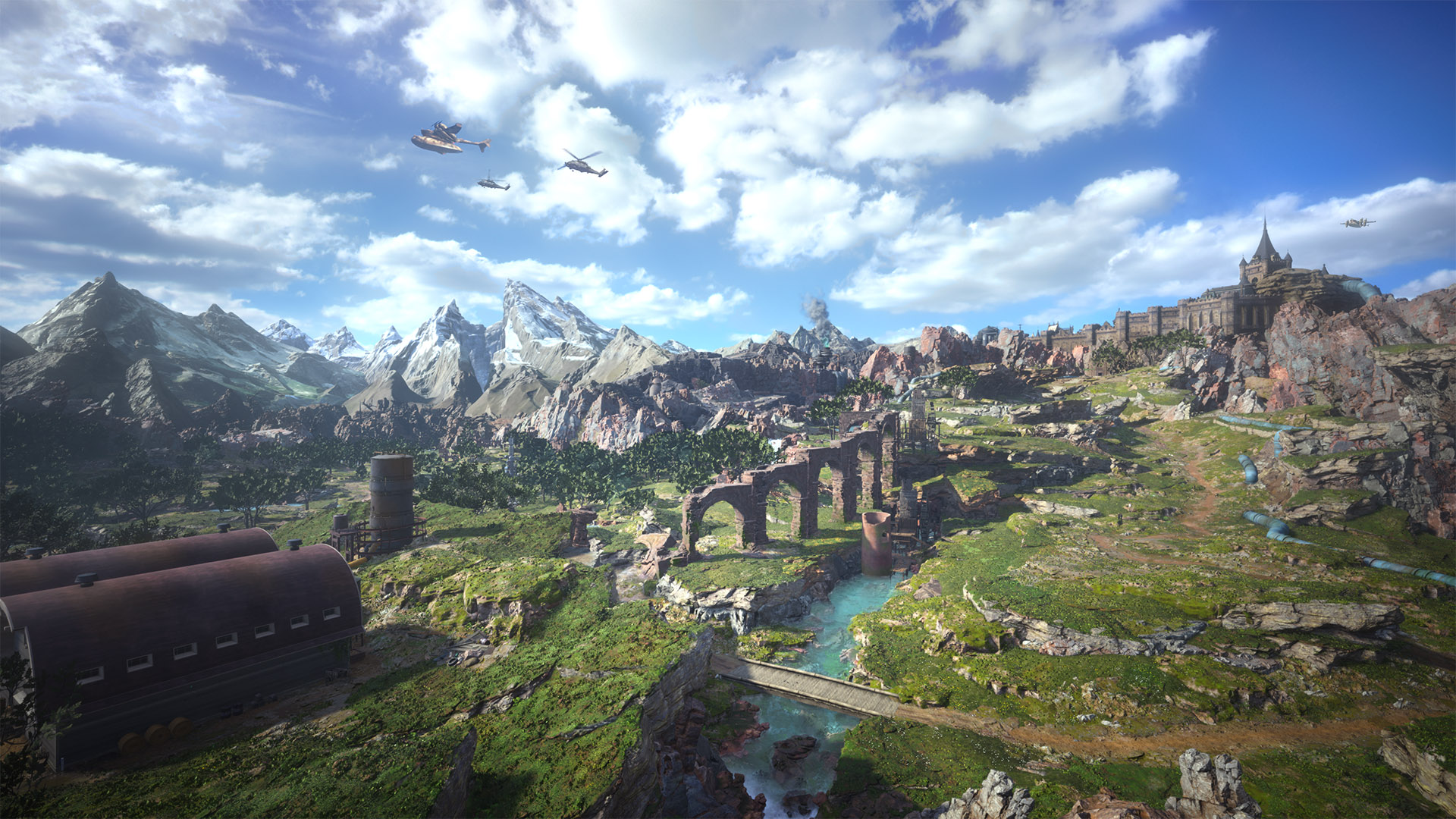
In an attempt to recreate the feeling of stepping out of Midgar and finding a vast overworld map to explore for modern audiences, Rebirth has become a semi-open world game. I say “semi-” because the world is divided into a set of interconnected yet separated regions that unlock one after another as you progress the story, rather than giving you a big map where you can explore every inch in any direction at your own pace. I would most readily compare Rebirth's structure to that of Xenoblade Chronicles, which really makes it feel like things have come full circle, given the very first Xeno game, 1998’s Xenogears, was born out of an alternate pitch for the seventh Final Fantasy.
While it doesn’t really replicate the feeling of the old overworld map, early on I kind of liked the separation of the zones and all that unexplorable out-of-bounds space between them. Before release I worried that the world would feel tiny, given it’s an abstraction of an entire planet as opposed to a single city, state, or country, like most open world games, but the fact that there are large chunks of these continents that we don’t see helped balance things out. At least, that was what I thought until the Tiny Bronco allowed me to seamlessly explore the world's waterways, revealing that they'd always been directly connected all along. This is supposed to be an extremely cool reveal, and it IS a neat trick, but sailing directly from Costa del Sol to Junon without zooming out to an overworld map makes it feel like you're crossing a moderately large lake at best, rather than sailing halfway across the globe. The world's probably going to feel even smaller when we can fly in the next game. But I'm not sure there was really any way around this short of retaining the overworld map, which they were never going to do when they could instead make this a modern open world game.
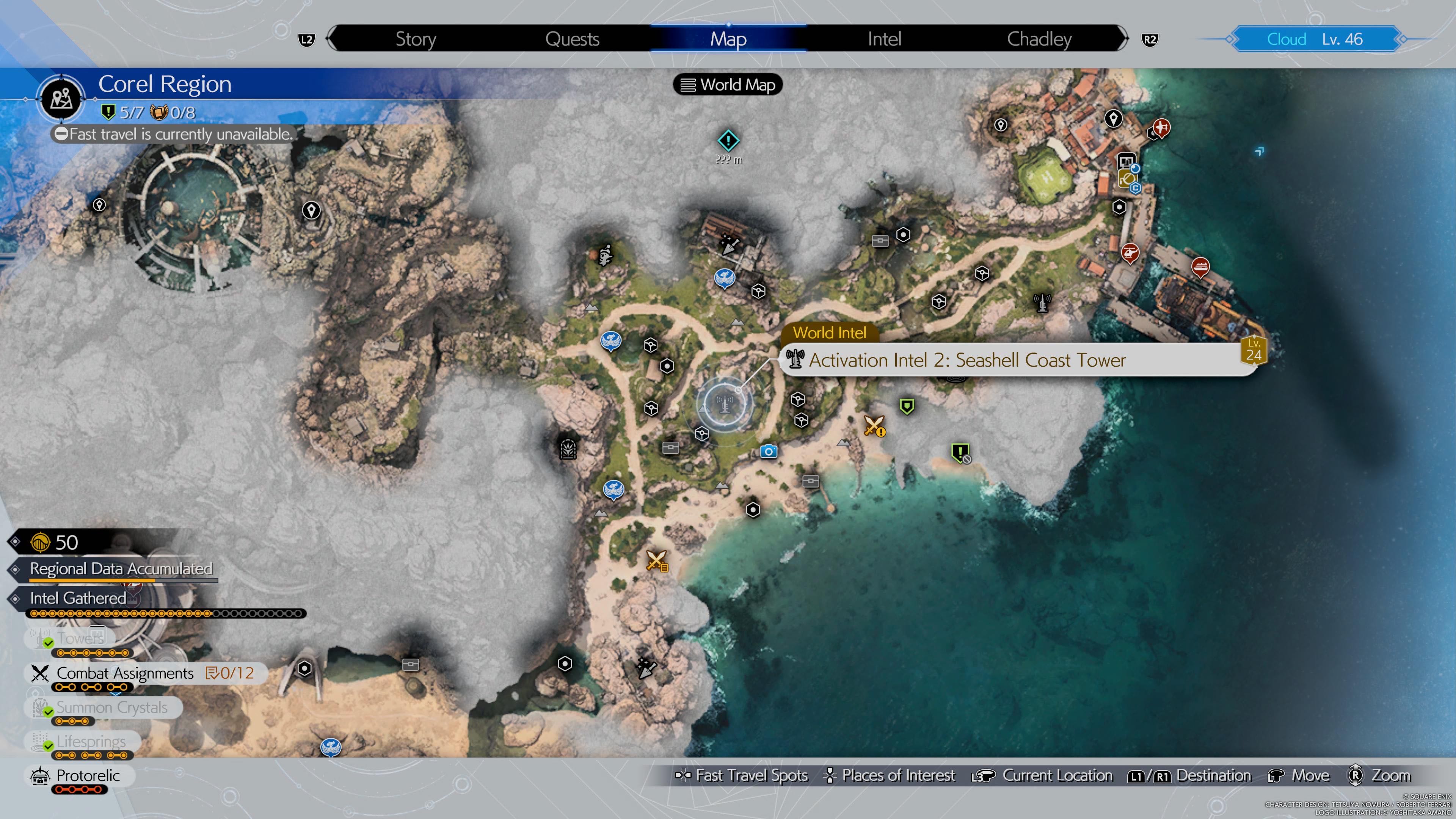
The actual execution of this open world is… lacking. It's the kind where you don’t really explore so much as you make a beeline for objective markers on your map, many of which are revealed by climbing and activating radio towers, because of course they are. Yes, I'm sorry, but the Ubisoft comparisons invite themselves here. Rebirth also takes very liberally from the design of the Horizon games, but I haven't played those and can't compare them in depth, aside from thinking the parts where you sneak around in tall grass to capture Chocobos sure remind me of Horizon gameplay.
There isn’t much of interest to find out there in your travels if you do choose to explore, aside from some additional fast travel points, the occasional treasure chest containing a mid-tier item, and of course the litany of generic crafting materials littering the ground in every area. You won’t find any interesting side quests out in the world, because those are just placed on the notice board of each town—and, in fact, random exploration will almost always lead you to interesting-looking landmarks that you'll realize are the sites of future side quests where you can’t do anything yet. You won't find any rare Materia or gear, because those are mostly locked behind the side quests and combat simulations or otherwise placed in main story levels. You won't find any optional dungeons, because there are none.
The stilted, stop-and-go movement doesn't help, either. Trying to go even slightly off the beaten path typically just gets your Chocobo caught on a rock or some weird bit of geometry you're not supposed to climb or an invisible wall or something. Traversing later areas like Gongaga and Cosmo Canyon gets particularly annoying because you'll often be left wondering where the hell they hid the one ramp or interaction point that lets you get to the specific level of elevation where your objective is. Of all things to retain from the PS1 game's world design, I don't know why they kept that. Even in earlier zones, it frequently feels difficult to discern your path without relying on the map and objective markers due to the high-detail, high-contrast visuals and poor lines of sight and landmarks. The world somehow feels both huge and also claustrophobically cluttered.
I quickly learned to just not explore and instead only travel to spots where I already had an objective marker waiting for me, which I can’t say captured the feeling of exploring a classic JRPG overworld map. (If you're itching for something like that, maybe check out Angeline Era.)
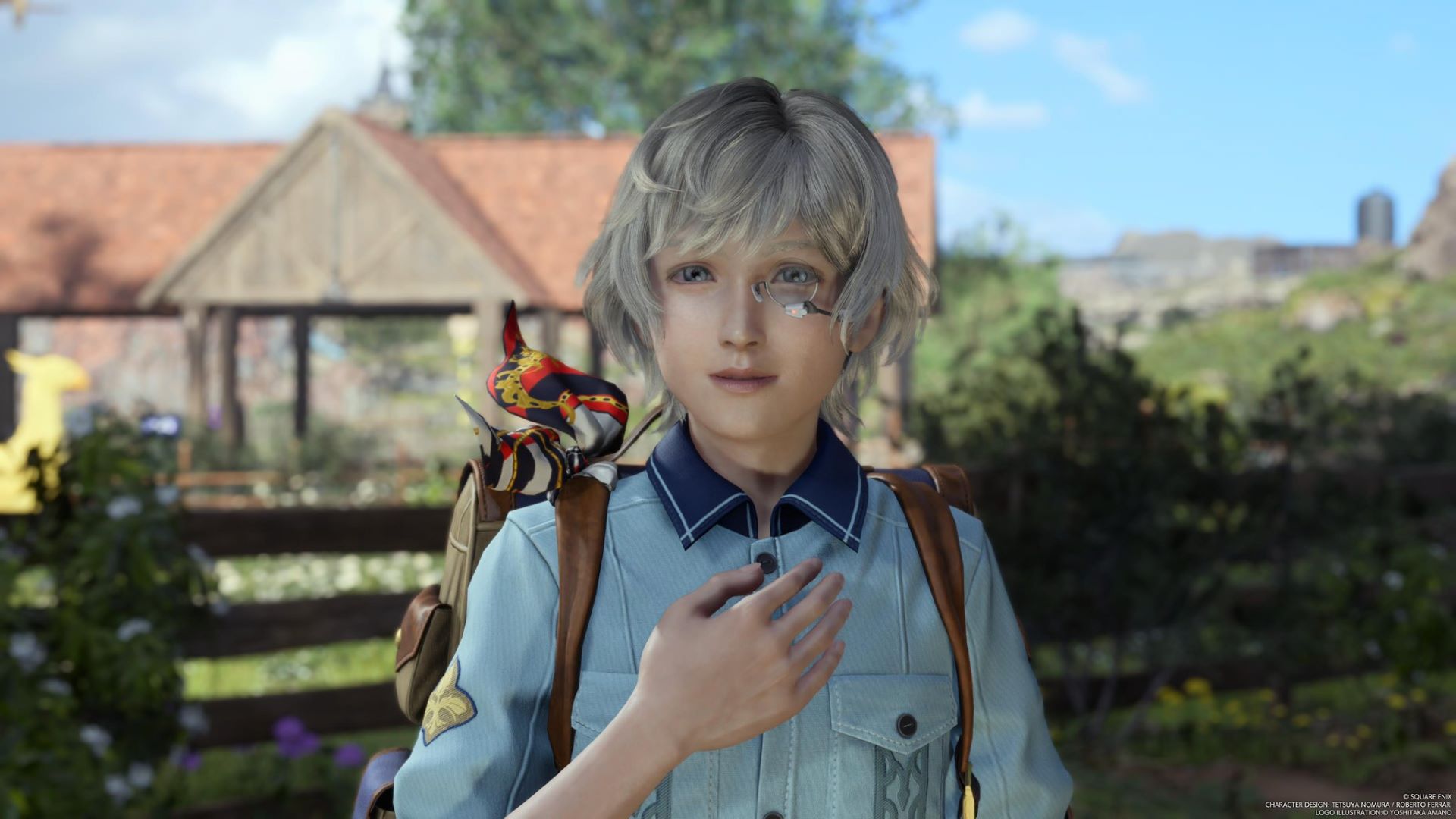
Most of those objective markers are for errands you're doing for Chadley, the weird cyborg kid created by Hojo who ran the battle simulator in Remake. Regardless of anyone's feelings on Rebirth as a whole, whether you love or loathe the game, whether you hate this fact or think it's hilarious, most players seem to be in agreement on one thing: there's way too much Chadley. He may very well have the most voice lines out of any character in the game.
Chadley truly dominates so much of the experience here. Exploring the world is a matter of filling out Chadley's checklist of errands. There's a whole dedicated "Chadley" tab on the menu next to the map and quest log. (Scroll back up to the map screen screenshot if you don't believe me.) Even worse, there are actually two Chadleys now, because he created a female AI named MAI who's basically just a Girl Chadley he bickers with sometimes. Every single time you find something of note in the open world, Chadley and/or MAI has to stop you dead in your tracks and FaceTime you to explain what it is, replacing any sense of curiosity with pure annoyance at the constant tedium. Every area is littered with spots where you have to inspect an object and do a quick time event so that Chadley can info dump at you about the area's lore, and then the completion meter for the region will go up a little. Rinse and repeat. So much of your playtime is just spent doing that. At times it almost feels like this literal child who wasn't even in the original game is the true leader of Avalanche, constantly bossing the heroes around and telling them what to do, and they just do it. I guess stopping Sephiroth from destroying the world can wait, Chadley's got Lifesprings he wants us to scan!
Before you write that comment telling me to just not be a completionist, if the amount of open world side content bothers me so much: believe me, I didn't play Rebirth like a completionist. I skipped a lot of stuff that didn't interest me and finished the game in 70 hours. The problem is that the game feels balanced expecting you to do a lot of the side content. I highly suspect that the average player who avoids the open world content is going to constantly be underleveled and low on gil, which is probably why if you try to focus on the main story and ignore most of the busy work for a bit, Chadley will literally call you up and pester you about getting him that World Intel he asked for. Want a decent selection of Materia to choose from? Then you better be running errands for Chadley, because he's the source for a lot of them.
When you're not running errands, the adventure is also full of—say it with me, folks—minigames!
Minigames and "minigames"
One of the big debates around Rebirth upon release was whether or not it has “too many minigames.” The defense is always that, well, the original game also had a ton of minigames, as do other FF games. I see where this line of thought comes from, but having played both games back to back, there’s a meaningful difference in how the two games frame these things.
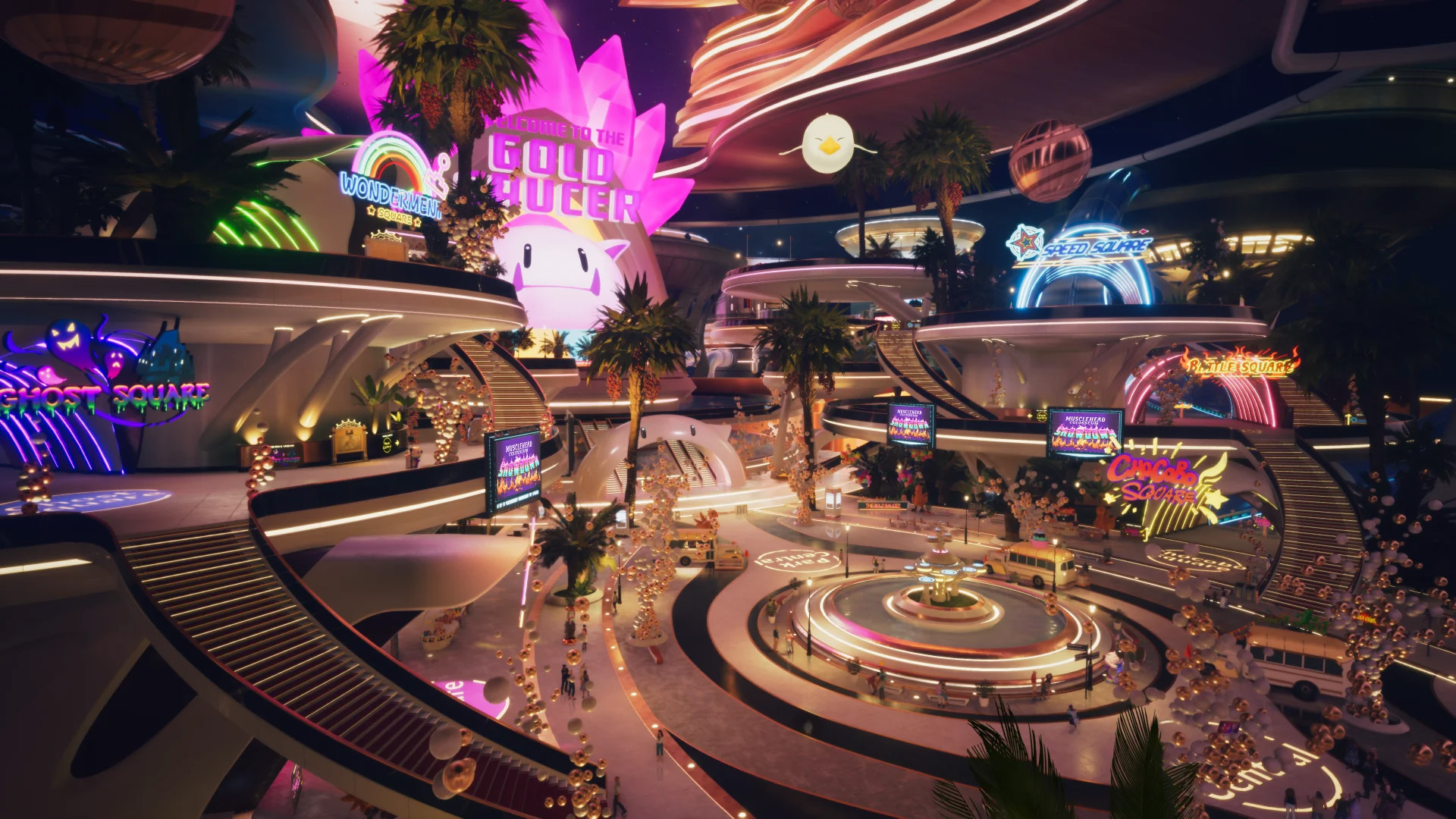
Final Fantasy VII is chock full of sections that could be described as “minigames,” but most of them are integrated directly into the events of the plot. Really, they feel less like “minigames” and more like major set piece moments where the dev team thought up a really cool scene and then went “now how do we make that interactive?” This was a style of set piece-driven game design that Squaresoft had begun toying with in the SNES era with things like the opera sequence in Final Fantasy VI or various sections of Super Mario RPG, but they really cranked it up to 11 with VII. The escape from Midgar comes in the form of a playable motorcycle chase. Infiltrating a military parade to get through Junon involves an interactive drill performance for Rufus. The raid on the underwater mako reactor culminates in a deep sea submarine battle. Acquiring a key macguffin to progress the plot is done via an archaeological excavation minigame that can reward you with other treasures. One part of Great Glacier replicates the feeling of getting lost in an arctic blizzard by having the camera rotate around on its own, forcing you to place down markers to remember which direction you came from. I could go on and on. Really, it’s mainly the Gold Saucer that’s home to minigames for their own sake with no story integration, which fits thematically since it’s a gaudy amusement park designed to distract you from the bleak state of the world and drain your hard-earned gil.
I’m not going to sit here and say I loved every single alternative gameplay segment in the original—a lot of them are clunky as hell, and several made me give up and look up a guide—but for a game from the '90s, I admire what they were trying to do. FF7 feels like a game made by passionate designers eager to experiment. They threw damn near every idea they had at the wall when it came to interactive storytelling, and these set piece moments with their unique gameplay are a huge part of that. It pairs beautifully with the wild "rule of cool" creative swings the game takes with its character designs and prerendered backgrounds. Yes, it's silly that you go snowboarding so soon after Aerith dies, but a lot of these so-called "minigames" mean something to key moments of the story. It feels like an extremely forward-thinking game in that regard, and it’s super ambitious for Square’s first 3D game. It was a big budget AAA game filled with these fun little segments that almost have the energy of a short, experimental game jam project.
(A more recent game I might compare this ethos to is Split Fiction, with its love of creative one-off gameplay segments. Admittedly I haven't played it myself, but I keep thinking back to the frequently clipped bit where one player is driving a motorcycle in a high speed chase while the passenger has to disable a self destruct protocol by frantically solving a bunch of captchas on their phone. That's not just a "captcha minigame," it's using a shift in gameplay to involve the player in a memorable moment in the story!)
Rebirth certainly still has some set piece minigames like this, including several direct updates that are admittedly more fun to play than the originals. But it also has a massive increase in minigames for the sake of minigames. Not unique bits of gameplay integrated directly into the story, but rather as straight up in-universe games diverting your attention away from the story.
While FF7 mostly relegated this type of minigame to the Gold Saucer and made them completely optional, Rebirth adds a bunch of them all over the place. It doesn’t matter if you’re in an amusement park, a religious commune, an old fishing village that’s decaying underneath a major military base, or a shady slum that’s supposed to function as an open air prison, all of these locations now feature similar goofy sideshow attraction minigames. Sometimes there's the most bare minimum story excuse for why you have to run around catching mischievous Moogles or participate in a frustrating auto battle minigame, but frequently they're presented as amusements for the sake of amusements in-universe. And you're forced to play a hell of a lot of them at least once in the main story, because too much time and money went into making all these annoying minigames for players to be able to avoid them.
There's also Queen's Blood, the obligatory trading card game where you fight for territory on a limited play area. And, sure, Queen's Blood is good. I like Queen's Blood. It has a lot of depth and a fantastic jazz soundtrack. But it didn't take me all that long to grow tired of it. When every single new town you visit has to have a whole new tier of Queen's Blood players to fight, it can become a huge time sink. Maybe in a version of the game with fewer other minigames vying for my attention I would've relished in it as a breather from the plot, but this is a game where even the critical story path feels like it's 80% breathers from the plot.
Mandatory Fun
One of the reasons why Remake felt like a miracle was because it embraced Final Fantasy VII's silliness after years of dour spinoffs that flattened the cast into the most boring versions of themselves. While the story focuses on its dystopian setting, psychological drama, questions of identity, acts of ecoterrorism, premonitions of the apocalypse, and grief, there are still many endearingly goofy moments along the way. Red XIII and Cait Sith poorly disguising themselves as humans. The painfully awkward "date" you get with Barret at the Gold Saucer if you fail to woo one of the girls. Enemies that can turn the party into frogs. Palmer running away and getting hit by a truck at the end of his boss fight. Cloud getting the chance for a badass line as he leads the party into the final battle and choosing to say "let's mosey," which he immediately gets teased for. This balance of drama and comedy was always a key part of classic Final Fantasy's charm.
But where FF7 and Remake were perhaps 75% serious and 25% silly, Rebirth feels like it inverts this ratio. The original game had its comic relief, but many stretches of Rebirth had me eager to use the main story as dramatic relief (if such a concept exists) from the relentless low-stakes silliness of the side quests and minigames. But then the main story itself is also full of new forced diversions, and playing just a bit of it would inevitably unlock more superfluous side activities and open world busywork for Chadley to pester me about. Yes, I love many comedic RPGs, from EarthBound and Deltarune to Paper Mario and Final Fantasy V and beyond. Which is why I made my own similar RPG full of dumb jokes! I also love long TV shows with tons of room for random tangents and "filler" and one-off episodes with goofy premises. But here, all of the lighthearted padding detracts from the story rather than enriching it, especially when Rebirth is also constantly watering down the parts of the game that were more serious in 1997.
Look, let me give you an overview of the five chapter stretch where this became a problem for me.
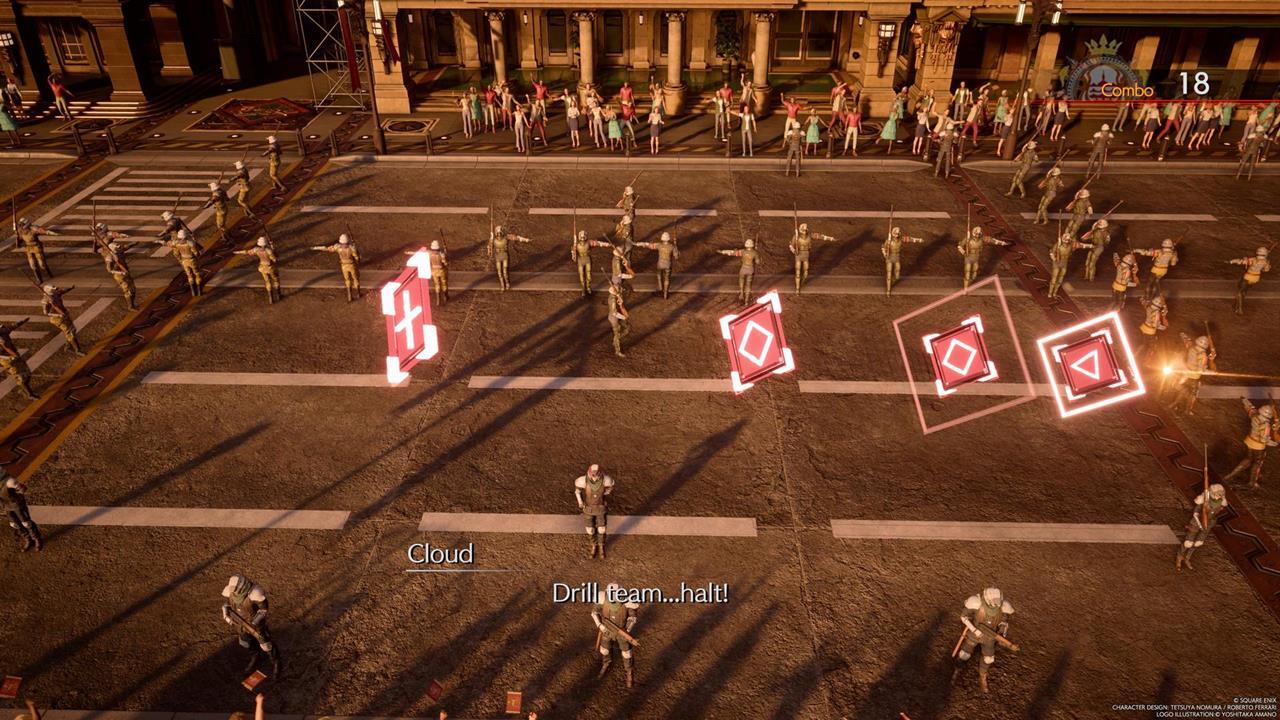
Chapter 4: Junon. The second open world zone, where you'll probably learn that some of the Protorelic quests will require you to beat multiple levels of convoluted and bad minigames, like the new Fort Condor auto battler tower defense thing. Then after doing the expanded dolphin riding minigame, and maybe also a Fall Guys challenge where you avoid getting knocked off a floating platform in frog form, things naturally culminate in the parade.
A lot more time is spent focusing on the parade in Rebirth, including additional cutscenes, running all around town to gather up your missing troops, and marching QTE minigames that last much longer than they used to. I don’t necessarily mind this so much given it’s an iconic sequence from the original game, but the focus on becoming buddies with the Shinra grunts feels odd given you’re just gonna go right back to slaughtering their brethren, a minor problem from the original that now feels exacerbated by how much longer the story lingers on the moment rather than leaving it as more of a throwaway gag. And Aerith and Tifa feel a little too eager to get into character as grunts here, given their histories with Shinra. It's only, what, a few days since the plate drop, but they're having tons of fun playing pretend as loyal soldiers for the guys who did it and spouting propaganda? But, sure, whatever, it was always an intentionally silly part of the story, I can live with this. You then fight your way out of Junon and onto the boat.
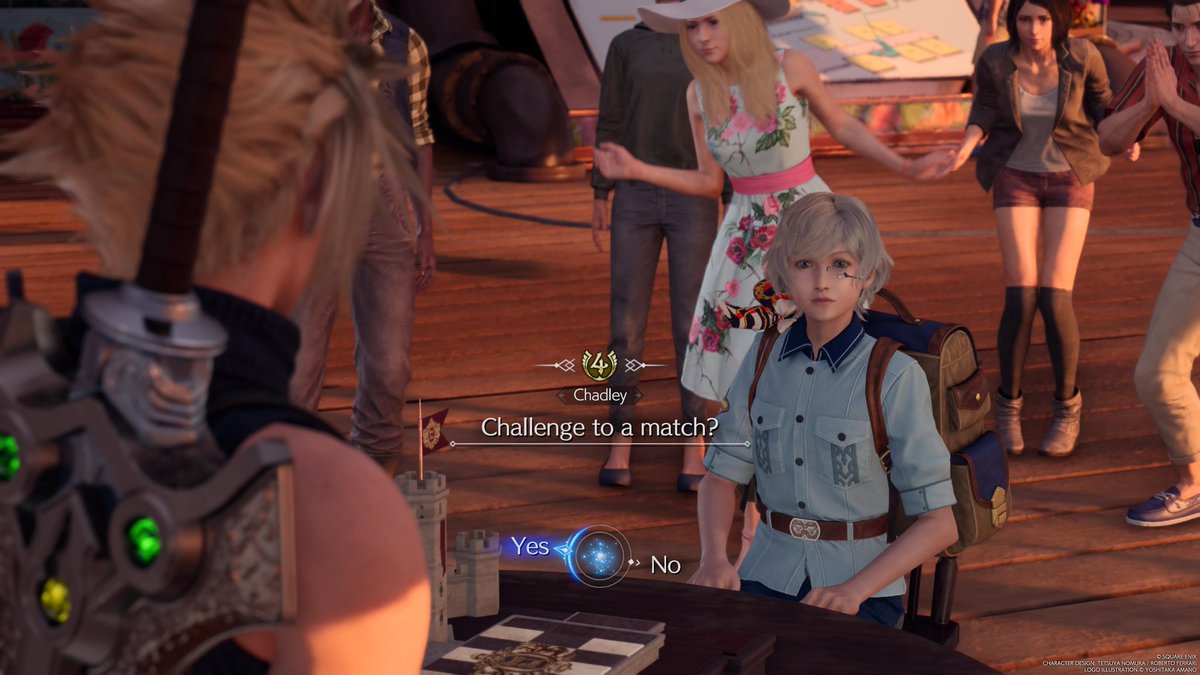
Chapter 5: The boat. In the original game this was a Shinra cargo ship, and you didn’t spend much time on it. You really just ran around checking on the party members in their disguises, you spied on Rufus a little bit, and then much of the crew got slaughtered and you fought Jenova. While you still fight Jenova at the end of the boat segment in Rebirth, the cargo ship has been turned into a luxury cruiseliner that’s home to an entire multi-round Queen’s Blood tournament, which could easily take you like an hour to complete. I wasn't tired of Queen's Blood yet at this point, and I didn't know just how many mandatory minigames awaited me in the next chapter, so I did the tournament, but you can skip it. Still, it's a completely different vibe from the original sequence. You're not wanted fugitives, you're guests on a cruise playing a trading card game to pass the time. At least they make you sleep in the bowels of the ship to reflect the recurring upper world/lower world class divide like in Midgar and Junon, I guess?
It's also worth noting that several of the tournament competitors are returning characters. A lot of the friendly NPCs from Remake appear here and elsewhere on your journey. While there were minor cases of this in the original game, Rebirth's emphasis on doing side activities with these returning characters makes the party's journey feel less like a death-defying adventure when damn near everyone in Midgar seems to have set out on the same path around the world to go sightseeing. It's like you're just tailing everyone on their vacations.
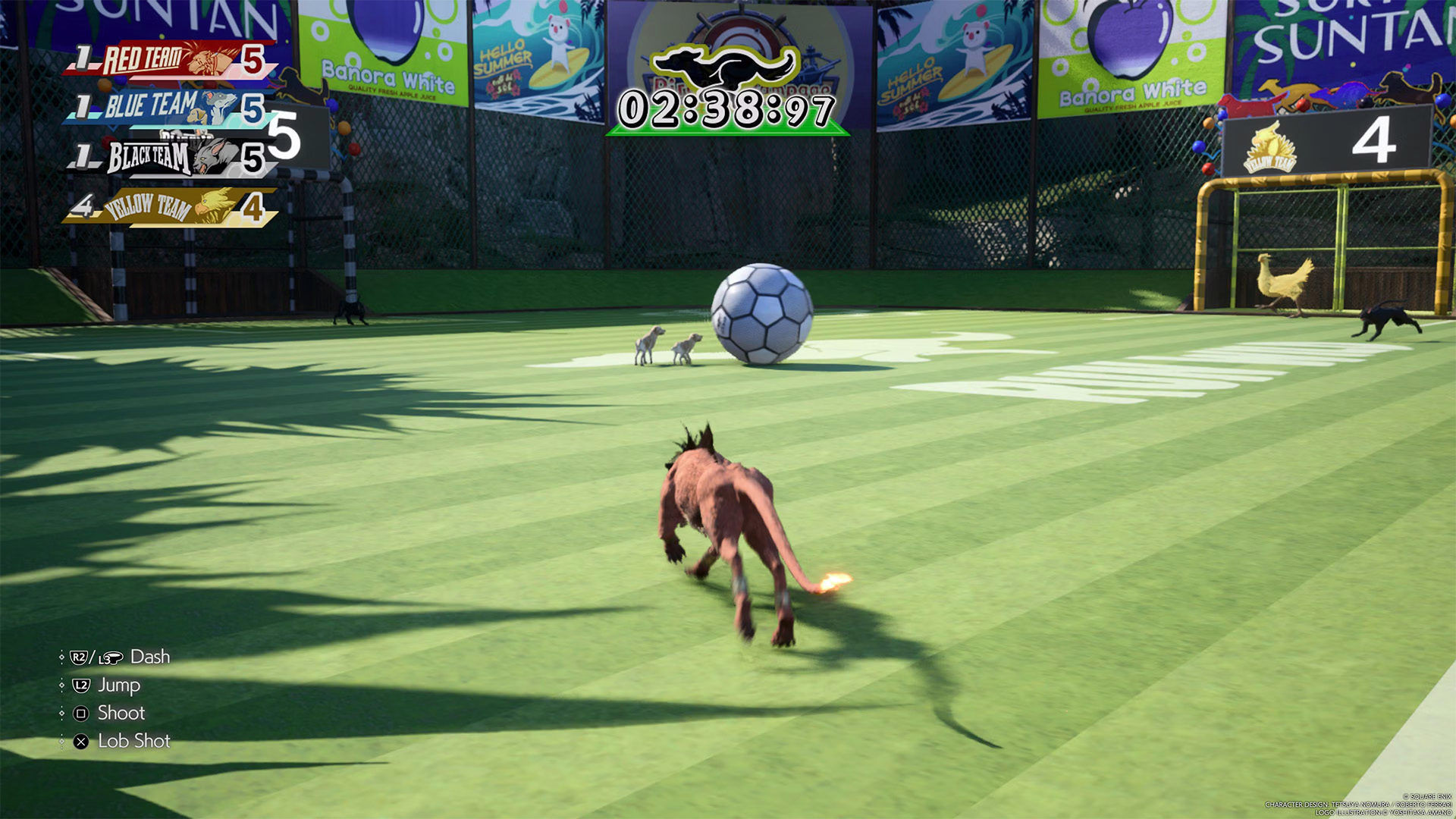
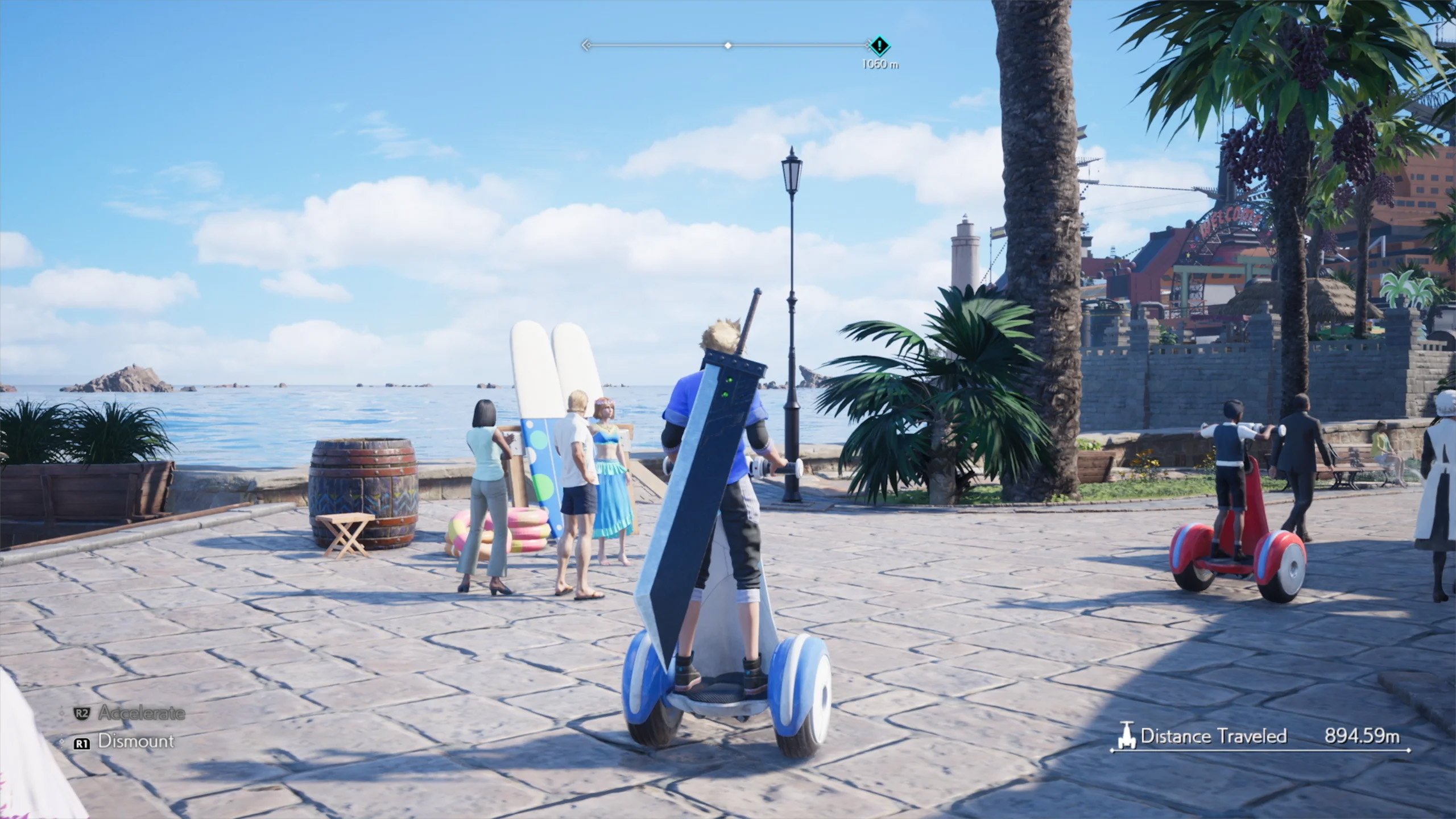
Chapter 6: Costa del Sol. After playing card games for like an hour, I was ready to get back to the story, or maybe explore a new chunk of the open world for a change of pace. Nope! Sorry, can’t do that. What was originally a very brief pit stop town that you could leave immediately in FF7 has been turned into a hub for half a dozen mostly mandatory minigames. A shooting gallery, four-way soccer with Red XIII, a scavenger hunt for Cactuar symbols hidden around town, a piano recital, some busywork gathering and returning misplaced Segways, and even a new rule variant on Queen's Blood, even though you probably just did a whole tournament of that. You have to do at least some of these to unlock beachwear for Cloud, Tifa, and Aerith, which you'll have to do before you’re forced allowed to do even more tourist stuff on the beach with the party. Also please enjoy all the time spent with everyone's favorite FF7 character, Johnny. Don't you want to help him with his dream of running a successful beach hotel? Only after this extended beach episode, capped off with a new boss fight, can you move on.
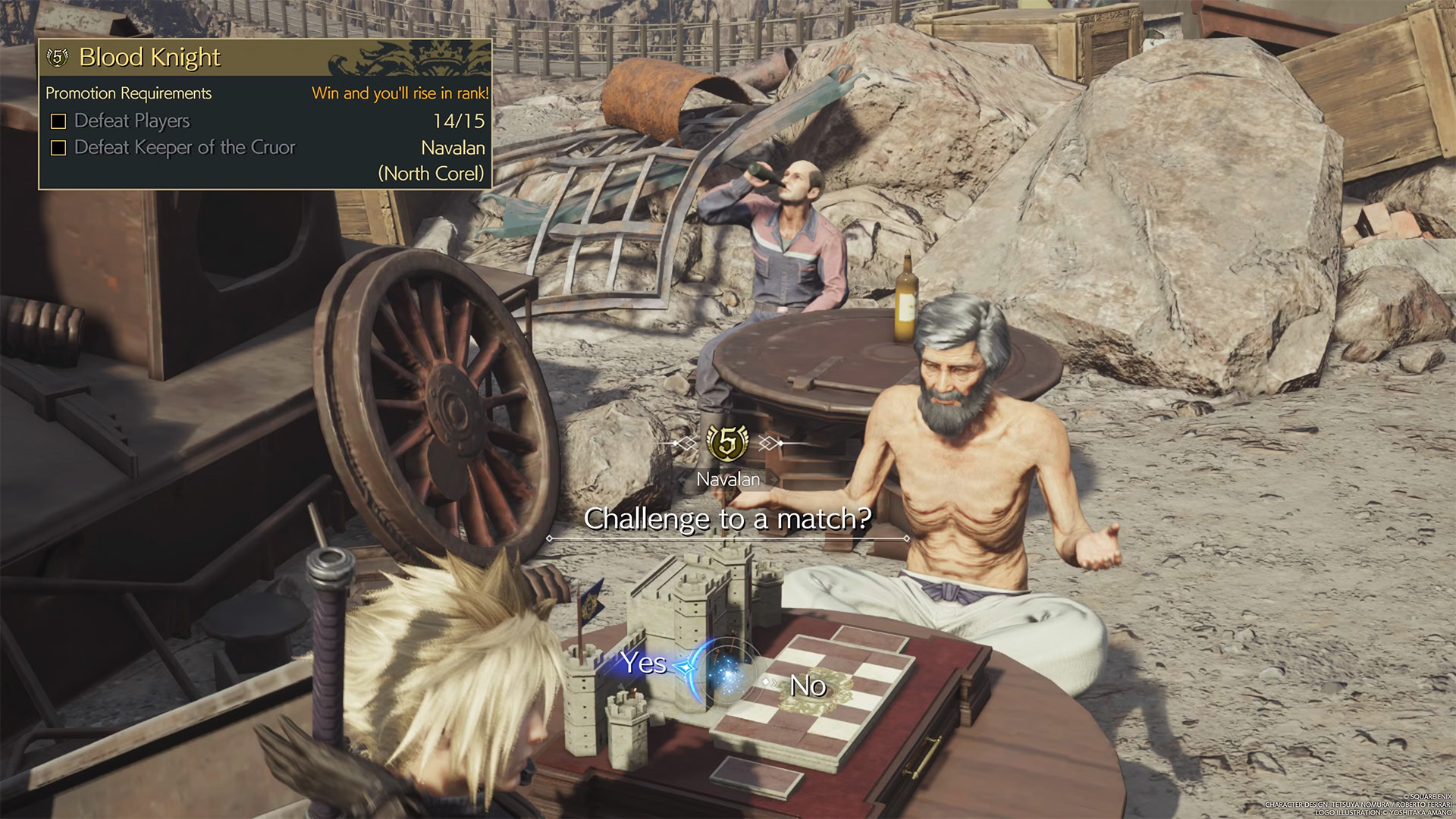
Chapter 7: Mt. Corel. As you’re preparing to leave Costa del Sol and explore the Corel region, multiple side quests will unlock, including one that requires you to do the newly updated and seemingly more annoying squats minigame.
After briefly exploring a very small new region of the world outside of Costa del Sol and traversing the abandoned mines of Mt. Corel (wow, a dungeon!), you arrive in the dilapidated ruins of North Corel, where you’ll find more side quests and Queen's Blood opponents right as you’re ready to leave for the Gold Saucer. Yes, they give you more minigames to do right before you get to the most famous minigame hub in all of video games. Yes, people are still eager to play the trading card game with you and ask for help with side quests in the depressing shanty town where everyone blames Barret for the fact that they're homeless and starving to death. It'd be too much of a bummer if they didn't wanna hang out with you.
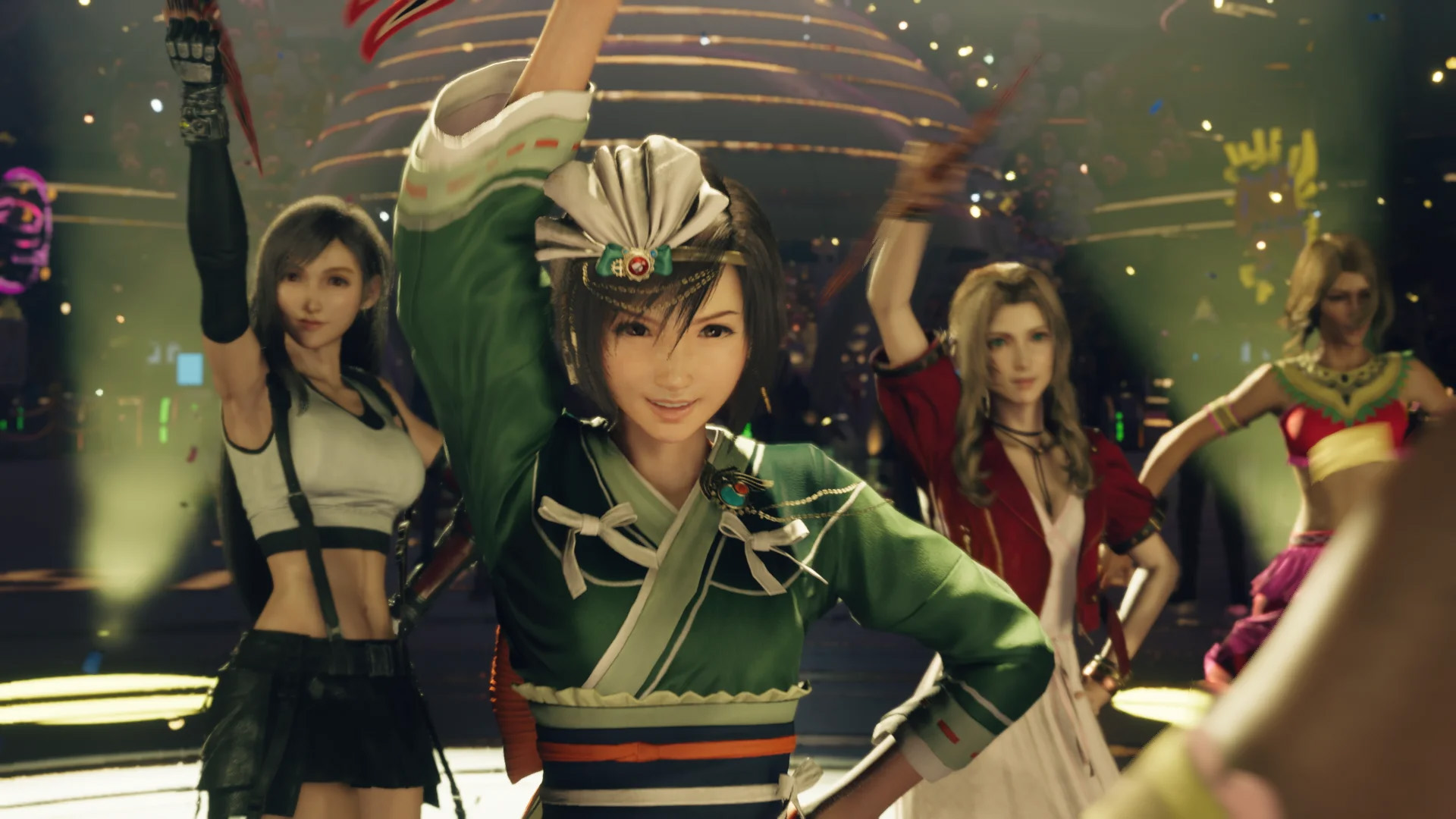
Chapter 8: The Gold Saucer and the Corel desert. Again, while the original lets you leave almost immediately if you know where to go, a lot more time is spent hanging around the park, and several new and returning minigames have been made mandatory. There’s some genuinely good story stuff here with Cait Sith’s introduction and the way Barret hates both him and the Gold Saucer, but the fact that the park and its save points no longer cost money undercuts the satire of the original.
I do have to hand it to Rebirth, though, the redesign of the Gold Saucer is kind of inspired. It's no longer literally gold, but rather lit up with a lot of warm golden light. From the ground, in the light of day, you see it for what it really is: a big grey concrete eyesore in the middle of a barren wasteland it's drained all the life out of.
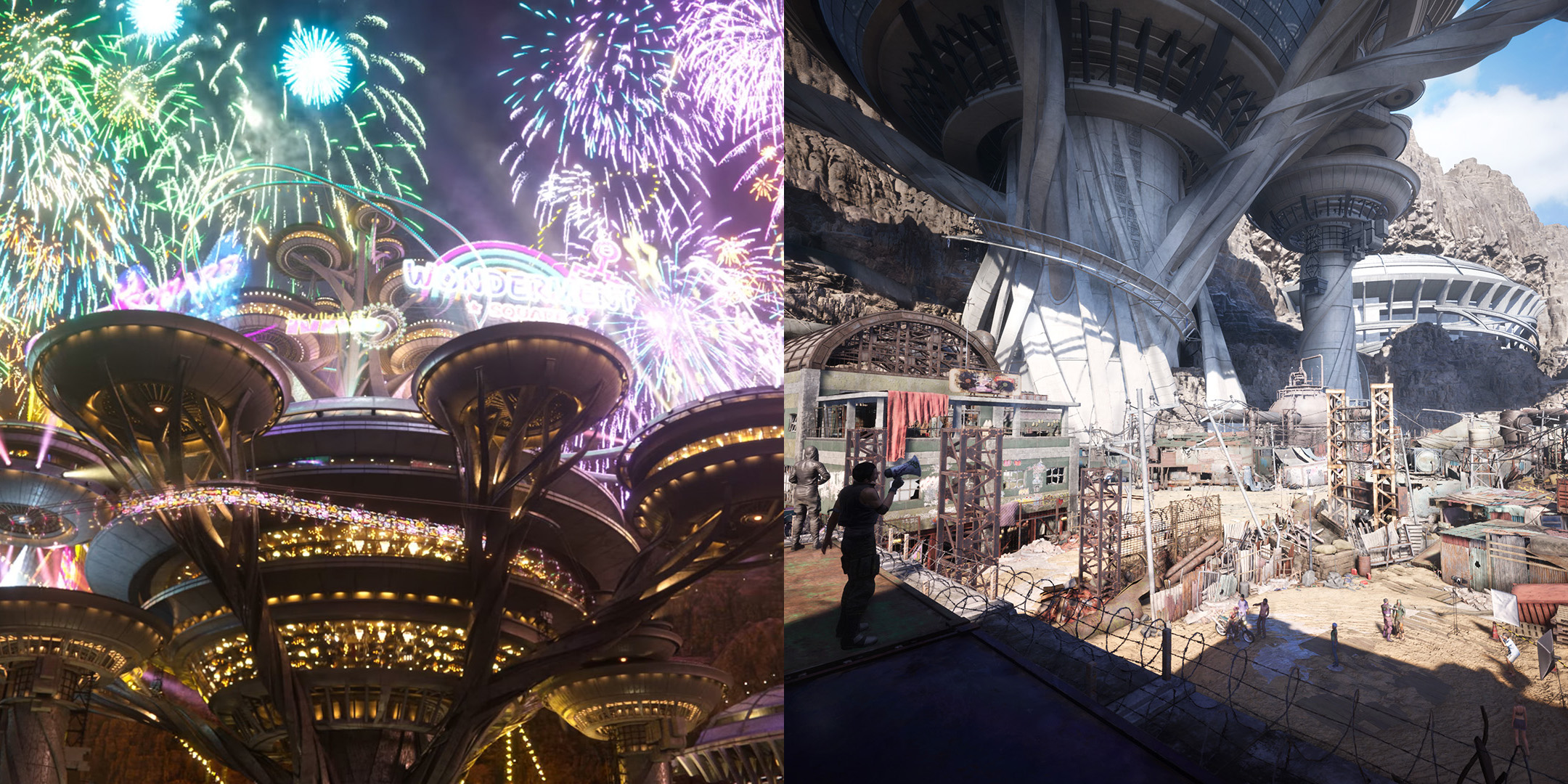
But as for the area's gameplay... several chapters earlier I had been excited to get here and sink my teeth into some minigames, but by this point I was so exhausted from all the minigames in every other area that the Gold Saucer no longer felt like a fun change of pace. Again, the satire is undercut. It's no longer a distraction from the misery of the rest of the world when the rest of the world is now full of similar goofy distractions. I was ready to leave pretty quickly, knowing I was finally close to some juicy drama.
The party is banished from the park after Barret is blamed for his old friend Dyne's attack (Rebirth removes all ambiguity that it could have been Barret who did it) and their subplot begins in earnest, but first the Corel Prison has—surprise!—been turned into another fucking town that serves as a hub for side quests and minigames.
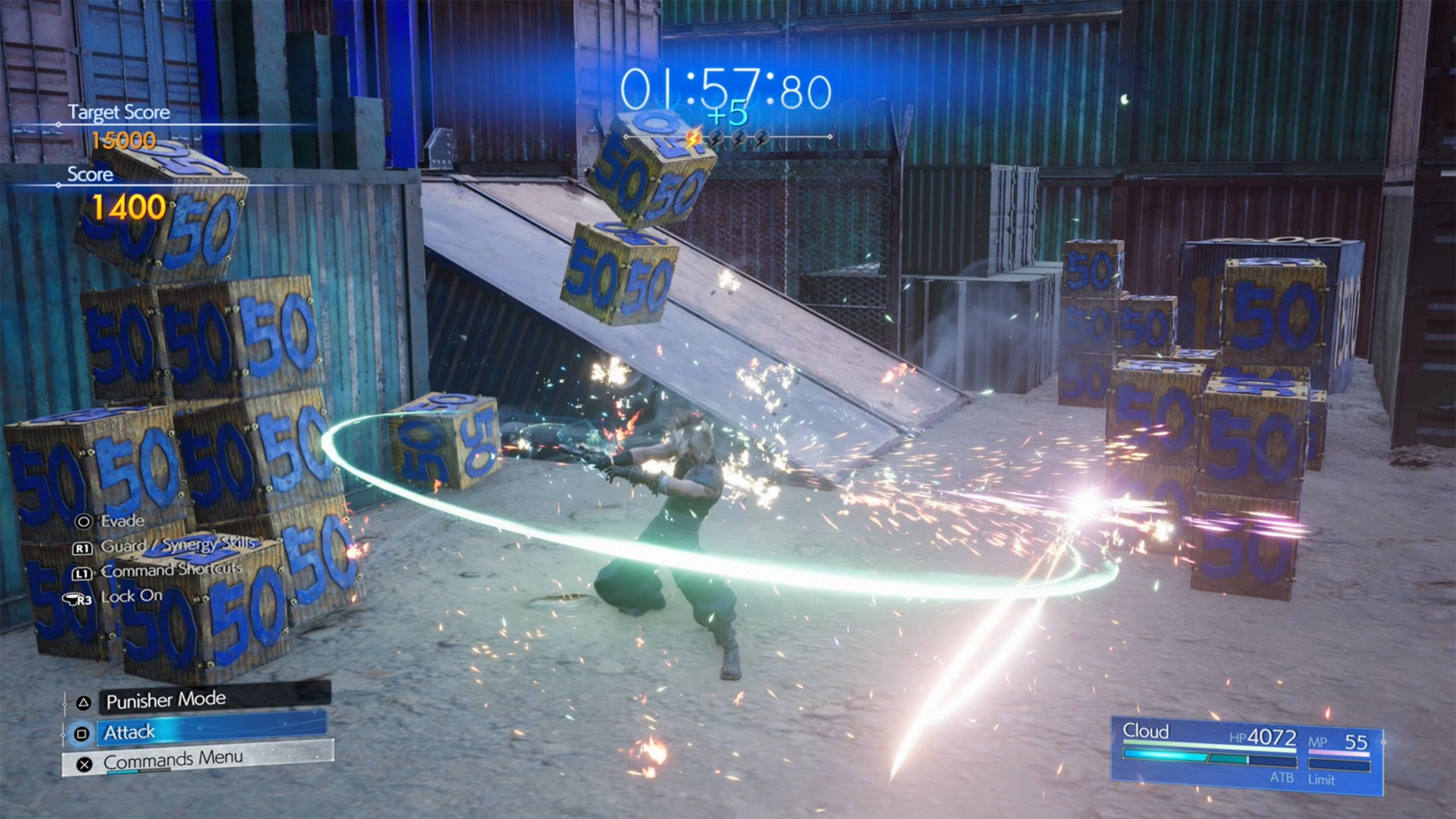
I was starting to lose it here. Why is the Corel Prison, the decrepit desert slum in what was originally supposed to be the ruins of Barret’s destroyed hometown—sorry that's not even canon anymore, for some inexplicable reason now it's just abandoned park employee housing—that the Gold Saucer banishes criminals to as a death sentence, now yet another bustling minigame hub? I just left the Gold Saucer! The Minigame Zone!!! I want to do something different outside The Minigame Zone! I want to move on with the story, like in the original! Why do I have to do a crate smashing minigame here? What happened to the bleak atmosphere of the original that contrasted so harshly with the vapid excess of the Gold Saucer, jolting you back into reality? Why are there wacky disco dancing comic relief criminals in this “prison” setting up carnival attractions for tourists? Why are there tourists in the open air prison? Even Chadley is here! I'd already have to do the Chocobo race to win my freedom, and I’m fine with that, but isn’t that enough of a distraction already? Why does the Corel Prison need to be Wall Market 2: Electric Boogaloo instead of having an identity of its own? Why does every area need to be like this?
Then finally, after all that, you get the confrontation between Barret and Dyne, one of the best dramatic moments in the game. Then there’s also an extra boss fight against Palmer in a big robot for the other party members tacked on, and after THAT Dio shows up with the buggy and does some goofy shit, all of which undercuts the drama while Dyne is still over there dying. I could also nitpick the execution of the actual Dyne scene and the way they really play up his insanity and give him a giant Eustass Kid junk arm to escalate the encounter, as others have done. Or I could complain about the loss of the very cool and memorable sequence in the original game where the vastness of the Corel Desert was portrayed via a maze of identical screens that seem to loop forever if you go the wrong way, which would understandably be very difficult to replicate in the middle of a fully 3D open world map but was unfortunately replaced with... nothing. But frankly, by this point I was just so relieved to get to a sequence with any pathos that I didn't care.
Sure, in isolation, a lot of those side quests and minigames are good, and an improvement over the rote side quests in Remake. I love the way the side quests each focus on one party member as your companion. (Regular readers will remember that this is something I wished the bajillion boring side quests in Final Fantasy XVI had done.) I enjoyed playing the piano minigame every chance I got. But there's just so goddamn much. It gets exhausting. We always joke about how the main plot takes a backseat to side activities in open world games, but it feels totally different when the characters themselves, within the main story, would constantly rather do anything else than participate in the fucking story. The girls announce how eager they are to see the sights and do tourist shit in every new town, and you're forced to indulge their whims for hours and hours at a time before you can move on. You can only eat so much cotton candy before it stops feeling like a fun treat and you'd rather have an actual meal instead.
This is why Rebirth feels so much more padded than Remake to me. Both games take single-screen sections of FF7 that you can breeze through in a couple minutes and stretch them out to an hour in length, but in Remake I always felt propelled forward by the story of Avalanche's battle with Shinra, the great character writing, and all the emotional highs and lows along the way. There was always another really strong scene just around the corner, and the stakes were always clear, even when there was downtime. It felt tonally consistent with the original! Meanwhile Rebirth takes sequences from the main story of the original game that were more serious and injects them with an overdose of levity, undermining what could have been some desperately needed drama in this 100-hour game in favor of adding hours of mandatory low-stakes, frictionless fluff at every single stop on the journey. It transforms what was once a rollercoaster ride of a story where the party can't stop moving because they're constantly evading Shinra into a leisurely backpacking tour of the world where all the highs and lows are flattened out.
A world of tourist traps
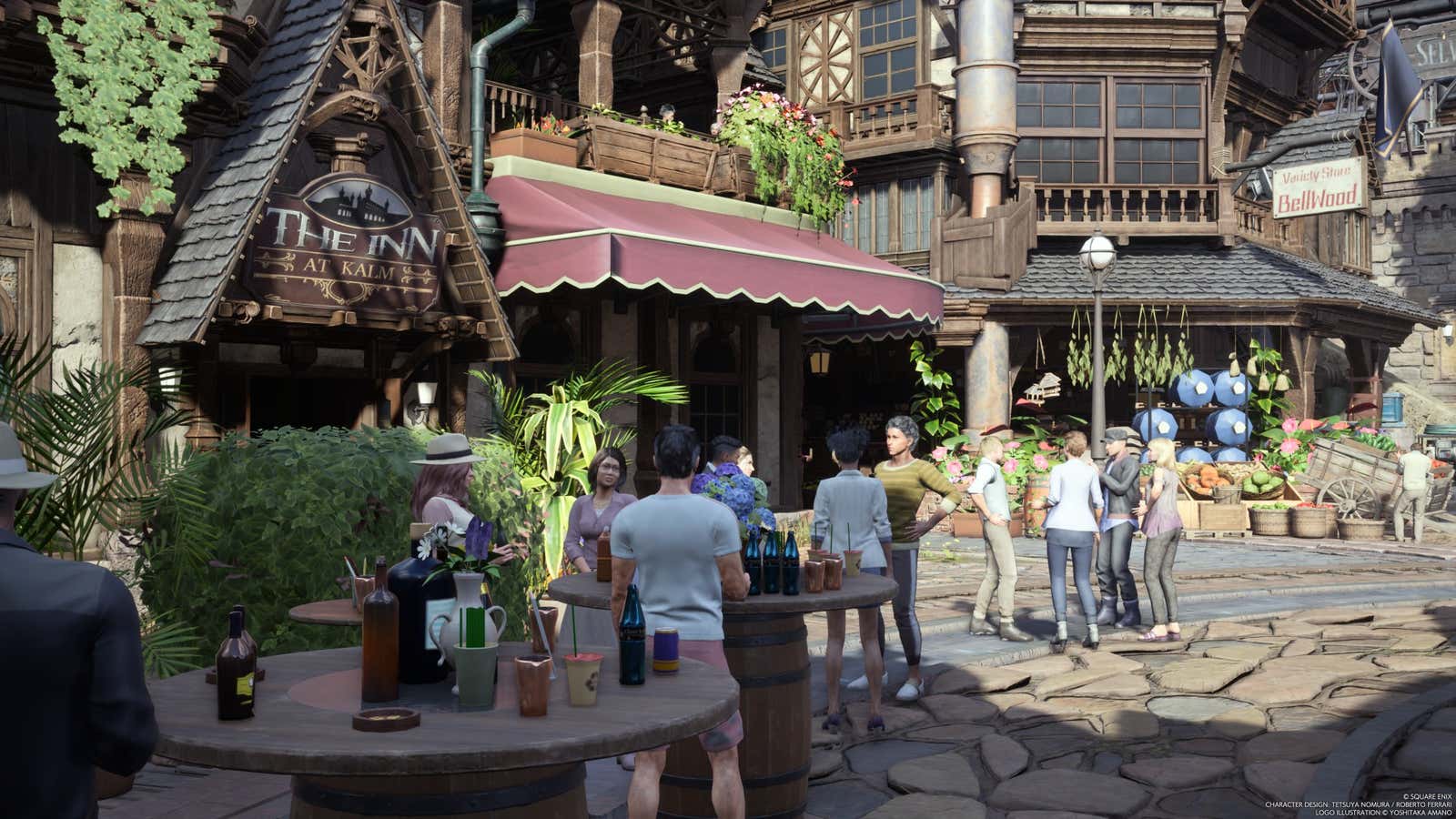
Rebirth's adventure kicks off in the village of Kalm, a small Central European-style town near Midgar. In the original game, it was your first example of what the world might have looked like before Shinra started strangling it to death. It leaves the distinct impression that the cyberpunk dystopia stuff is a recent development, and that this used to be more of a traditional Final Fantasy world, especially in the time of the Cetra. Hell, Kalm's a dead ringer for, like, every town in Final Fantasy VI. It's neat!
In Rebirth, when I stepped outside into this perfect little picturesque village, I initially thought it was beautiful, but then thought that it felt kind of... fake. Everything is too perfect. It's like a theme park. It feels like the squished down Main Street USA version of a quaint Swiss town, full of happy people just kind of standing around and taking in the sights. I quickly realized, though, that this might be intentional. Kalm isn't just some random village, it's the gentrified suburb just outside of Midgar where wealthy Shinra employees go to retire. It looks this nice so that they can ignore how ravaged the world right outside their wall is. It basically is a fake theme park town. That's a great bit of environmental storytelling for those paying attention! This game is gonna be awesome!
And then I kept playing, and that feeling that every town was set up for tourists never really went away. The aforementioned cruise ship and Corel sections of the game were the parts where it started to grate on my nerves, but the earlier Mythril Mine dungeon was also reframed as sort of a mining museum filled with placards for tourists, and this vibe continued into the second half of the world map as well.
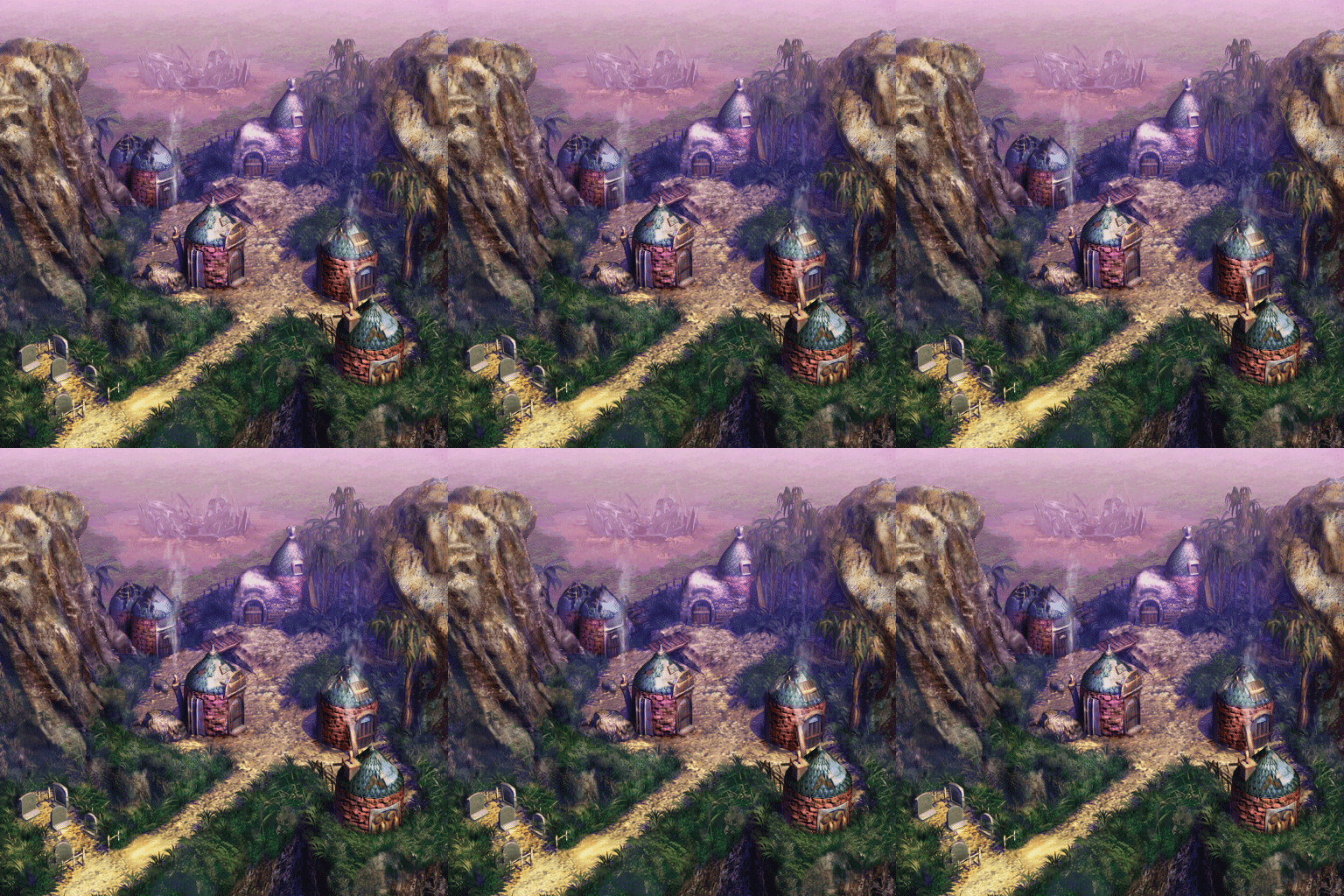
After leaving Corel, you'll head for the jungles of Gongaga, Zack's hometown. In the original, Gongaga is a depressing little village. It consists of five tiny buildings, all with damaged roofs, and a graveyard, which is the first thing you'll see upon arriving. Look at that sickly purple haze. In the distance lie the ruins of a Mako reactor that exploded a while back, wiping out most of Gongaga's population. Ever since that incident, the survivors have sworn off Mako energy and returned to a more old-fashioned way of life, but this wasn't a magic cure-all for their problems by any means. The situation in Gongaga is still bleak. Pretty much all they talk about is the incident. Most of the NPCs are elderly folks, and you get the vibe that most of the young people were either workers who died in the explosion or people who left town for work elsewhere like Zack did, leaving Gongaga to slowly wither away.
This is the state of things in so much of the world. Small towns getting bled dry, making people want to move to Midgar where there's at least a theoretical chance you could be better off. Maybe you'll be one of the lucky few who get to live on the upper plate. But then the constant expansion of Midgar drains more and more Mako, hastening the world's demise.
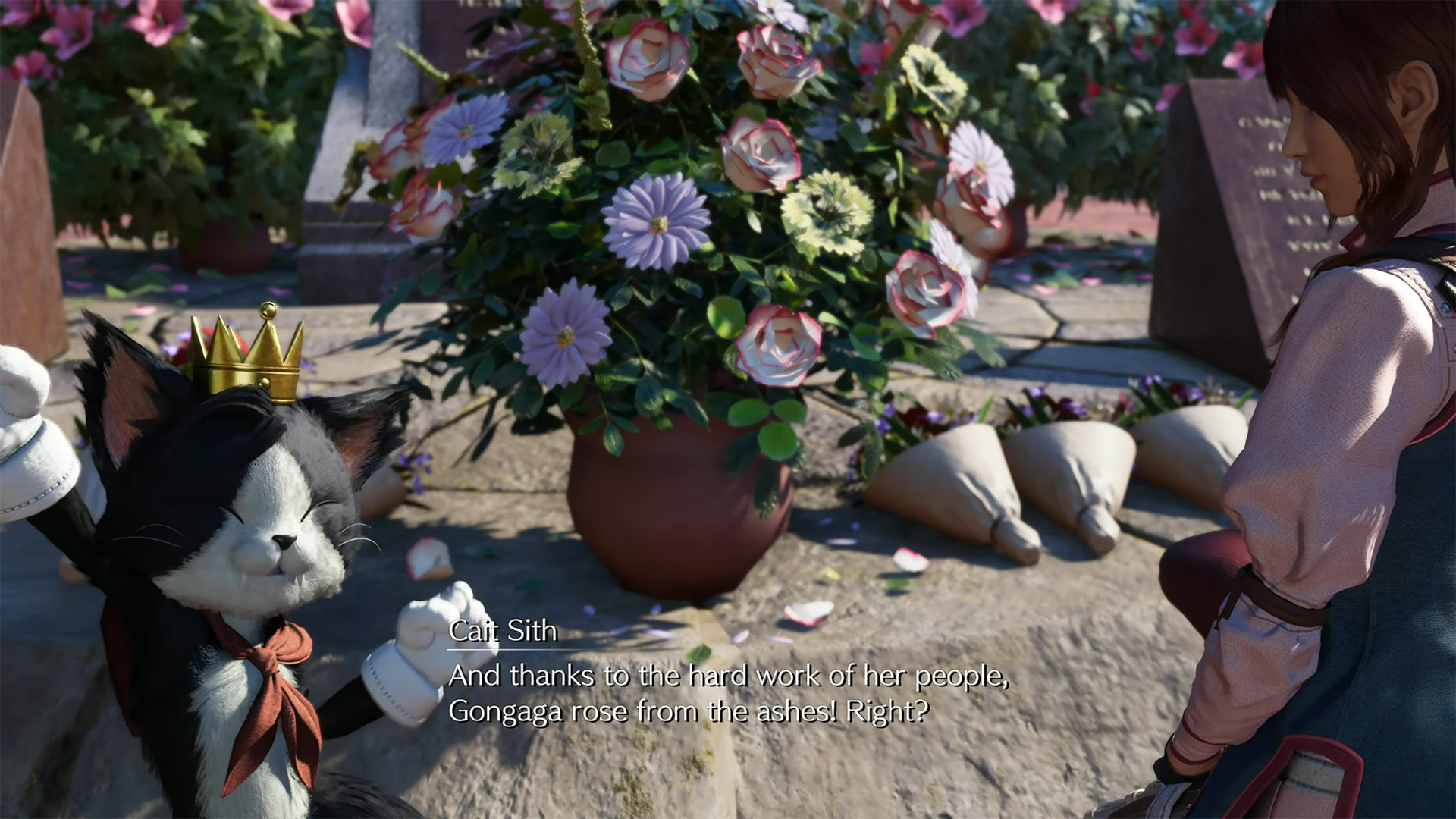
In Rebirth, Gongaga now a peaceful, cheery little jungle village, yet another scenic stop on your road trip. Sure, there's a memorial over there where we can acknowledge that a bunch of people died in a reactor explosion, but don't worry about that. Gongaga's so full of gumption that they bounced right back. There's still tons of people here, see? They're having a great time! It's super lively! There's visitors playing Queen's Blood, Chadley's here, Snaps is here to take photos of the beautiful scenery, just like every other town. It's all good! We love being here! Out with the dreary old music, in with a cheery new track with acoustic guitars and pan flute so you can bask in the splendor of the forest. You even get a warm welcome from returning Crisis Core character Cissnei! If Gongaga was too much of a bummer, that'd sour the mood for all of the new side quests where you do things like gather up some lady's chickens or help a children's book illustrator get out of her art block by taking goofy photos of Red XIII! And we couldn't have that!
It's not just the village, though, as changes have been made to the reactor, too.
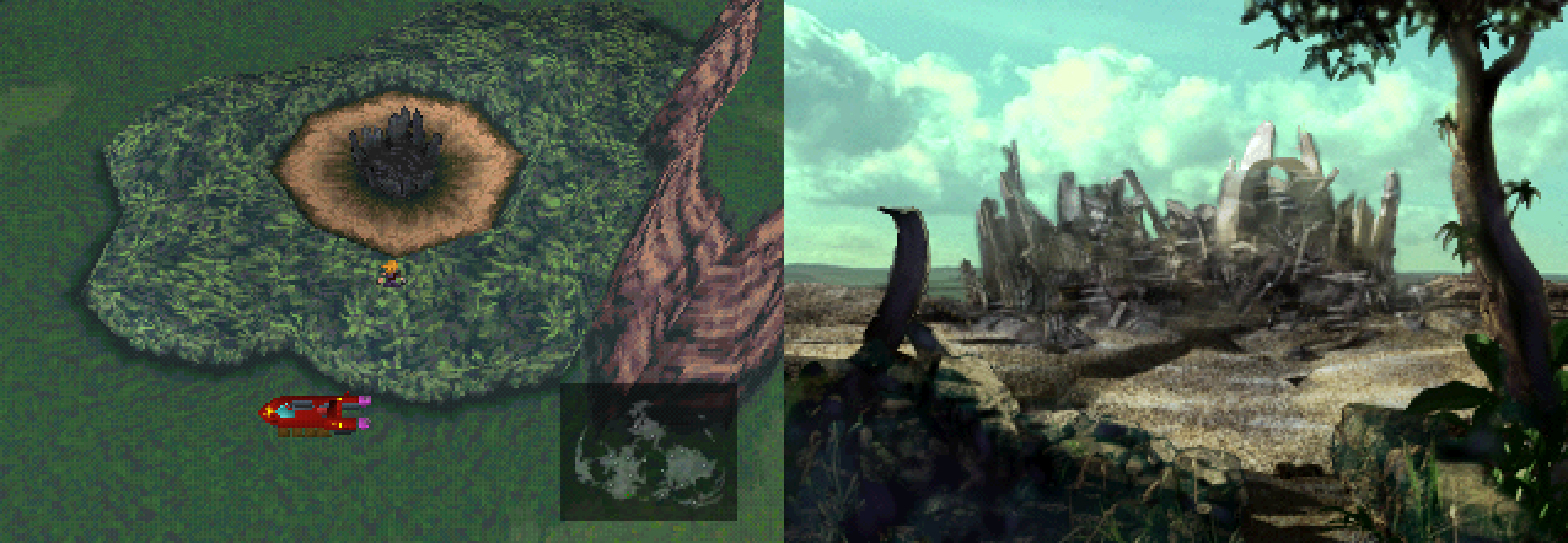
In the original, the husk of the Gongaga reactor is visible from the overworld as a scar on the land. It's the epicenter of a dead wasteland smack dab in the middle of the lush jungle, showing the damage that Shinra is doing to the planet in the most stark contrast possible. Nobody knows if that damage can even be fixed. Avalanche has no real evidence that a better future is possible, and that feeling of doomerism only grows stronger after Sephiroth hangs a meteor over everyone's head. But damn it, they have to keep trying anyway. It takes until the very end of the game, in a scene set centuries in the future, to see that shot of Midgar overgrown with plant life and get a confirmation that there's still hope. The planet will eventually heal itself. Our heroes may never live to see that brighter future, but they have to keep fighting for it and believing that it's possible.
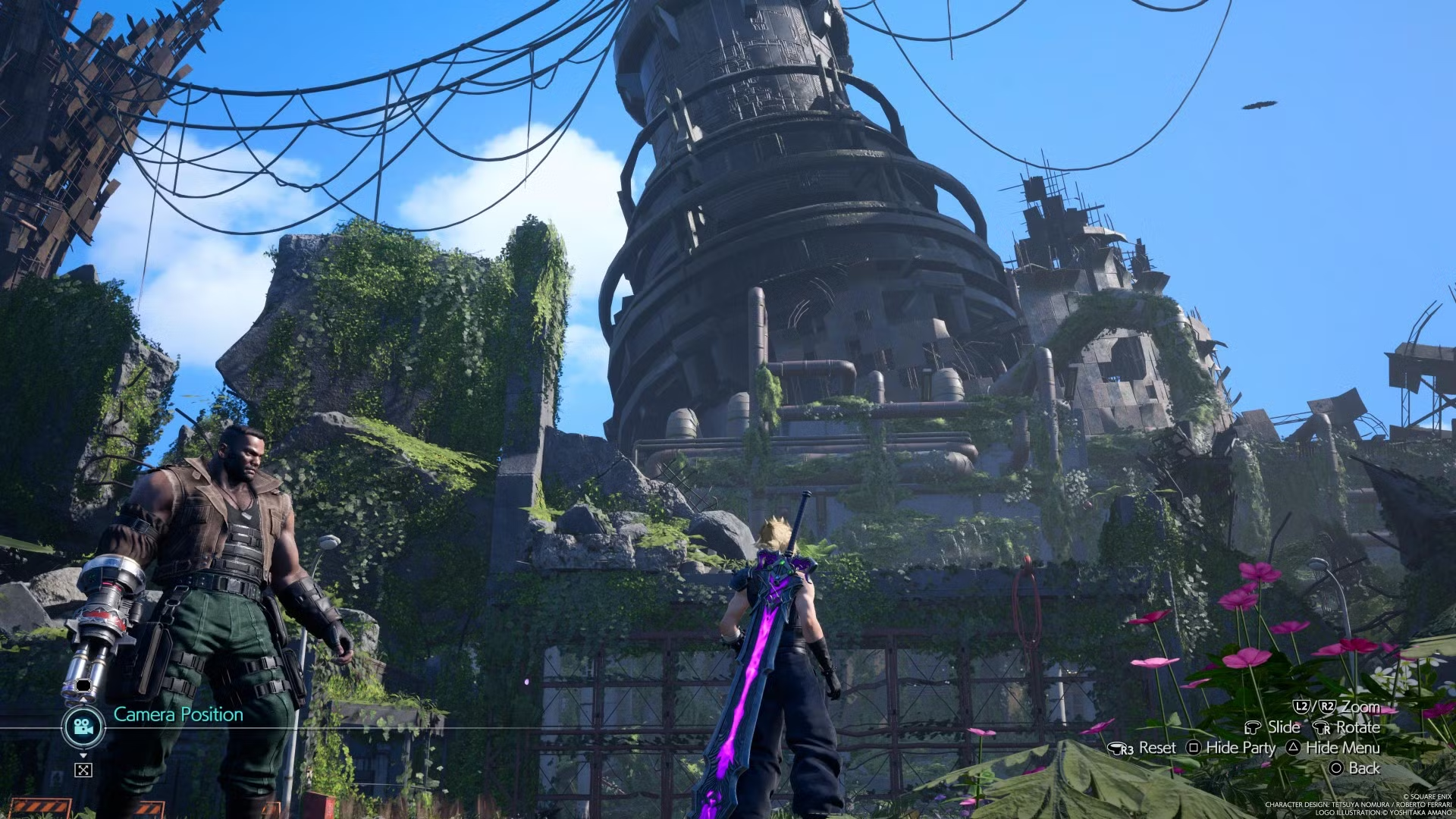
But in Rebirth... nature is already returning to the ruins of the Gongaga reactor. It's only been three years since the explosion, but lush vegetation is already everywhere. It certainly makes things more visually appealing for the area, which is now an extended dungeon sequence. But I think it really undercuts the power of that original ending if halfway through the adventure our heroes already have explicit confirmation that yes, nature will heal itself, everything will be fine in a few short years if we can just stop Shinra and Sephiroth.
Also then they add a whole bunch of new shit to the story in the ruins where Sephiroth possesses Cloud way earlier than he's supposed to and nearly kills Tifa and knocks her into the Lifestream so new plot shit can happen with the Whispers. I won't elaborate on that here. And then everyone's still totally cool with Cloud after, and no one really brings it up again, and he and Tifa even nearly kiss. God forbid we let the story have any lasting tension.
This feeling of not wanting to sit with discomfort is felt in many other places throughout Rebirth. Take the return to Nibelheim.
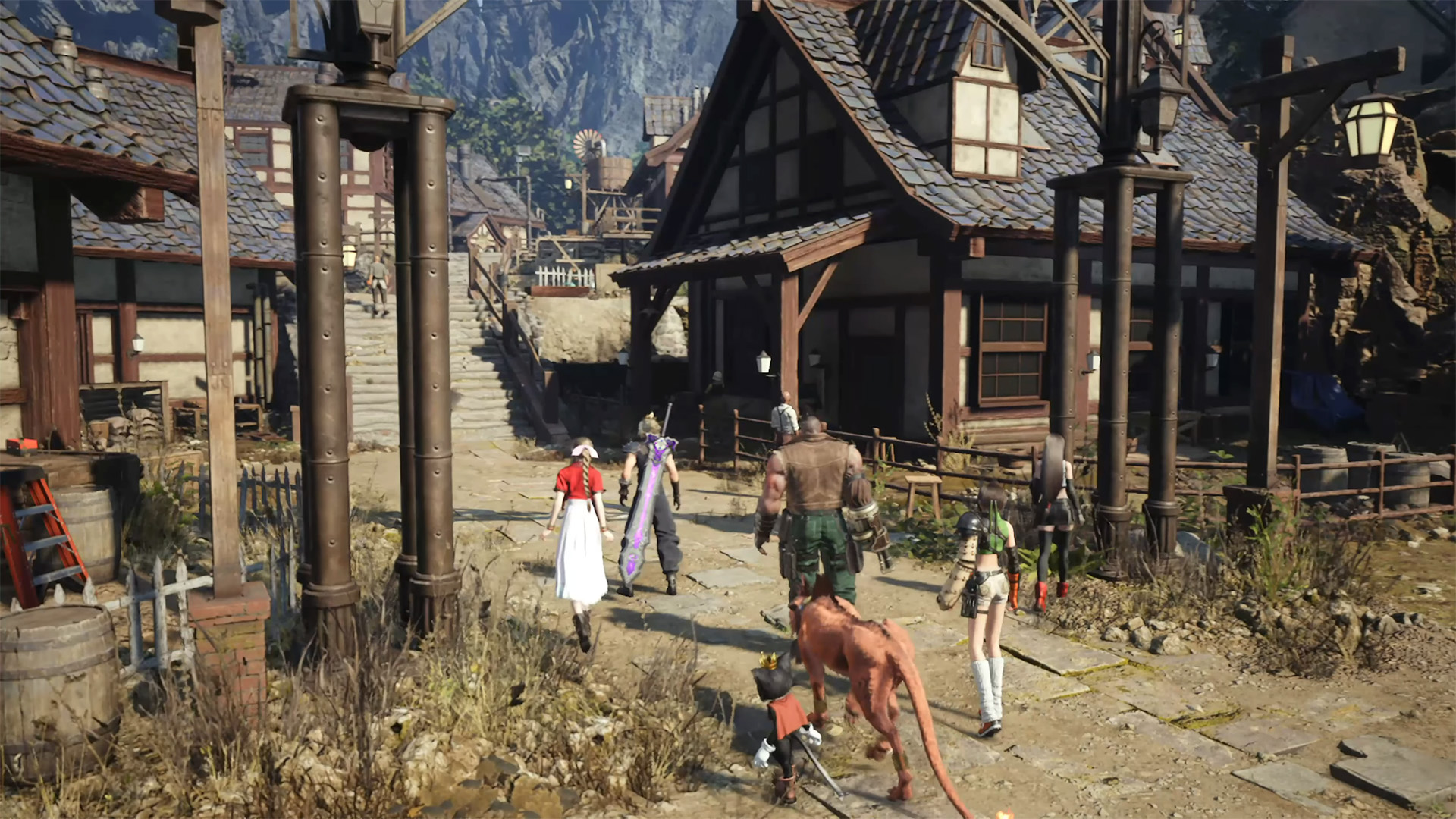
In the original, it's a creepy little sequence where Cloud discovers that the hometown he saw Sephiroth burn to the ground is still intact, full of strangers telling him they've always lived there and that the town was never destroyed—and also a bunch of those creepy black robe guys muttering about Sephiroth. If you dig a little, you can find some hints at what's going on here and piece together that the NPCs are Shinra plants covering up the incident and keeping an eye on the black robe guys, but it really isn't elaborated on much. It's just another mindfuck for Cloud, and another thing to make you question what Tifa's hiding. At this point she's still afraid to speak up and contradict Cloud's false memories, and Sephiroth's disembodied voice has been whispering in Cloud's ear and trying to make him distrust her. Is it really true that the town was never destroyed, and Tifa knew all along? How many of Cloud's memories are false? Are the things we're witnessing right now even real? The game refuses to spell anything out and instead forces you to just sit with how fucking weird all of this is before entering the ultra-creepy Shinra Manor.
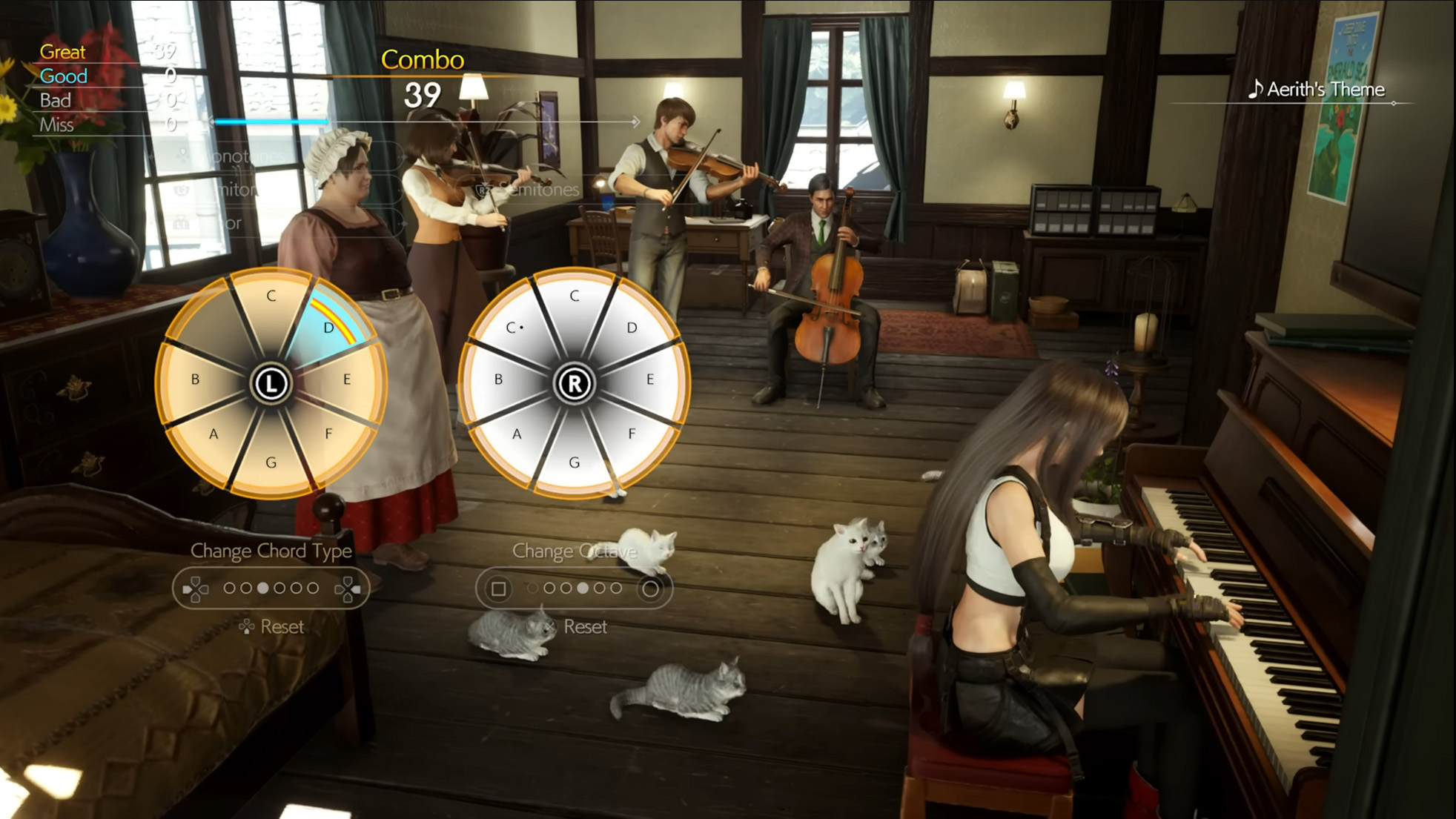
In Rebirth, though, we have to get excuses for everything up front. The second you step foot in town, Tifa surmises that it was rebuilt recently by Shinra because she touches a pole by the entrance and there's no dust on it, immediately dispelling the ominous questions about Cloud's memories and what is and isn't real. Then a friendly NPC walks up to explain how Shinra has repurposed the town as a sanitarium for the black robe guys who keep showing up there, who are written off as mere victims of Mako poisoning. And then you can go do side quests where you make friends with the Shinra plants who are actually totally nice when you get to know them, because every area has to be full of fucking Activities. Please enjoy this side quest where Tifa finds out that the Shinra plant living in Cloud's house is taking care of her old cat, and they get a band together to play Aerith's theme, of all songs, for the cat and its kittens, because nothing means anything anymore.
I wish I was joking. I really do.
(Also Shinra Manor gets turned into more of a traditional dungeon with a part where you have to play as a solo Cait Sith and do box puzzles. Everyone seems to hate this part. I don't have strong feelings on it. At least it was a break from the open world.)
Without a doubt, though, the area I feel was done the most dirty, the area where my disappointment was cemented, is Cosmo Canyon. For once, they didn't soften the seriousness with comedic antics and carnival games. At least, not on the critical path—there are bad minigames in the neighboring open world zone. But its storytelling still feels undermined nonetheless.
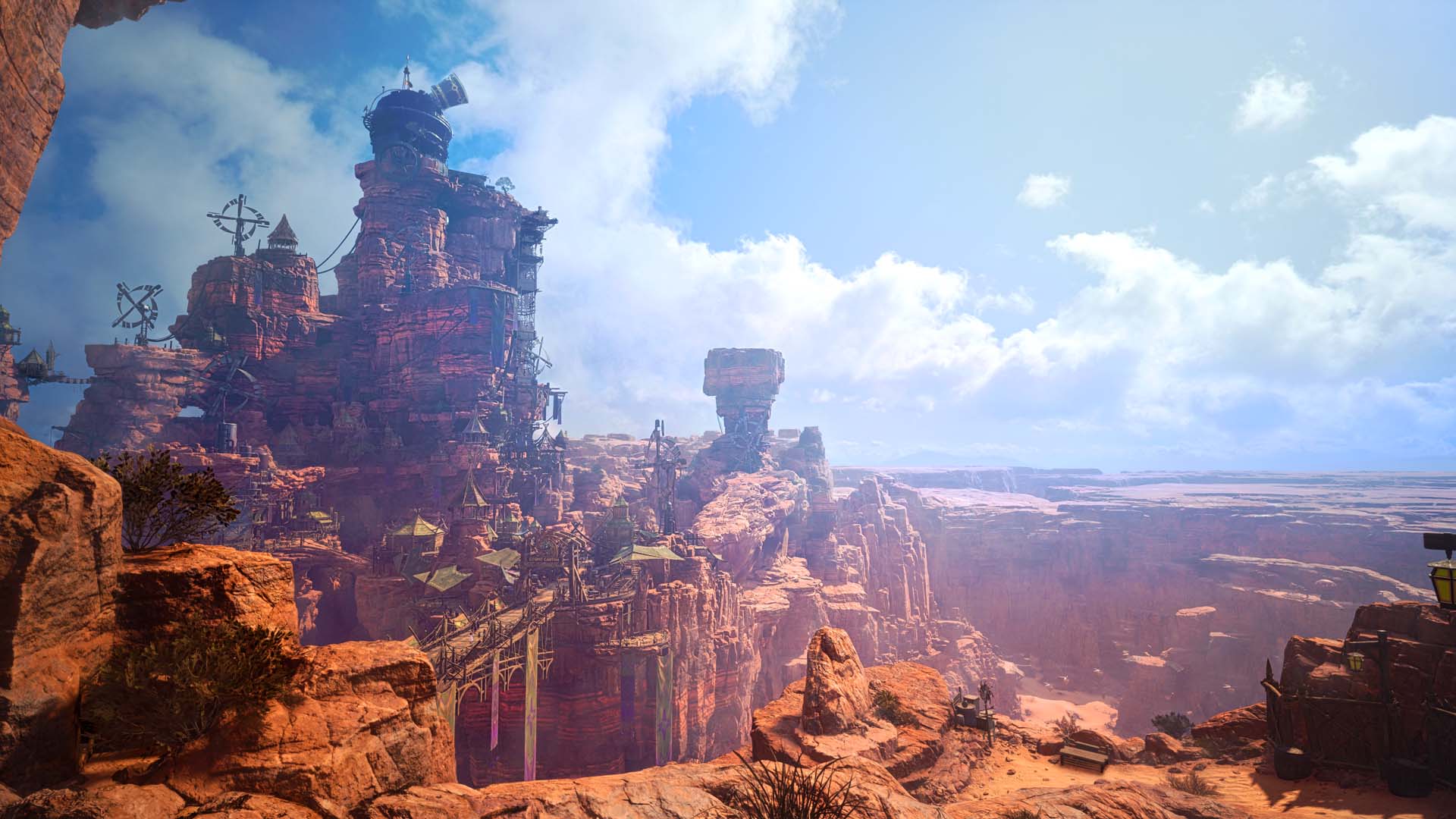
Cosmo Canyon was one of the most memorable areas in the original game, partially because of the striking visuals and instantly catchy music, but also because of what it represents in the story. After hours and hours spent in a world ruled by Shinra, where you're constantly on the run, where their presence is always felt whether they're actively present or not, Cosmo Canyon is your safe haven. It's a place untainted by Mako harvesting where like-minded environmentalists gather to study the planet and the Lifestream, a place that shows a different way is possible. You don't exactly get any easy answers here, but it at least gives the party some time to catch their breath and think, and Bugenhagen's lesson on the Lifestream helps cement the stakes of the conflict. It also has some extremely overt Native American theming and, well, I won't make a judgment call about how that was handled, but the idea was clearly to depict a native community whose teachings about nature have managed to survive the colonial takeover of the rest of the world. It's Nanaki's cherished home that gave him all of his firmly held beliefs, a place his family has guarded with their lives for generations.
Corel was where Rebirth started to lose me, but I kept telling myself I had to keep going, I had to get to Cosmo Canyon. Much like the party, it would be my safe haven. And when I got there... it was another fucking tourist trap.
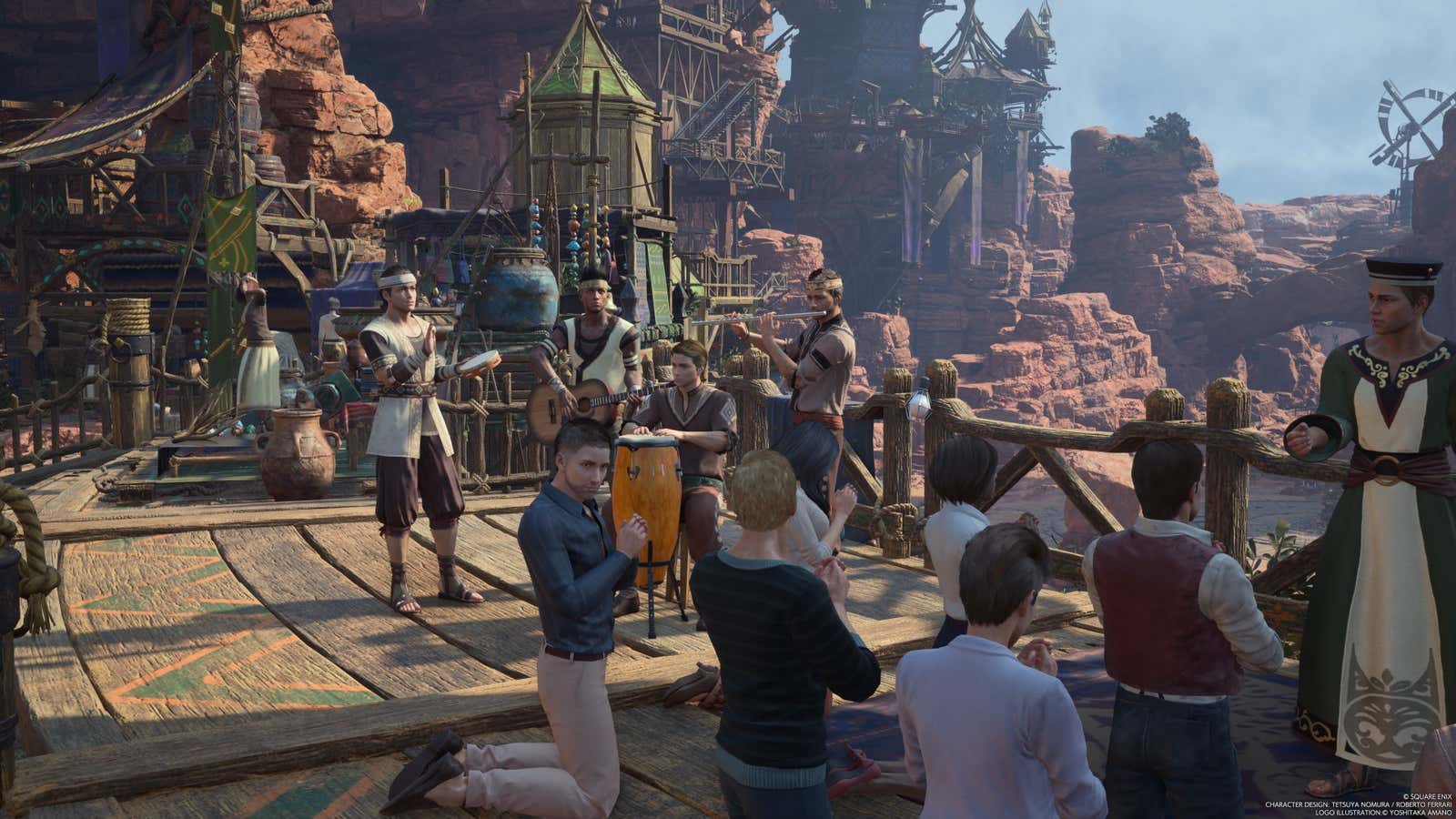
Now, okay, sure. In the original game, it's mentioned that Cosmo Canyon gets visitors, and the inn seems to be advertising itself as a tourist destination a little bit. But the town is framed more as a place where planetologists like Avalanche go on a pilgrimage that's deeply important to them, both ideologically and spiritually. Considering the fact that all the stuff they say about the planet and the Lifestream is 100% verifiably true and worth risking your life over, you'll probably take the people of Cosmo Canyon seriously.
But Rebirth's Cosmo Canyon is a place that constantly has all these tourists milling about like you're at Burning Man, and they're here to do this hokey group therapy wellness seminar shit. It feels less like you've found the safe haven full of people who understand your mission, and more like you've found this patronizingly preachy little cult that believes in bullshit woo woo new age hippie spiritualism. They're here to tell you your loved ones are doing well in the Lifestream like they're TV psychics. They're on the verge of trying to sell you a crystal that absorbs bad vibes at any given moment. At best, the local planetologists are depicted as condescending ivory tower academics who understand the mechanics of the Lifestream in theory but don't get what the party is going through.
At the group therapy circle Tifa brings up the time she fell into the Lifestream in the Gongaga reactor, what she saw in there, the party's war with Shinra, and how she's uncertain about all of it. The planetologists are completely unprepared for someone to get real like that. All they know how to do is sit in a circle and tell each other their feelings are valid and clap. It's so fucking lame! Barret tries to ask a mentor what to do, and she tut-tuts him for daring to think he can do anything at all rather than letting the planet take care of itself. "These planetologists would rather study the world than live in it," he says. Aerith tries to vent about her baggage as the last Cetra at a ceremony that night, since this is supposed to be the one place where her peoples' beliefs are kept alive, but it's just a bunch of tourists who look uncomfortable and confused until she finds a way to pivot and put a positive spin on her little speech. They don't know about all that, man, they just came to stand around a big bonfire and see the lanterns get released into the sky.
And sure, you could do something with the idea of a historically important cultural site being turned into a tourist trap in the modern day. That's a thing that happens all around the world in real life. But Final Fantasy VII already had an area for that! It's Wutai! Where Yuffie's from! The East Asia pastiche that gets conquered by Shinra and turned into an exoticized resort town for foreigners! An area that's definitely going to be a huge portion of the third game! Why does that two-faced tourist trap vibe need to bleed out into the rest of the world, in the same way that the Gold Saucer bleeds out and turns the rest of the world into a minigame hub? Why can't Cosmo Canyon be a sacred refuge? Why can't Gongaga be sad? Why can't Nibelheim be scary? Why does everything have to blend together into this big vacation?
Eventually, all I was really left with to break up the monotony of the adventure was the fun of the combat system. At least I still had that, right?
Materia and combat
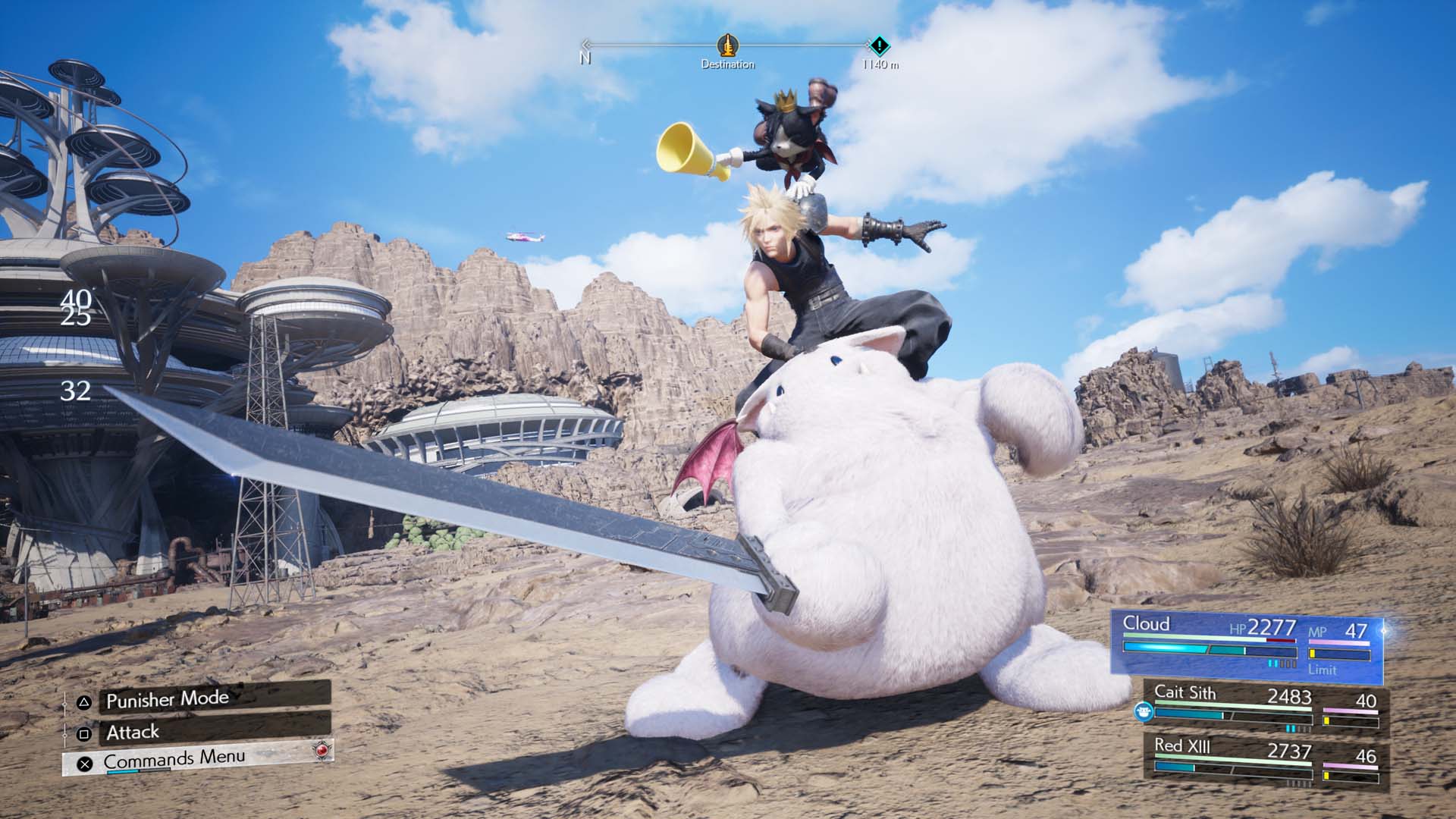
Look, the combat is good. I liked it back in Remake, and I like it now. I love the way it captures the cinematic flashiness of the original. I love that it's a real time combat system that still lets me swap between my party members and slow down while in the menus to think about what moves I want to use, giving me the best of both worlds. But it's a very different beast from the original game, especially when it comes to Materia. This is the mildest of my complaints here compared to everything else, but in a world where most people seem to think that the new combat is an objective upgrade, I feel the need to explain why I think the old ATB battles and party building still have their merits.
The main gameplay hook of Final Fantasy VII is its extremely freeform Materia system. Tons of abilities that were tied to characters' classes in previous Final Fantasies are now available as Materia, and you can mix and match them to your heart's content. Want to make Cloud a beefy tank who takes hits for his friends and then counter-attacks, but also let him steal items, mimic other characters' moves, absorb HP any time he uses poison magic, AND use his sword as a long range weapon? You can do that with ease, so long as you've found the right Materia.
The tradeoff to this is that your party members in FF7 can sort of just feel like nothing more than a cosmetic choice attached to your sets of Materia, with little to set them apart aside from their Limit Breaks, whether they use ranged or melee weapons, and some mild base stat differences. In theory, you can give each character their own bespoke set of Materia specifically tailored to them. In practice, though, I just ended up having three sets of Materia that I swapped around depending on who was in my active party at any given time. I never wanted to lose access to my favorite abilities, nor did I want to miss out on precious AP to level them up. With your party members having so few inherent traits of their own that you'd need to complement or counterbalance, this can also make your Materia choices feel a bit arbitrary. These things all bothered me more in the early game, but by the late game I had so many crazy Materia to choose from that the fun of customizing my party and figuring out how to make everyone busted outweighed my complaints.
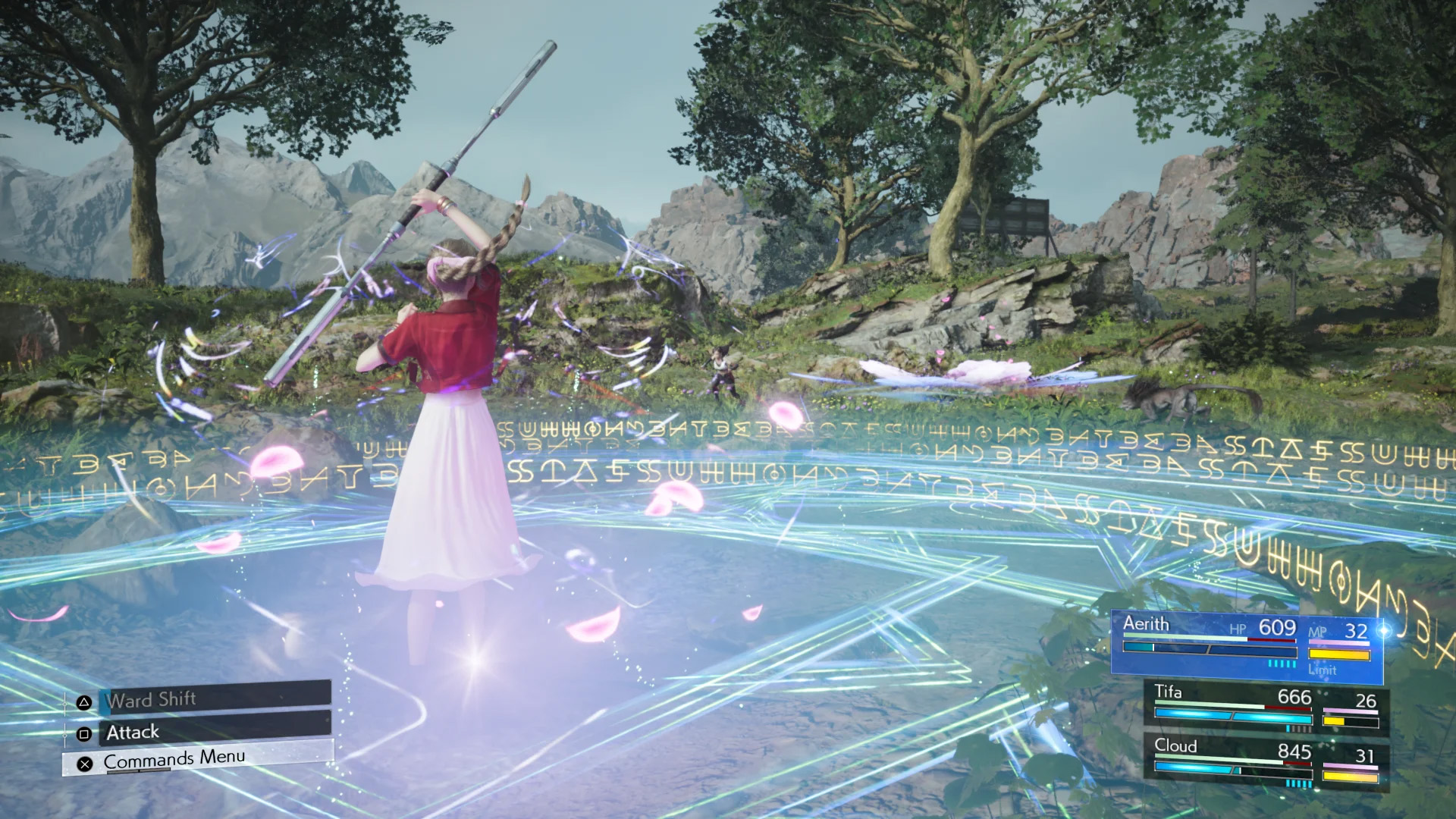
It's not strictly true that you can't experiment and come up with busted Materia builds in Rebirth. It's not hard to find people online explaining things like the "Exploding Yuffie build" that will break the game. But it feels like it's now the realm of high level min-maxers who really understand the ins and outs of the combat system, rather than a space all players are invited to play in. Your Materia selection now feels like it's more about giving you some spell options and fine tuning the existing combat system to your liking with tweaks to how your ATB meter charges, blocking, parrying, etc. rather than a way to mix and match your own crazy classes from scratch.
My go to example for how the Materia system has changed is the Enemy Skill Materia. In the original game, there were 24 different enemy skills you could learn just by getting hit with them with the Materia equipped. There were a wide variety of skills on that list, including both offensive and support skills, and some of them were really damn powerful. Thorough players could kind of break the game by equipping all three of your party members with these skills. Which I did! And I had a lot of fun doing so! It took a little work and patience, and I had to look up a guide for where to learn the best skills to make sure I didn't miss any, but trying to acquire all of them added an extra layer of consideration to many fights, and the reward for that thought and effort was the satisfaction of watching my party steamroll a bunch of fights with their highly versatile movesets.
In Rebirth, the highly cinematic, action-packed encounters are simply too complicated and too expensive to make to allow players to truly steamroll them that easily. This means that the Enemy Skill Materia needs to be restricted. The list of available skills was cut down from 24 to a mere seven skills, and you can no longer learn them during normal fights. Instead, they're rewards for completing challenges in Chadley's combat simulator. And you only unlock those by assessing dozens of enemies and defeating special encounters out in the world. Like with so many other things in the game, it's tied to completing the giant checklist of side activities. And I hear it's still a really powerful Materia. But it's such a chore to level it up now that I don't even want to do it.
On paper, this is "better" game design, forcing you to engage with more of the core combat mechanics and saving the most powerful spells and summons as rewards for players who have already proven their skill. But I still kind of miss the old, busted Materia system. That's a big part of the fun with these old turn-based RPGs, and it's something that can be lost in modern games in the name of "better" balancing and combat design.
It also felt to me like Rebirth had far fewer Materia options to play with than the original game, despite being two to four times as long. I don't think this is actually true, and Rebirth probably does have more Materia, but it never felt like it to me. Maybe it's because so many of your Materia options are gated behind doing all of the side content and I quickly gave up on 100%ing this game, or maybe it's just because so many of the ones you do get don't feel as flashy and immediately powerful.
Each party member also now has so many inherent abilities, skills learned from equipping different weapons, and skill tree upgrades available that Materia can feel like a lesser concern when it comes to the character building and combat. They have a lot going on gameplay-wise, with very clearly defined roles and abilities and a lot they can do without a single Materia equipped. Just a few years ago, I considered this a straight upgrade over the original's mechanical blank slate party members. I thought I'd like it better if Materia was more of a way to complement the party's existing strengths and weaknesses. But now that I've actually played the back half of the original game for myself and gotten into the deep end of that classic Materia system, I finally see the fun in it, and in some ways I prefer it. Funny how that works.
And so, while the combat in Rebirth is certainly a lot of fun, and I'd love to see this team expand on similar design ideas in a new game after this remake trilogy is complete, it wasn't quite enough to compel me to actually finish the game, given all my other complaints with the open world and the storytelling. So I didn't, and this article sat 70% complete for over two years. Finally, in 2026, I bumped it down to easy mode so that I could just blast through the remainder of the story, ignoring the rest of the side quests and Chadley errands I never got around to. I just had to see how it ended before putting out this article.
It's time we discuss the game's final chapters. Major spoilers from here on out, including screencaps of the climax and ending.

The very long final dungeon
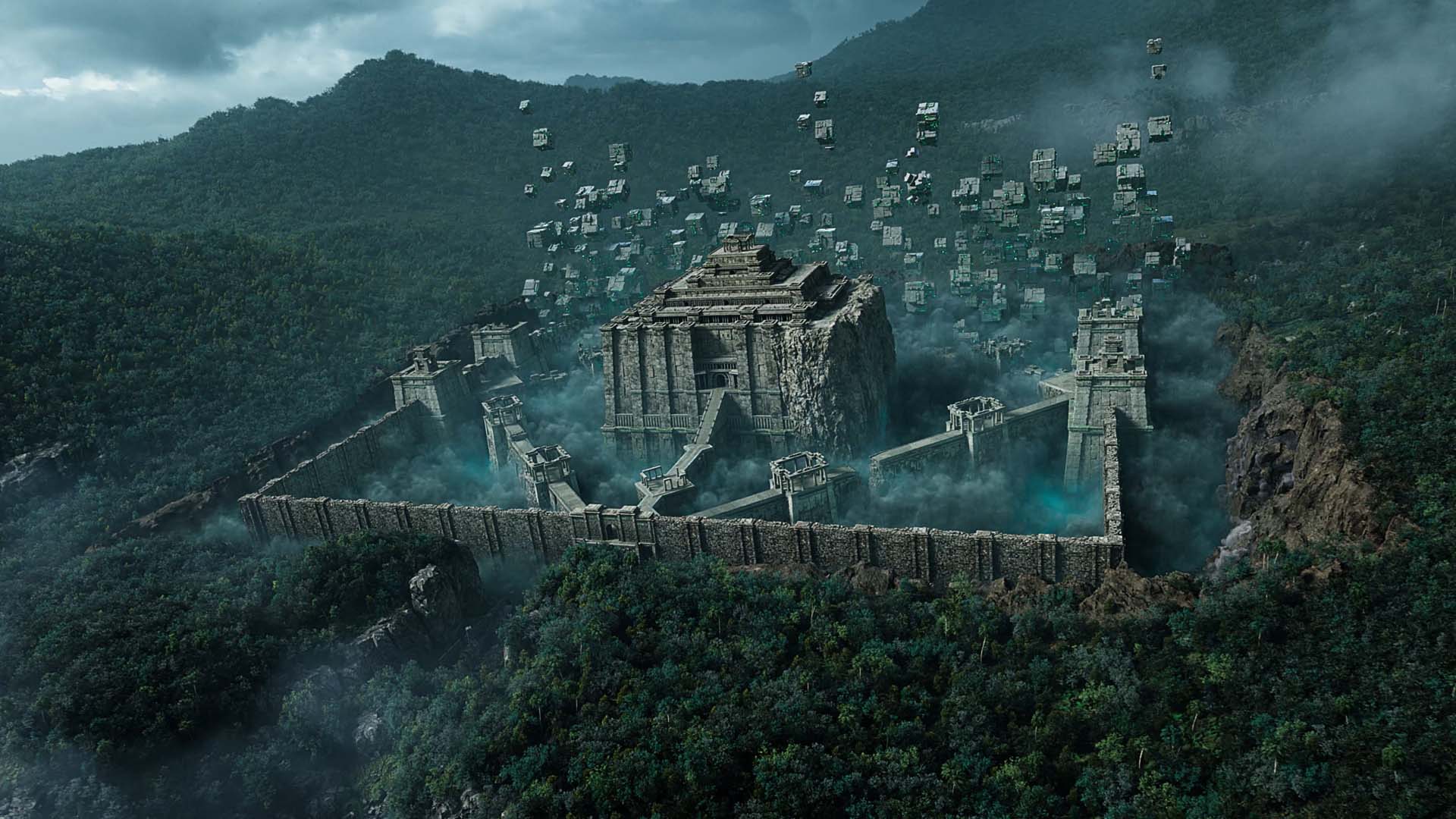
There's very little buildup to Rebirth's endgame, which consists of the Temple of the Ancients as a final dungeon and the Forgotten Capital as the grand finale.
As you should expect by this point, events at the Gold Saucer prior to this play out more or less how they did in the original, just with more silly bullshit added between the existing story beats. You still have the extended interactive stage play, and the date (I got Barret), and Cait Sith betraying the party to give the Temple of the Ancients' keystone to the Turks. But now you also have to fight Don Corneo and his underlings in a big wrestling match to stop him from buying out the Gold Saucer and turning it into Corneoland. And his goons Scotch and Kotch have to hype him up by rapping like the Beastie Boys. Fuck it, why not.
In the stage play Aerith sings a new song, "No Promises to Keep," which serves as sort of a vocal theme for the game. It's nice, but its singer sounds absolutely nothing like Aerith's actual voice actress, which distracted me. This feels like the point where the narrative goes "oh shit, we forgot about Aerith" and starts giving her things to do and romantic tension with Cloud again at the 11th hour, after having very heavily prioritized Tifa for most of its runtime to the point that for a while I thought there would be a big twist where they killed Tifa at the end instead of Aerith. (Tifa even gets to kiss Cloud if she's your Gold Saucer date, while Aerith does not.)
After these events you're free to go off to the Temple of the Ancients whenever you want, which marks the game's point of no return. There's very little buildup to this finale because the dungeon is the buildup to the game's ending. It's now stretched out to a slightly agonizing three or four hours in length so that it can have more room for character development moments, making it feel like Rebirth has at least some amount of closure as its own chapter of the story after dozens of hours spent screwing around.
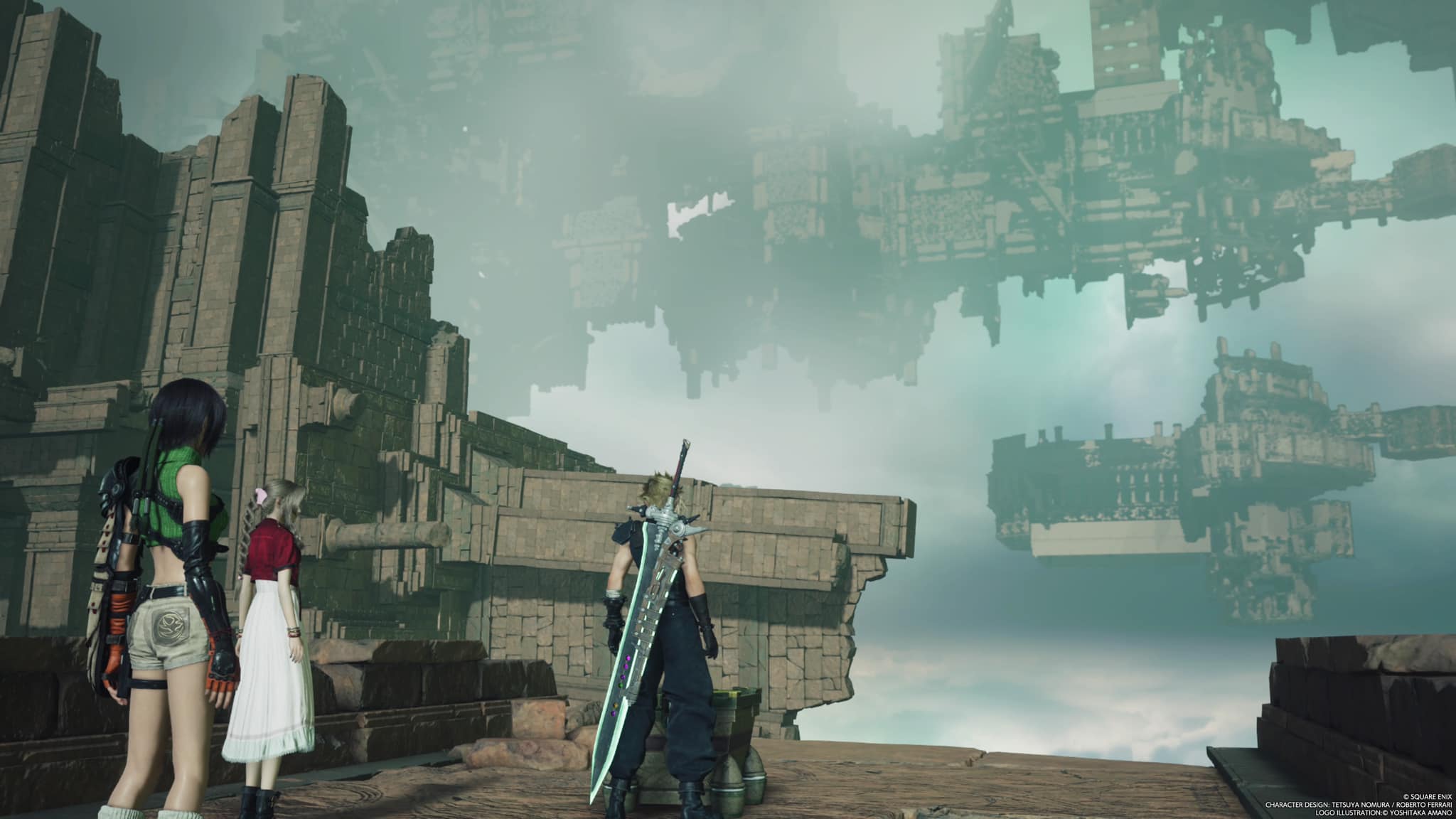
The first significant addition is a part from Aerith's perspective where you have to repeatedly hold triangle to stand still and pray to absorb little motes of Lifestream Energy into your Lifestream Meter and then use that to fill up Lifestream Energy Wells on various floating hunks of dungeon to move them into place and create a path forward. It's incredibly tedious, and having the Cetra commodify Lifestream energy for dungeon puzzles feels wrong in a story about how commodifying Lifestream energy is bad.
Later there's a series of "trials" in The Rooms That Make You Remember Your Traumatic Backstory, so that all of the party members can get one last dramatic scene of their own before the end of the game. Except Cid and Vincent, who don't get to come. Cid actually sits out most of the game's story when not needed as the party's chauffer, and Vincent just kind of appears periodically to aura farm a bit. I guess that's Vincent for you.
Also, you fight all of the Turks again, and Tseng's not-death scene paints him as a more sympathetic character who really cares about Aerith because Square can't help but frame the Turks as these really cool antiheroes who are good people deep down. Pretend to be surprised, they've been doing this for over 20 years.
At least they cut the rolling rock hallway, which was perhaps the worst bit of gameplay in the original. And also it's several hours where the story consistently takes itself seriously and you don't hear a single peep out of Chadley and MAI and there are no tourists milling about. So I can't hate this extremely long dungeon. The gravity shifting stuff was neat.
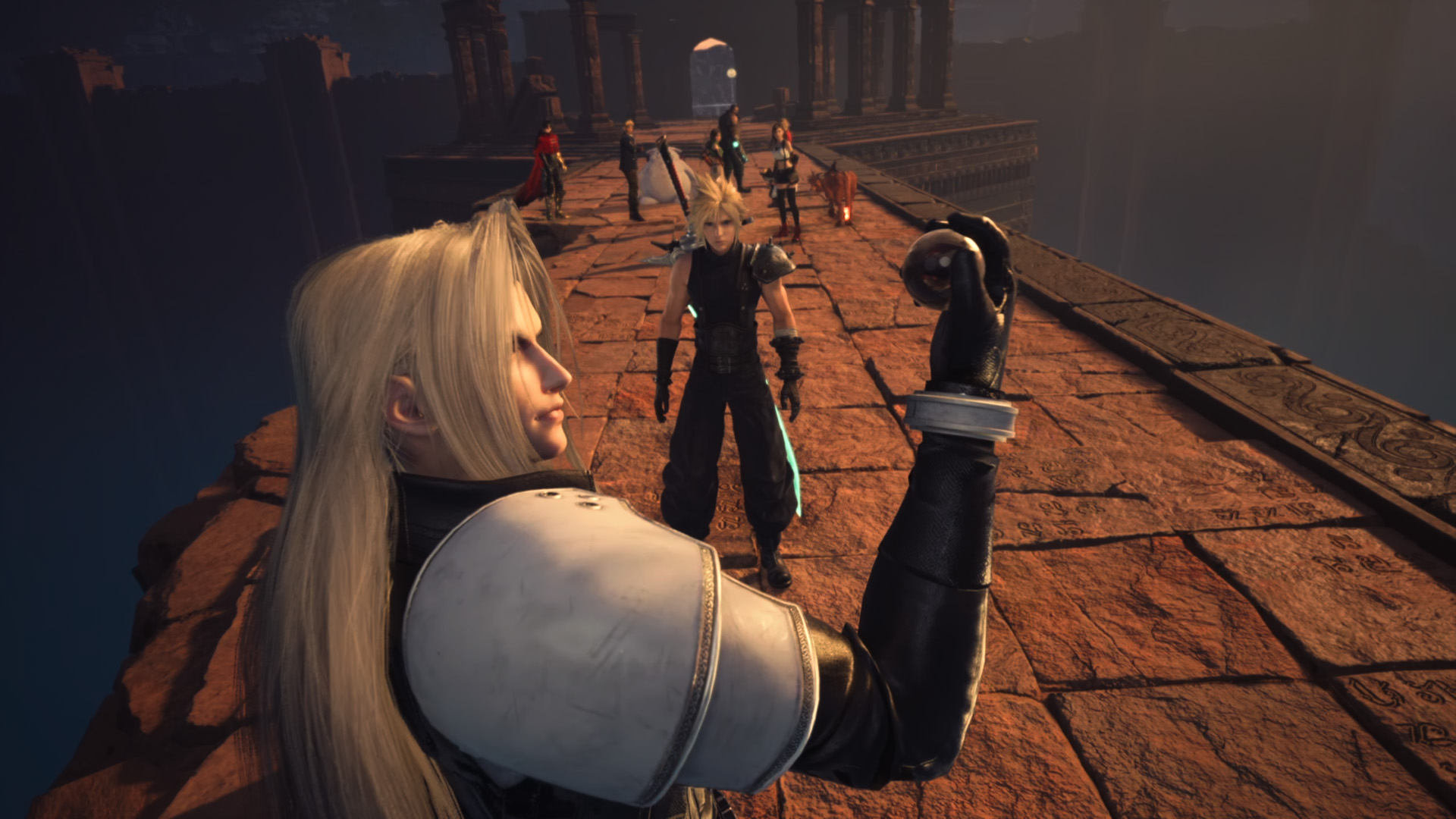
Of course, the main point of the Temple of the Ancients is that it's where Sephiroth explains his evil plan, starts more aggressively possessing Cloud, and uses him to acquire the Black Materia that will summon the planet-destroying meteor. All very important. All of this remains true in Rebirth, but much of it is done at least a little worse here.
For one, I find it lame that Rebirth explicitly shows that whenever Sephiroth appears it's because he's either in Cloud's imagination or possessing one of the black robe guys, rather than letting you believe he's really there in the flesh. Cloud also outright murders one of the black robe guys being possessed by Sephiroth at one point, which everyone is just... weirdly chill with? Just like they barely question Cloud all the other times he says some serial killer shit or becomes uncharacteristically violent because Sephiroth is controlling him. Everyone's worried, but they don't really push him on it, even after he tries to kill both Tifa AND Aerith on separate occasions throughout the story. He even tries to behead Elena! Guy just shouldn't be allowed around women until Sephiroth is out of his head, I'm starting to think!
And then there's the actual bit where Cloud gives Sephiroth the Black Materia, which is turned into this big game of hot potato kicked off when Barret inexplicably grabs it and nonchalantly tosses it away. I was going to give a play-by-play of that bizarre scene and the ways in which it undercuts its own emotional clarity with needless complications and theory-baiting questions about whether or not that's even the real Black Materia, but this pales in comparison to how those same problems affect Rebirth's ending.
Yes, it's time to answer the big question looming over this entire remake project.
Aerith's fate
There were two main ways this could have gone.
Option one: the story changes. Unshackled from the chains of fate after the ending of Remake, Aerith lives. Maybe someone else dies in her place, with the Whispers no longer able to protect people who aren't supposed to die like they did for Barret in Remake. Maybe none of the party members die. But either way, the story has fully diverged from the original at this point, now charting new territory where we no longer know how things will play out. Does Aerith's survival actually make it harder to stop Sephiroth, since we know the only thing that could eventually stop the meteor in the original game was Aerith wielding the Lifestream itself from beyond the grave to shield the planet from harm? We'd have to wait and see. The Unknown Journey Continues. (Yes, I know in interviews they've said the story will ultimately be compatible with Advent Children, but that doesn't mean things can't diverge in the middle before reaching a similar end point.)
Option two: the story remains basically the same. Aerith still dies. The ending of Remake broke the chains of fate to give us false hope and make the most widely spoiled death in the entire medium hit us like a truck all over again. They got us. It was not a given that she had to die this time, but it still happened regardless, because life can be cruel like that.
I was prepared for either of these routes. I was not prepared for the surprise third option Square chose with Rebirth.
Things don't immediately go off the rails. Between the scene where Sephiroth gets the Black Materia and the dream scene recreated from the original where Aerith announces she's leaving to deal with Sephiroth and Cloud struggles to chase after her in the forest, there's now a new sequence, which I actually think is pretty good in isolation.
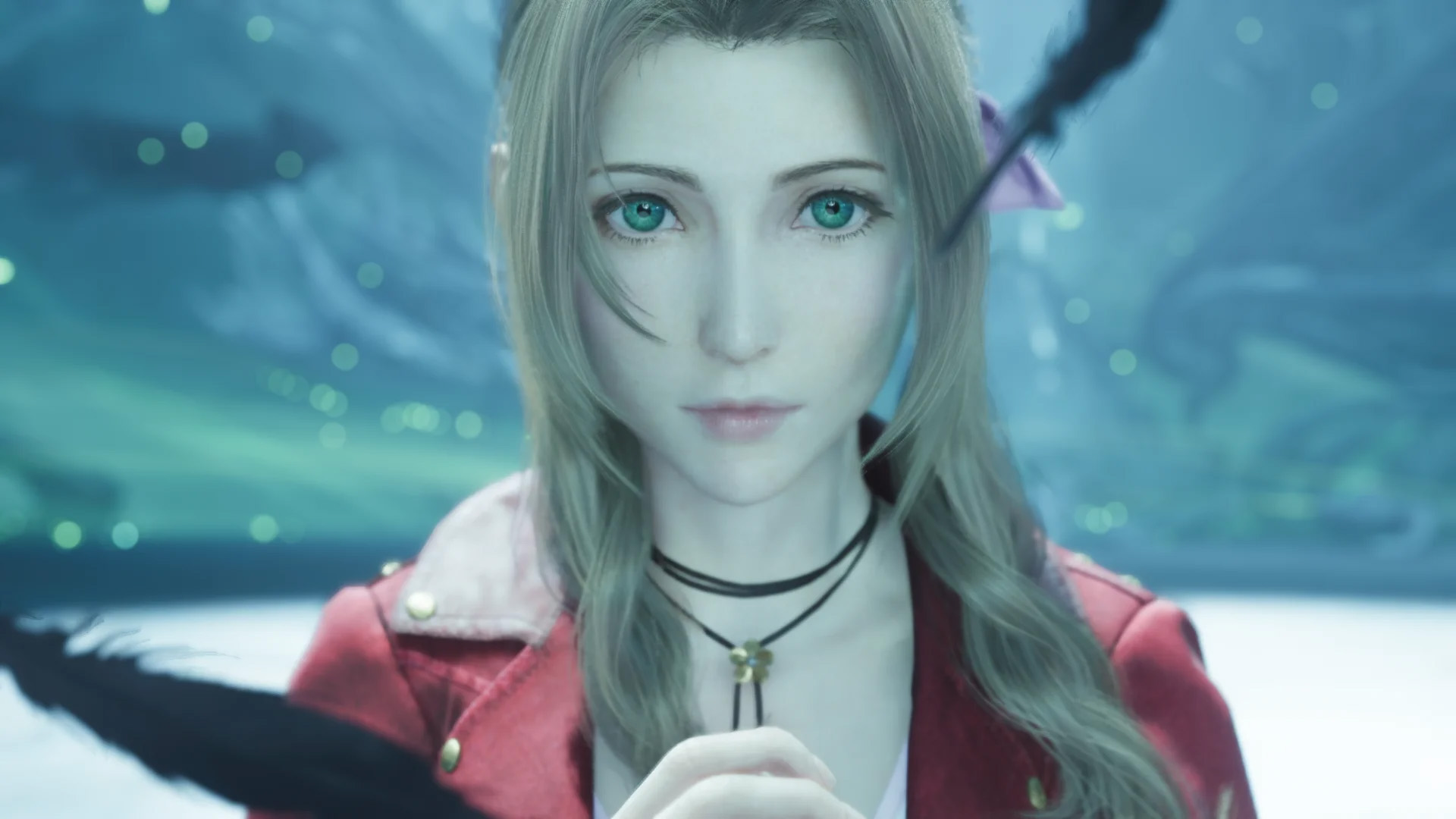
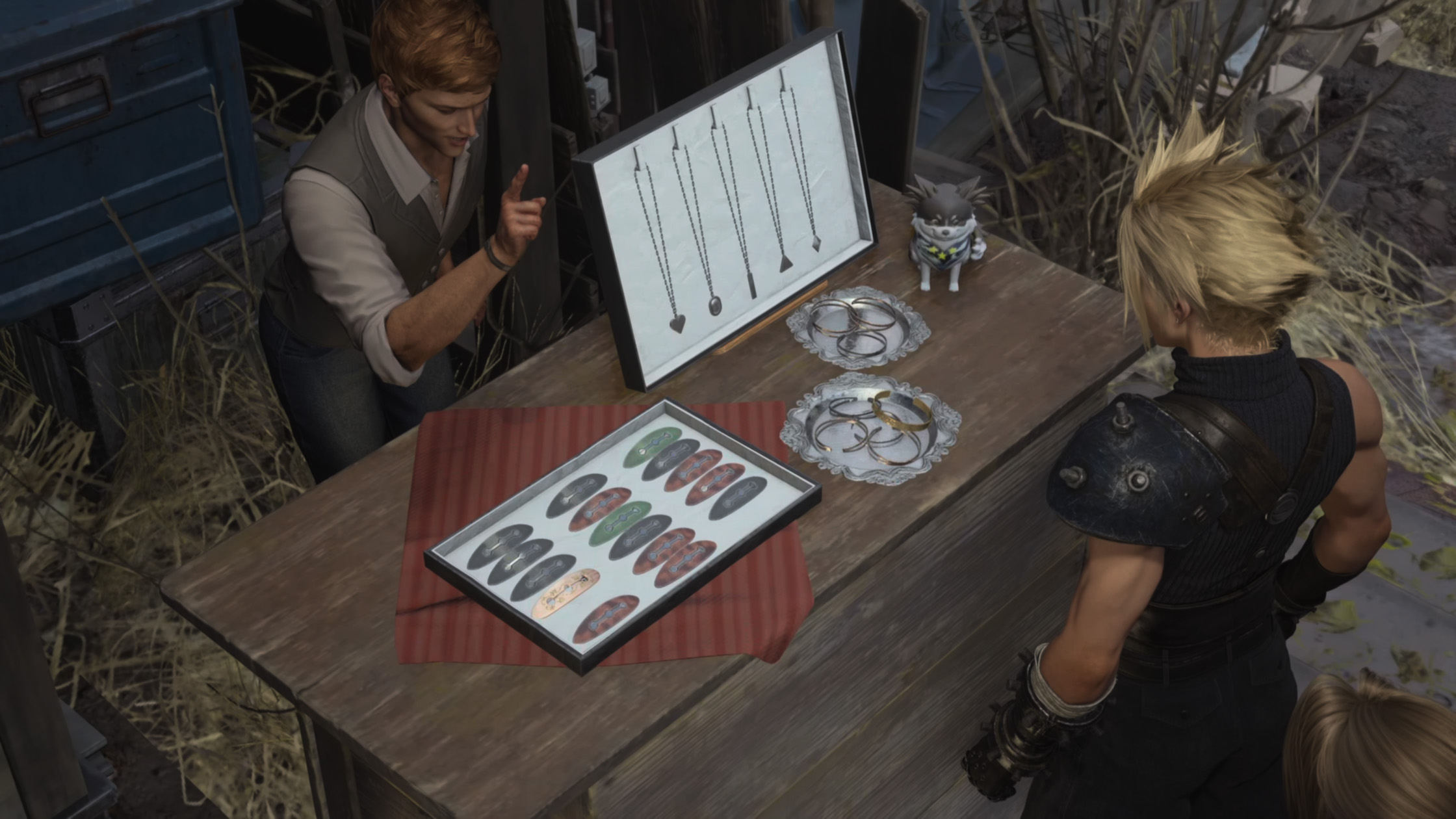
Temporarily jettisoned to an alternate, doomed timeline, Cloud gets to have one last date with Aerith before having to say goodbye to her, with Aerith trying to savor their time together while she still can. They walk around the Sector 5 slums for old times' sake and browse the stalls. The player is asked to choose gifts for Aerith and snacks, but no matter what you choose, you don't get what you want, and instead the vendor gives you something else instead. I've seen this framed as metacommentary on the remake project not necessarily giving fans what they think they want but rather something new and different that they might like in a different way. Personally, I read it more as a denial of Cloud and the player's agency and ability to change things. Likewise, Cloud doesn't get to choose to stay in this world with this alternate Aerith. They cannot live in this happy memory under the steel sky. She pushes him away at the end and sends him back home as Sephiroth menacingly enters the church. Again, it feels like the game backtracking at the eleventh hour to make Aerith's death hit after spending so much of the game prioritizing Tifa as Cloud's love interest, but I still like this part.
No, things really start to go off the rails after this. At long last we get to the part we’ve been waiting for: the end of the game. The epic arrival at the Forgotten Capital. And for some reason it had to be epic. I don’t know why.
Even knowing what's about to happen, in the original this sequence builds this immense feeling of dread. If anything, it might actually be even more powerful knowing that Aerith is about to die. The Capital is quiet. You're in the eye of the storm. You're walking around this gorgeous, surreal place that's like nothing you've seen in the game up to this point, a relic of a lost civilization only Aerith can begin to understand, but the atmosphere is all wrong because there's not a single enemy there to cut the tension. Cloud knows Sephiroth is nearby, and you have to trust his intuition, but you don't see him, building up suspense like a good horror movie. You're just left alone with the dread of what's about to happen. All you can do is march on towards the inevitable.
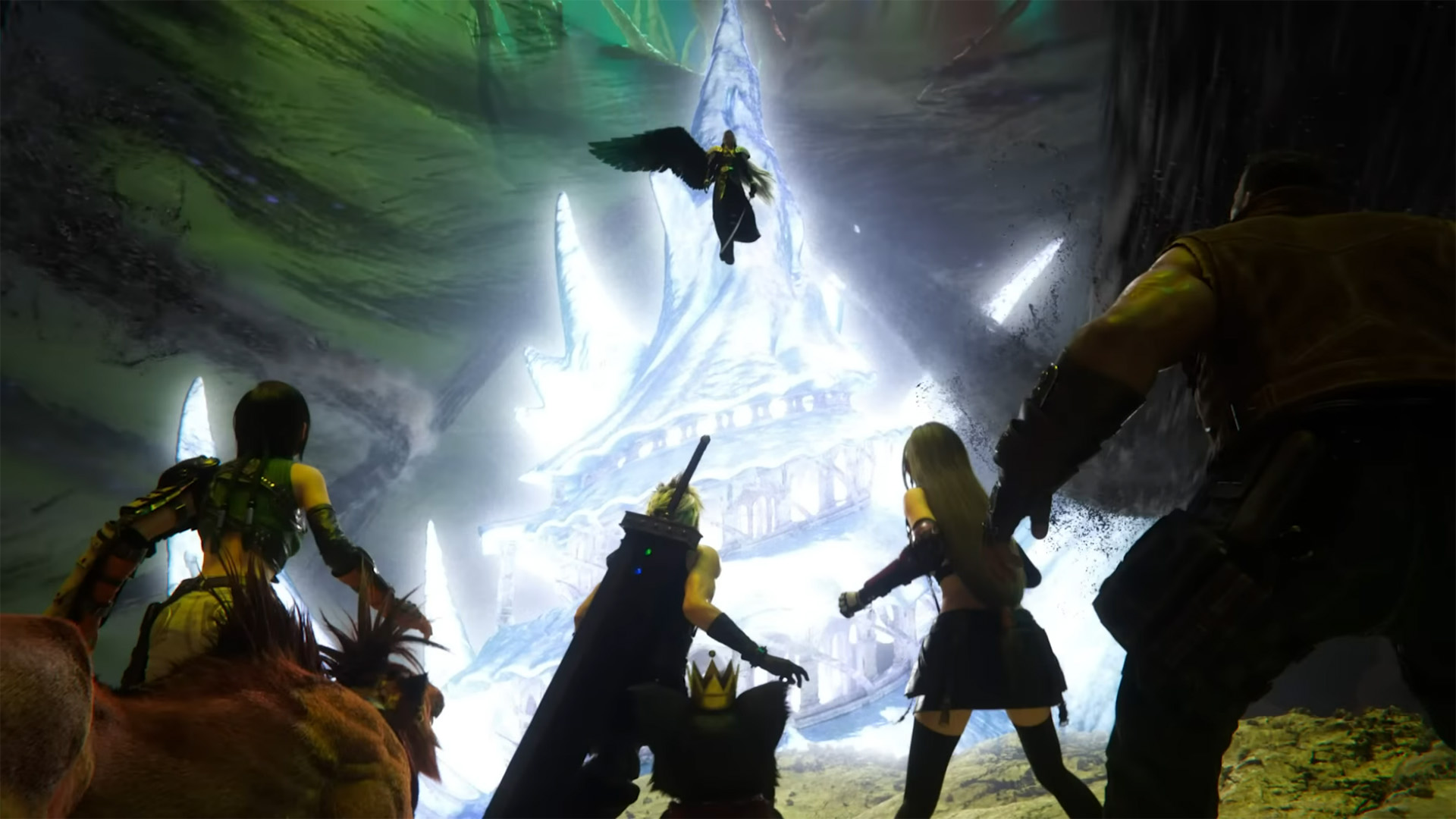
But in Rebirth, Sephiroth has to show up before you even go inside the Capital and show off his power and make a big rift in the sky and summon a bunch of Whispers and gloat about his new plan to become a god by merging the multiverse through the power of despair or whatever, which he is somehow accomplishing by mostly doing the same things he did in FF7. You know he's here to kill Aerith the entire time. He might as well go "mwahaha, I'm going to go kill Aerith now." You no longer get to quietly explore the Capital for several minutes because it's now a truncated straight shot to the altar, briefly interrupted by a fight with some Whispers. I guess I'm at least thankful they had the restraint to not turn the Capital into an hour-long dungeon.
Cloud approaches the altar where Aerith is praying. Like in the original, he's manipulated into raising his sword, ready to strike down Aerith, but he resists and regains control. This time, though, Sephiroth drops in from the ceiling to impale Aerith before Cloud has put his sword away...
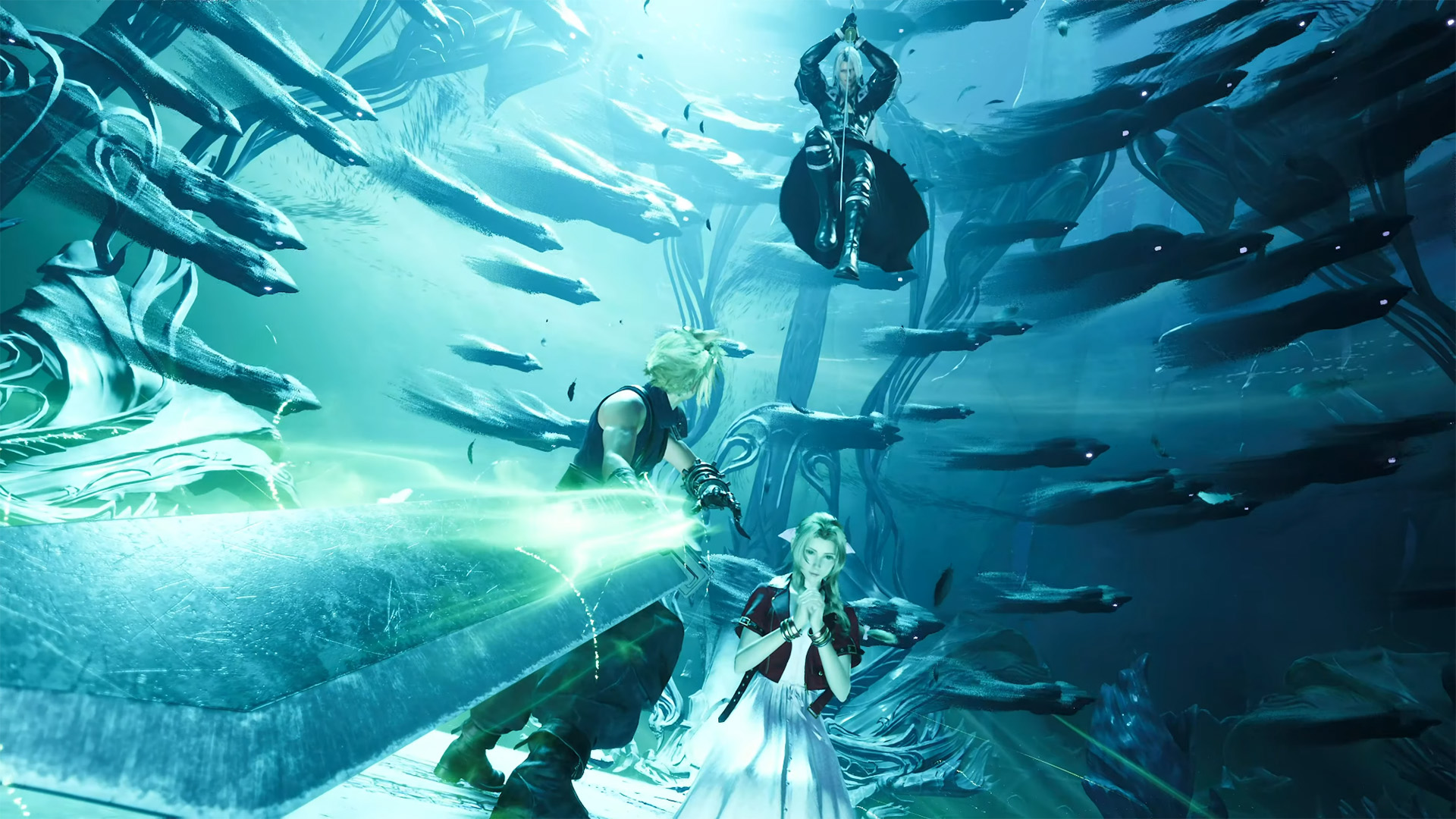
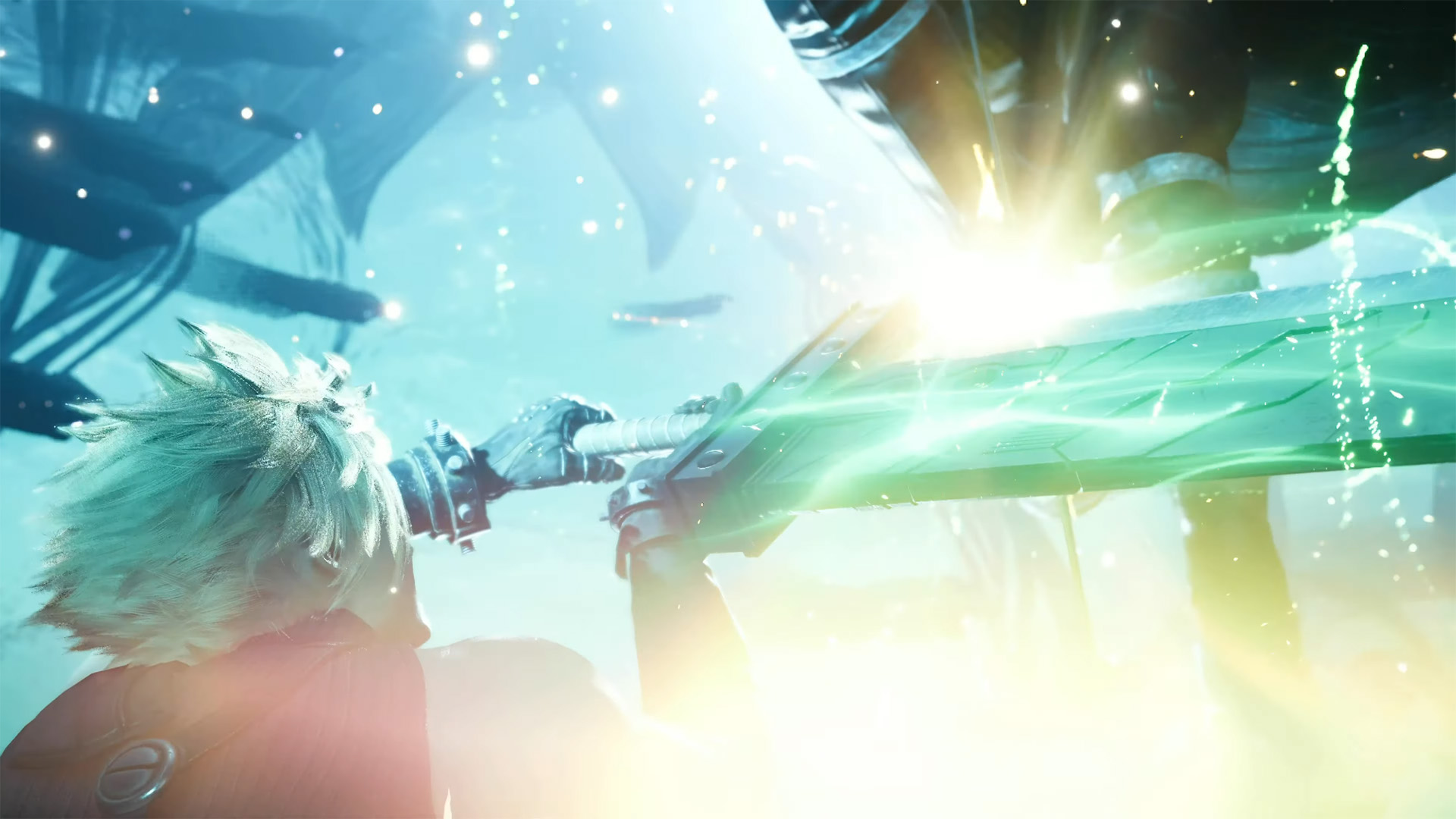
...and Cloud is able to block Sephiroth's killing blow, saving Aerith.
...Until, suddenly, he hasn't? With some static we jump to an alternate timeline where Cloud didn't block Sephiroth, Aerith's already been stabbed off-screen (we never clearly see the killing blow), and she dies, like in the original. Most of the dialogue from the original is cut, which further hampers the scene. Sephiroth no longer gloats about how this advances his plans for world domination only for Cloud to interrupt his text box with a "shut up" so he can instead mourn Aerith. We skip Cloud's thoughts and we instead jump straight to Sephiroth calling his feelings fake because Cloud is just a puppet.
...Or, hold on, is Aerith still alive after all? Because now as Cloud's holding her body she reaches out to caress his cheek and tell him it's okay. The rest of the party shows up, and as Tifa looks on it flickers between two versions of the scene, one where Aerith is covered in blood from the stab wound and one where she isn't.
Folks, Square has done the unthinkable. Aerith is simultaneously alive and dead. They've given us Schrödinger's Aerith.
As you're still trying to figure out if you should be grieving Aerith or not, hold that thought, because first it's time for a forty-five minute long final boss gauntlet. And that's if you do it without dying!
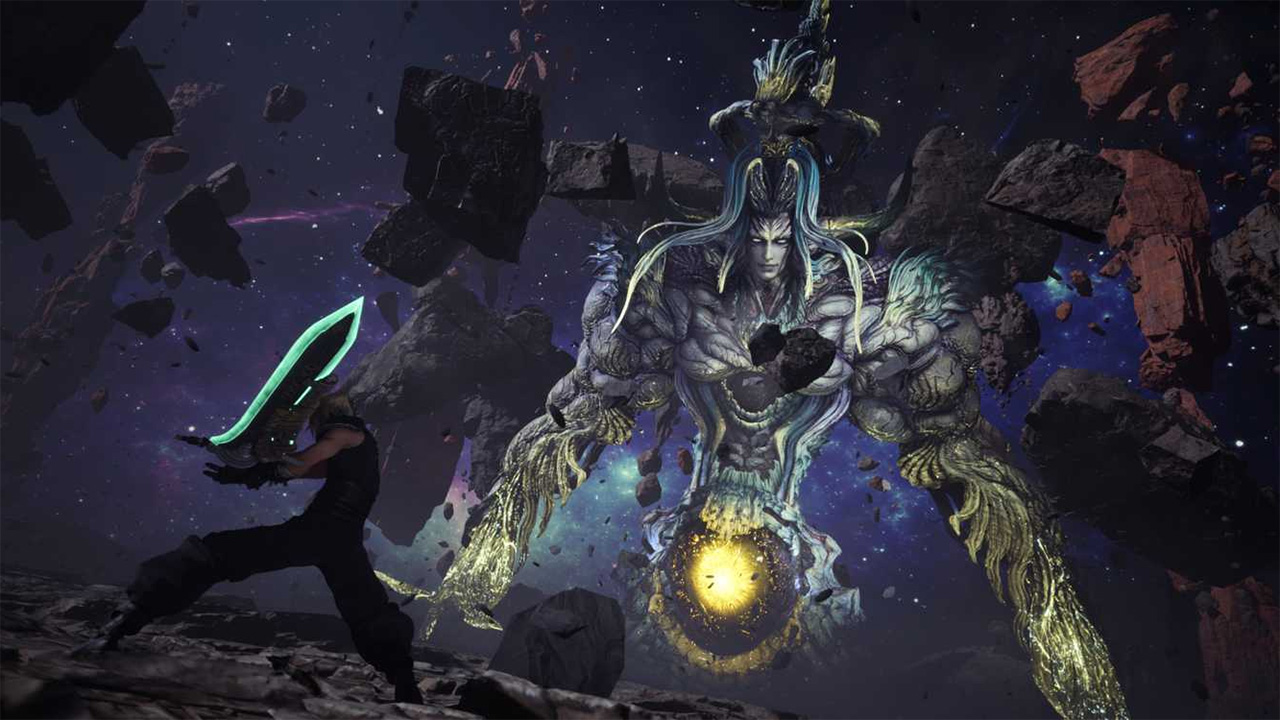
The brief Jenova fight from the original is stretched out into a multi-phase tag team battle across multiple party configurations where everyone gets to do cool attacks and shout one-liners. It's now so long that they give up on continuing to play Aerith's theme partway through and just switch to a new mix of J-E-N-O-V-A, like the game got bored of being sad about Aerith. Then Cloud finds himself in a white void where he meets Zack, and they fight Sephiroth together in space. (This cameo is all Zack's subplot really amounts to.) Then Sephiroth somehow turns into the gigantic Bizarro Sephiroth from the first phase of the final battle of the original game, and everyone takes turns whaling on him across multiple phases and multiple realities, and also his Whispers take the form of Bahamut Arisen and you have to fight THAT for a few phases, too. And as if all of that wasn't enough, Cloud has to have one final rematch with the normal Sephiroth set to One-Winged Angel... with Aerith there to help. We already did that at the end of Remake! How is the mechanical side of Aerith's death, the loss of her as a party member, supposed to hit when we can still play as her after her death? Do you even remember that's what you were fighting over by the end of this feature length onslaught of spectacle where Aerith has already come back to life twice?
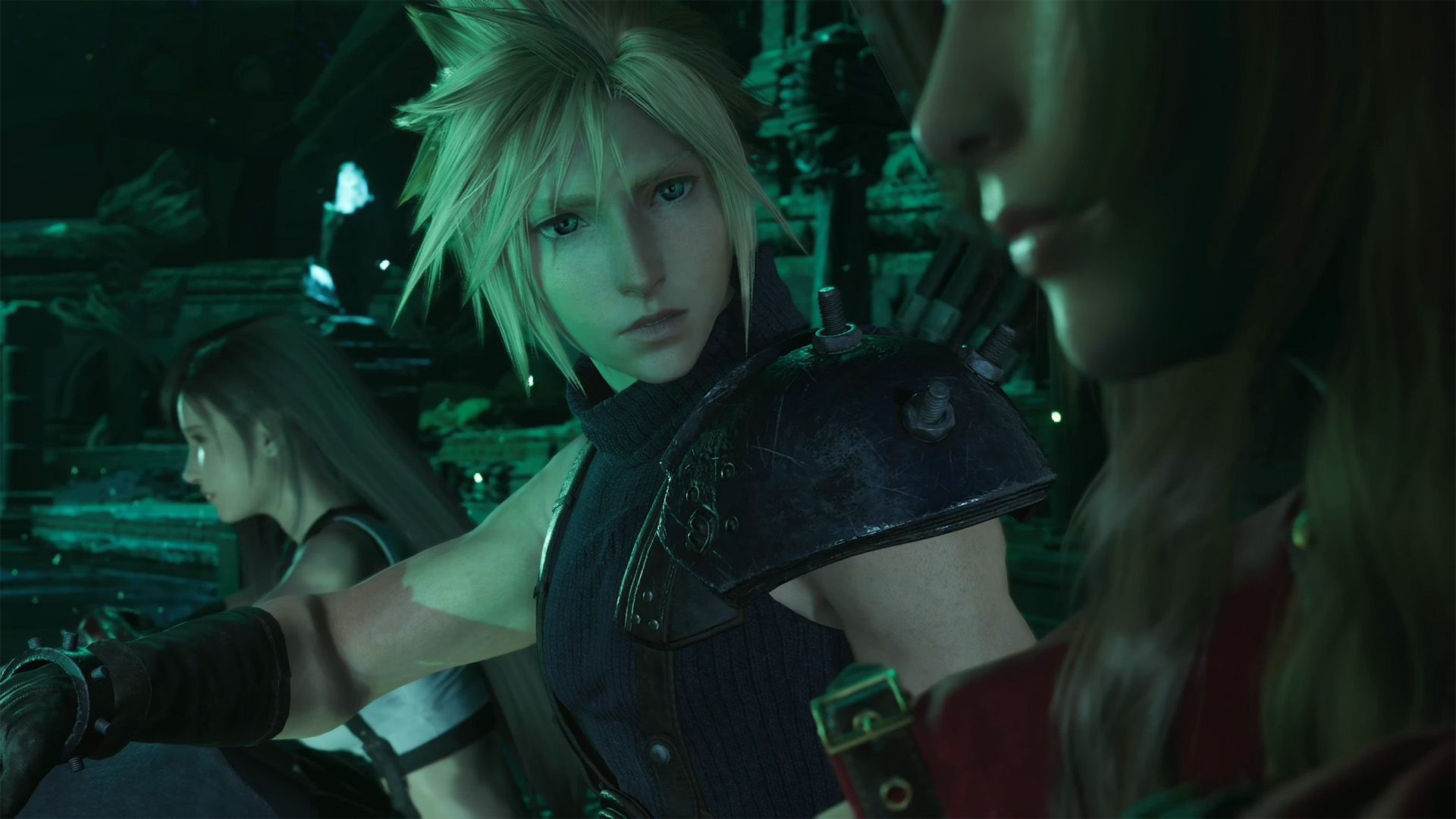
After the fighting finally ends, Cloud says goodbye to whatever version of Aerith he was fighting Sephiroth with and is returned to the scene in the Forgotten Capital with his friends, where Aerith wakes up in his arms and comes back from the dead again. Then a scene transition and she's gone again, then a flash of static and she's back again. The final scenes focus on establishing that Cloud can still see and speak with Aerith even though no one else can, because to everyone else she's dead. (Nanaki seems to be able to faintly sense her in the last scene as well as a sequel hook.) They can't have the iconic scene where Cloud lays her to rest in the water, because from his perspective she's still alive and he's acting like everything's fine.
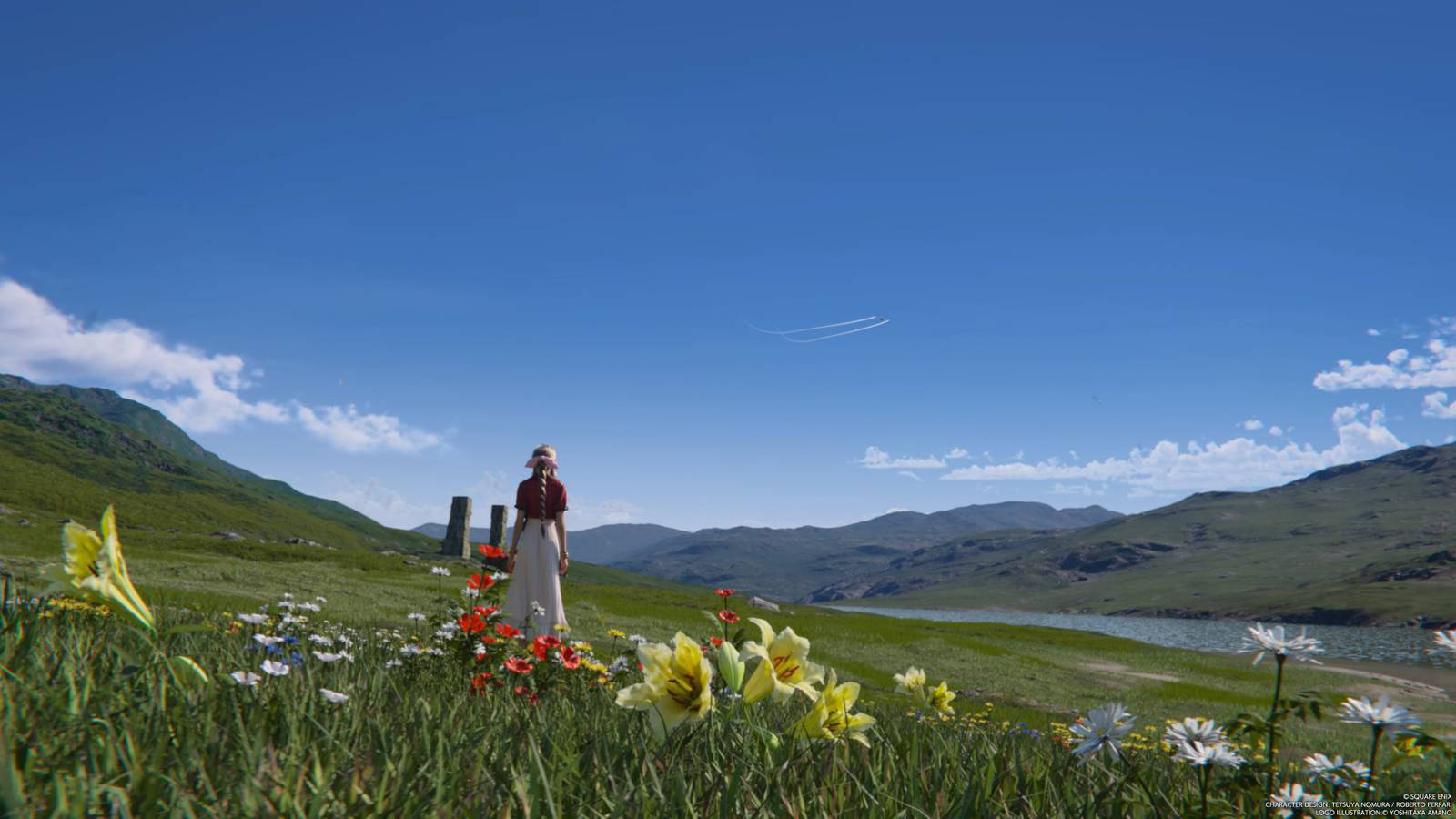
Is Cloud seeing Aerith's ghost from the Lifestream? Is he experiencing both his reality and another divergent multiverse world where Aerith lived at the same time, hence him seeing the big end-of-the-world rift in the sky that all of the doomed timelines have? Which timeline is this Aerith from? It doesn't really matter. On a metaphorical level, these are basically the same thing. The point is Cloud can't let go of Aerith and accept that she's gone. Everyone else can see the truth, but he's in denial and repressing his feelings. I will admit, the final shot of Aerith saying goodbye as the rest of the party flies away on the Tiny Bronco works for me. If it was literally only that as a final twist, a tease that Aerith's ghost may still appear in part 3 to some extent (it did in the original!), it might've hit for me. I also probably would've popped off if they waited until the end of part 3 to bring in Aerith's ghost as a tag team partner, calling back to Remake. But the way they actually did it here is a huge misfire that ruins the emotional impact of the original scene.
In a game full of twists and turns and psychic manipulation and magic and metaphysics and cloning and multiple levels of unreliable narration, Aerith's death in Final Fantasy VII is a cutting moment of emotional clarity. Cloud had someone very special in his life, and now she's dead and he doesn't know how to deal with that. This is the grounding moment the entire story hinges upon, one of the most famous cutscenes in the history of the medium, many players' first video game moment that made them cry. And Rebirth does everything in its power to undercut and undermine it. How are we supposed to mourn Aerith when the game keeps having her reappear as if she's still alive over and over again after the fatal blow? How are we supposed to feel sad when the game is trying so hard to confuse us and make us question what we're looking at instead? And hell, how is confronting Sephiroth in part 3 to avenge Aerith supposed to feel climactic when Cloud's already beaten him in fights set to One-Winged Angel in both prior games, and when the whole party has already beaten Sephiroth in his penultimate god-like form two thirds of the way through the story? Yes, I know technically we still haven't faced the real Sephiroth since his actual body is still trapped in the North Crater for now, but come the fuck on.
Rather than just telling a good story and providing a satisfying climax for Rebirth as its own game, the ending feels like it was designed solely to keep fans speculating on what's going on with Aerith in the years between Rebirth and part 3, in which Square will figure out what the hell to actually do with all this. "Don't you want to analyze all the different Stamp designs and the different White Materia to figure out which characters in which scenes are from which multiverse reality?" No, I can't say I do! I don't want the story to be a puzzle to solve, I want it to resonate with me emotionally, and rather than aiding in that goal the metatextual multiverse mystery box elements are getting in the way. Why should I get invested in the possibility of this new stuff meaning anything when all the shit with Zack and the alternate timelines teased in the ending of Remake, the trailers for Rebirth, and the literal cover art of the game only resulted in a gratuitous cameo in the final battle? They literally showed a split second of Cloud blocking Sephiroth's killing blow in the final Rebirth trailer to make people speculate like crazy (this is insane to me), and look what they actually did with that!
But how can I act surprised when the ending of Rebirth recreates the story in a broadly similar way but with more pulled punches and a bunch of new bullshit added on to dilute the original game's emotional arc, when that's been the entire game's modus operandi?
Closing thoughts
As hard as it may be to believe, I cannot fully bring myself to hate Final Fantasy VII Rebirth. I've focused on the bad here, but like I said at the start, there are many individual moments I like. Individual scenes, lines of dialogue, boss battles, images that will stick with me. The voice actors are still doing a great job. Queen's Blood is fun. It gave me the bow wow wow song. But where the original Final Fantasy VII was much greater than the sum of its parts, its many individual moments of jank, frustration, and rushed translation paling in comparison to the overall experience and its sheer creative gusto, Rebirth is much less than the sum of its parts. Every time I think back to those bits I like, I also think about the bad. The bland open world. The countless times I got interrupted by Chadley. All the parts where they killed the somber or unsettling vibe of a sequence from the original by making everything feel more like a vacation. The annoying Protorelic quests I abandoned. Having to fly a Chocobo through rings under a time limit like it's Superman 64. The awful ending that botches the story's most important scene, only to then shrug and go "I dunno, we'll figure out how dead Aerith is next game." I can't help but be disappointed.
I don't think Rebirth "ruined my childhood" or anything that hyperbolic, of course. FF7 is still there, readily available on modern platforms and via emulation, just as good as it always was. But it increasingly feels like the remake trilogy is the default way for new players to experience the story. When you look up scenes on YouTube, you now get the remake versions first. It's one of those major releases everyone with a PS5 feels obligated to play. And for as many things as the remakes do well, it sucks that those new players are getting a worse, more toothless version of the story. A story that was once so powerful because it was often scary, bleak, and tragic but now has to maintain more of an upbeat sightseeing adventure vibe. A version where things are arbitrarily changed for the sake of adding new levels of mystery box to theorize about while still technically being the same story when you zoom out, rather than being either a more faithful remake or an actual new story that did more interesting things with the material. Rebirth has found a way to be the worst of both worlds.
While many will be quick to argue the whole idea of an expanded remake trilogy was doomed from the start, I don't think it was. I still love how Remake reimagined Midgar, and I think most of Rebirth's faults were unforced errors that you can't pin entirely on it being a standalone adaptation of the rest of disc 1. They could've just, y'know, written a better script, and been more judicious with the side content. But I understand the production realities that would make a single remake of the entire game and its many unique locations prohibitively expensive at anything close to this level of fidelity. I also don't think a straight graphical update of the original game with a remastered soundtrack and voice acting would've been better, no matter how many oldheads say that's all they really wanted. In some ways, the remakes being so different on so many levels as opposed to being straight remasters means that they'll never completely supplant the original. There is truly no replacement for Final Fantasy VII, and I still find it a marvel of game design full of some of the most striking images in the medium. God, the prerendered backgrounds all look so fucking cool. I'm at least glad that Rebirth gave me an excuse to finally see it through to the end.
And y'know, call me crazy, but part of me is still slightly looking forward to part 3. At least a little. I have no reason to believe the new story elements will go anywhere interesting after how big of a nothingburger Zack was, but part 3 will be adapting the much more serious and action-packed back half of the game, so the relentless low stakes vacation vibe should theoretically be less of a problem, at least. I'm curious to see how Cody Christian plays Cloud once he regains his true memories. And Hamaguchi has said that part 3 will be "a bit more concise" than Rebirth. But then again, they probably don't want to shy away from how Rebirth did things too much, because most people liked Rebirth way more than Remake. I'm the weirdo outlier here for thinking the full game spent in dreary old Midgar is way better than the one with the vibrant open world full of Activities. So it's hard to get too excited about what the final chapter has in store for me after all this. As Rebirth's ending itself proclaims: "No promises await at journey's end."
More than anything, Rebirth betrays a lack of confidence. It's afraid that a straight retelling of FF7 wouldn't be interesting enough, but it's also afraid that diverging into more of a new story and fully indulging in what haters call "Kingdom Hearts bullshit" would scare the purists off. It's afraid that modern players will be unsatisfied with a modern RPG that doesn't give them dozens and dozens of hours of open world Content to complete. And it's afraid that if it plays things seriously for too long, if it makes you face the reality of its dying world for more than a few minutes at a time with no newly inserted jokes or minigames or pet the dog moments to break things up, players will just get bummed out and bored and do something else. And so a revolutionary classic beloved for its bold creative swings has been contorted into the shape of what Square Enix thinks is the most broadly palatable singleplayer action RPG possible for the 2020s. This has resulted in a hit release for now. But will it stand the test of time like the original has? Personally, I'm not sure it will.
Thank you for reading. This review was in the works for over two years, longer than any other review I've ever written, and I'm happy to finally have it out. If you still want even more, you can check out this bonus post with more scattered thoughts on these games and several sections that were cut from the main review.