
Metroid Prime 4 is pretty good


I was worried about Metroid Prime 4: Beyond prior to release, between the eight or nine years of development across two completely different studios and the last few trailers focusing on things that felt decidedly un-Metroid. I was worried it was going to be a total mess caught between multiple incompatible visions for what the game should be.
And, well, it's still messy. From the very beginning of the game where you're met with a choice between performance mode and graphics mode, after which you'll get an action-packed cutscene of Samus flying into a battle at a Galactic Federation base, it seems clear that this is Nintendo's attempt to prove they can make a modern AAA game for big boys, like what the other consoles get. Look how good we can render a human face! Look at those framerates! But I'm pleased to say that I think the desire to make a traditional Metroid Prime game mostly won out over the desire to make something more generic to appeal to a broader modern audience. Overall, this leaves me with a game that I think is pretty good. Not perfect, certainly not the ultimate Metroid Prime game of your dreams, but pretty good. It's really truly not that bad, if you've just been hearing people tear it to shreds.
Let's get straight to the two big points of contention. First of all: the NPCs. Seemingly taking a page out of one of Metroid's original inspirations, the Alien series, Samus is stranded on a hostile planet full of ravenous monsters alongside a ragtag group of Galactic Federation space marines with broad personalities, kind of like Ripley's allies in Aliens.
Yes, this is a Metroid game with talking. I know that this is considered a cardinal sin for the series, especially post-Other M. But my first Metroid game was the dialogue-heavy Fusion, and that game owns, so I'm not inherently opposed to the idea of a Metroid game having dialogue with NPCs, or even a Samus who talks. (People always seem to forget that Samus talked in Super Metroid, too. The game literally opens with a whole long monologue from her summarizing the story so far. She's not inherently supposed to be a silent protagonist! But, again, Other M cast a long shadow, so now she's mostly mute.)
Unfortunately, while I'm open to the existence of NPCs and dialogue in these games, Prime 4's NPCs do not make a good first impression.
The first half hour or so on planet Viewros feels like proper Metroid Prime through and through, where you get to take in the atmosphere, piece the worldbuilding together by scanning everything, and enjoy the music by returning composers Kenji Yamamoto and Minako Hamano—if you aren't aware, they've both been with the series since Super Metroid. A touch I particularly love is that upon first arriving on the planet, Samus's scans provide precious little information about what anything is, but once she's given psychic powers and her Scan Visor becomes the Psychic Visor she suddenly knows what everything is. Because she's psychic now! And the Lamorn beamed all that info about their world and culture into her head! The game doesn't draw attention to this directly, it's just something you'll realize on your own.
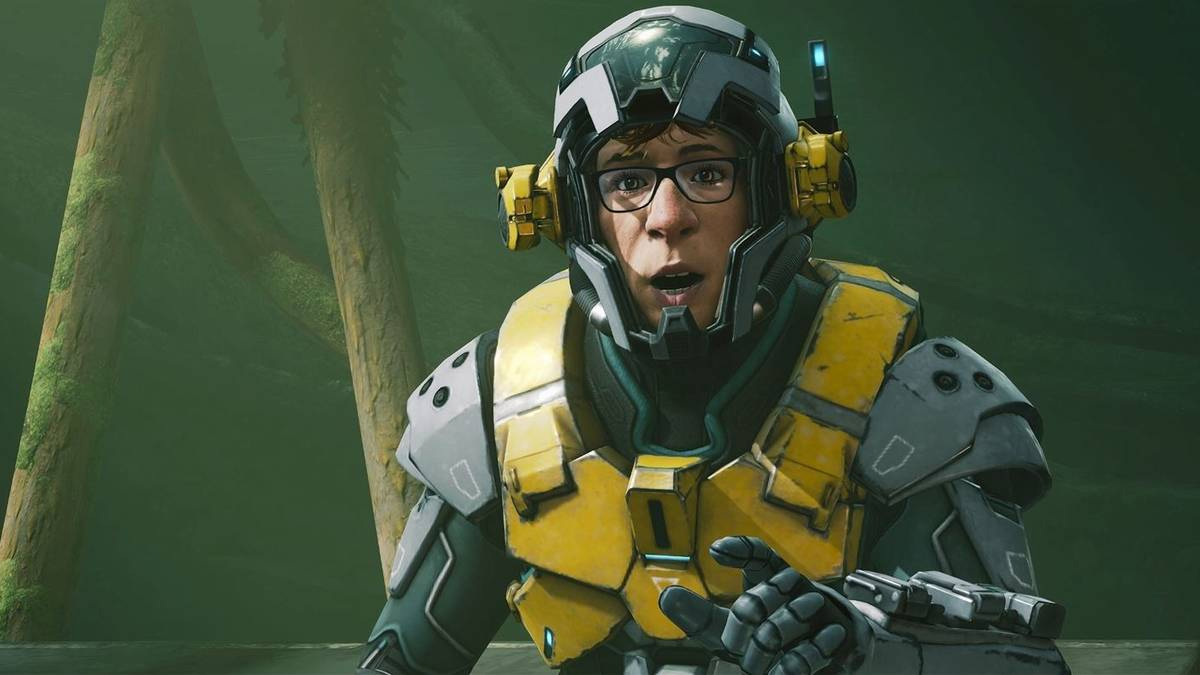
And then halfway through the first proper area you'll rescue the bumbling nerd Myles MacKenzie and escort him to the place where he'll set up your base camp, and he has to make a patronizing comment on every little thing along the way, rather than letting you think your own damn thoughts about what you're seeing and figure shit out on your own. Samus, you should check the map! Ooh, I wonder what that thing does? Maybe try shooting a missile here! Oh no, a monster, scary! It's such a sudden, stark shift in tone that I genuinely wondered for a bit if someone had written this character out of spite, perhaps attempting to parody the chatty protagonists and companions in many recent first party PlayStation hits so that Samus's silence the rest of the game would be more appreciated.
(I wish Nintendo wasn't so famously secretive, because god, I'd love to hear a tell-all expose about what the hell happened behind closed doors while making this game. Even shortly after the massive backlash to and subsequent commercial failure of Metroid Prime: Federation Force on the 3DS, series producer Kensuke Tanabe was still talking about how he wanted the next Prime game to heavily feature the marines. This was not a new idea, this was always the plan. Clearly he got his wish, but I'd love to know how many people tried to talk him down along the way.)
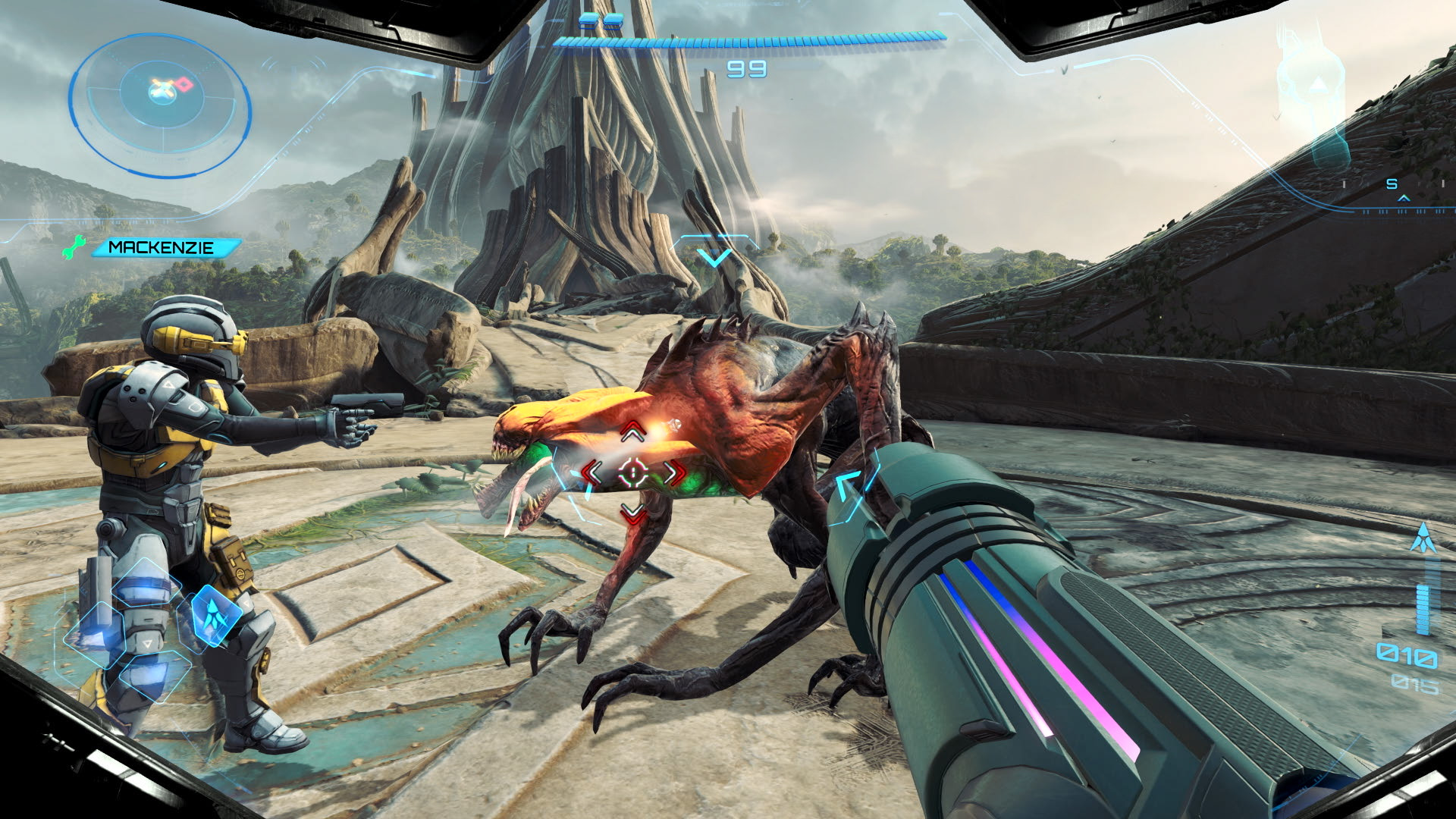
As I got further into the game, though, I was relieved to learn that you go long stretches without hearing from the marines much, if at all, allowing it to feel like a regular old Metroid Prime game. There are many parts of the game where radio interference means you won't be talking to anyone at all, or at worst you get a one or two sentence call to confirm your next objective. Over time I even grew oddly fond of Myles, just because it's so funny when he says some dorky shit and then the camera cuts to Samus and she gives him a single silent nod and no other reaction. Again, Samus has a long history of talking, but she's just decided to go nonverbal on this mission, I guess. It's also amusing to me when the rookie marine fangirls out over seeing Samus's world-famous ability to turn into a ball in person, or when you find the stoic sniper character camping out in the middle of the desert for no reason and he decides to tell Samus about Space Jesus, and Samus once again has no reaction whatsoever. Is all this "good writing"? Eh, not really, but it amuses me enough that I don't hate the marines.
Sadly, two of the later areas in the game do suffer from being framed as escort missions where you're accompanied by some of the NPCs, with the mine area in particular feeling like one long corridor full of scripted moments with the companions. This is particularly unfortunate because this is the last full area in the game, so it'll probably be one of the things people remember the most from Prime 4. Still, I suppose I'm mostly thankful that this only represents maybe two or three hours total of my 13 hours spent with the game, and that it still feels like Metroid Prime when you're free to revisit previously explored areas to pick up items you couldn't reach before.
Then there's the other big point of contention everyone was worried about: the "open world" desert.
There's a certain kind of video game enthusiast who's developed a kneejerk negative reaction to anything that even slightly resembles an open world due to the prevalence of the genre in modern AAA games. And, look, I get it. There are too goddamn many of those Ubisoft games, and when I hear a game is 60-100 hours long it more often than not comes off as a threat. I'm way more likely to appreciate something tightly designed that I can finish in under ten hours, or even just one or two hours. But now people will write off anything even close to an open world game as cookie cutter slop. People refuse to engage with these games on their own terms and see the differences between them, even when looking at games that couldn't be more different in how they want players to tackle their worlds.
Case in point: Metroid Prime 4 isn't even really an open world game! At all! It just has a large central hub area between the regular zones.
The desert has maybe a dozen or so points of interest to find as you travel from point A to point B, including some little challenges you can find for some optional upgrades, and the expected Things You Should Come Back To When You Have The Right Upgrade Later. But the overwhelming majority of your time will still be spent in the claustrophobic confines of the traditional Metroid Prime areas comprised of many small, intimately-crafted rooms. Based on the trailers I compared the desert to Ocarina of Time's Hyrule Field, which it turns out remains a pretty good comparison. I'd say it's probably somewhere between that and Wind Waker's ocean in terms of scale and amount of things to do, though it only takes like a minute or two to get from one side to the other. It's fine. (If Wind Waker came out today, would people be seeing red and writing it off as Ubisoft-style open world slop, rather than writing it off for its "childish" cel-shaded art style?)
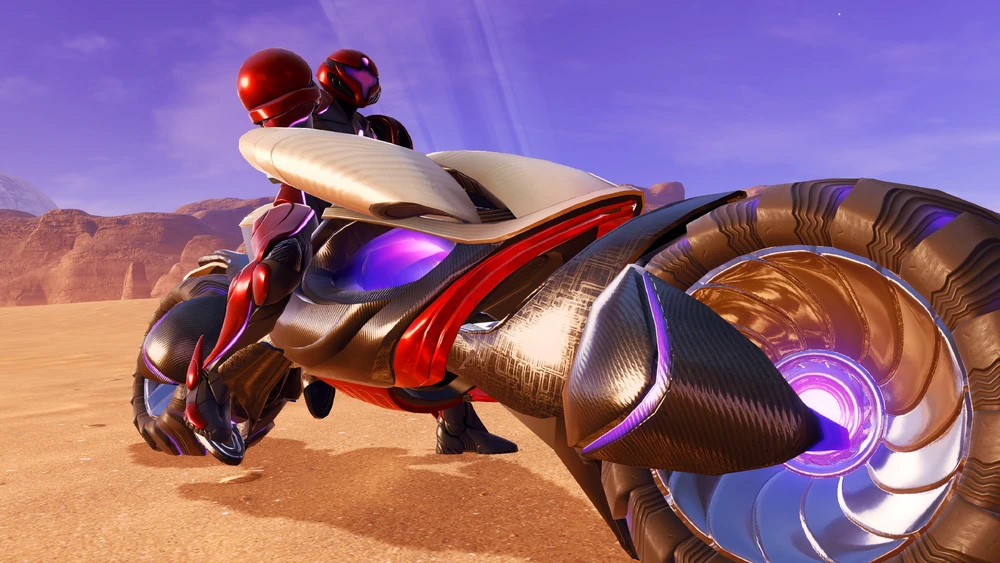
If anything, I think the open desert and its searing sunlight is a nice change of pace that makes the indoor areas feel even more dark and cramped and moody in comparison. It always felt a bit refreshing to head back out into the desert after finishing up a zone. And also seeing Samus ride across the desert makes her feel like a cowgirl. Just, y'know, one with a motorcycle instead of a horse, because it's sci-fi. The series did always have more potential for space western energy as a series about a lone bounty hunter.

Granted, it's clear that they didn't entirely know what to do with this vast desert, as the main activity in the hub is smashing your bike through these big green crystals that dot the landscape. Once collected, these crystals can then be turned in at an altar next to your base camp for a string of rewards, including something that's required to access the final boss. It is very, very obvious that they didn't know what to do to fill in all that empty space in the hub, but someone said they had to do something with it, and this was the simplest and least labor-intensive solution.
Many players absolutely despise the mandatory green crystal quota you're met with at the end of the game, but to be completely honest, I didn't have any trouble with this at all. I saw that I'd get valuable upgrades for collecting the green crystals early in the game (the very first one is your arm cannon's damage upgrade), so I was always sure to collect some on my commutes across the desert. They also served as a decent breadcrumb trail leading me to areas of the desert I hadn't been to before where I might find something else. The crystals you've already smashed turn grey, so if I saw green ones I knew that was a direction I hadn't gone before. This becomes even easier once you unlock the ability to see green crystal locations on your radar, and once you get the obligatory Power Bomb upgrade near the end of the game you can use that to destroy the giant ore deposits that are conveniently placed next to the entrances to every area and fill a big chunk of the meter all at once. It's mindless filler, yeah, but it really wasn't that big of a deal. In fact, I already had all of the crystals I needed by the time I was told they would be mandatory to beat the game, since you only need like half of them to fill the meter. Past that, all you can get is some bonus concept art for filling the meter a second time by collecting 100% of the crystals across the map. Just don't bother if you don't care about this.
No, the late game scavenger hunt that did annoy me a bit was the hunt for the six parts to repair MacKenzie's mech, which are found at points of interest across the desert. They're not hard to find, but even if you have the upgrades required to get to them you can't actually send them back to base until an arbitrary point in the late game. You have to find the sniper guy hanging out at a random spot in the desert so that he can give you an item that Myles can turn into some teleporter patches. And you'll probably only know to do that because Myles literally calls you on the radio to tell you to go find him to progress the story. Only after all that can you finally retrieve the mech parts that you've probably already found. But I guess it wouldn't be a Metroid Prime game without an endgame scavenger hunt that would've been way less of a pain if it just let you retrieve the items across your playthrough.
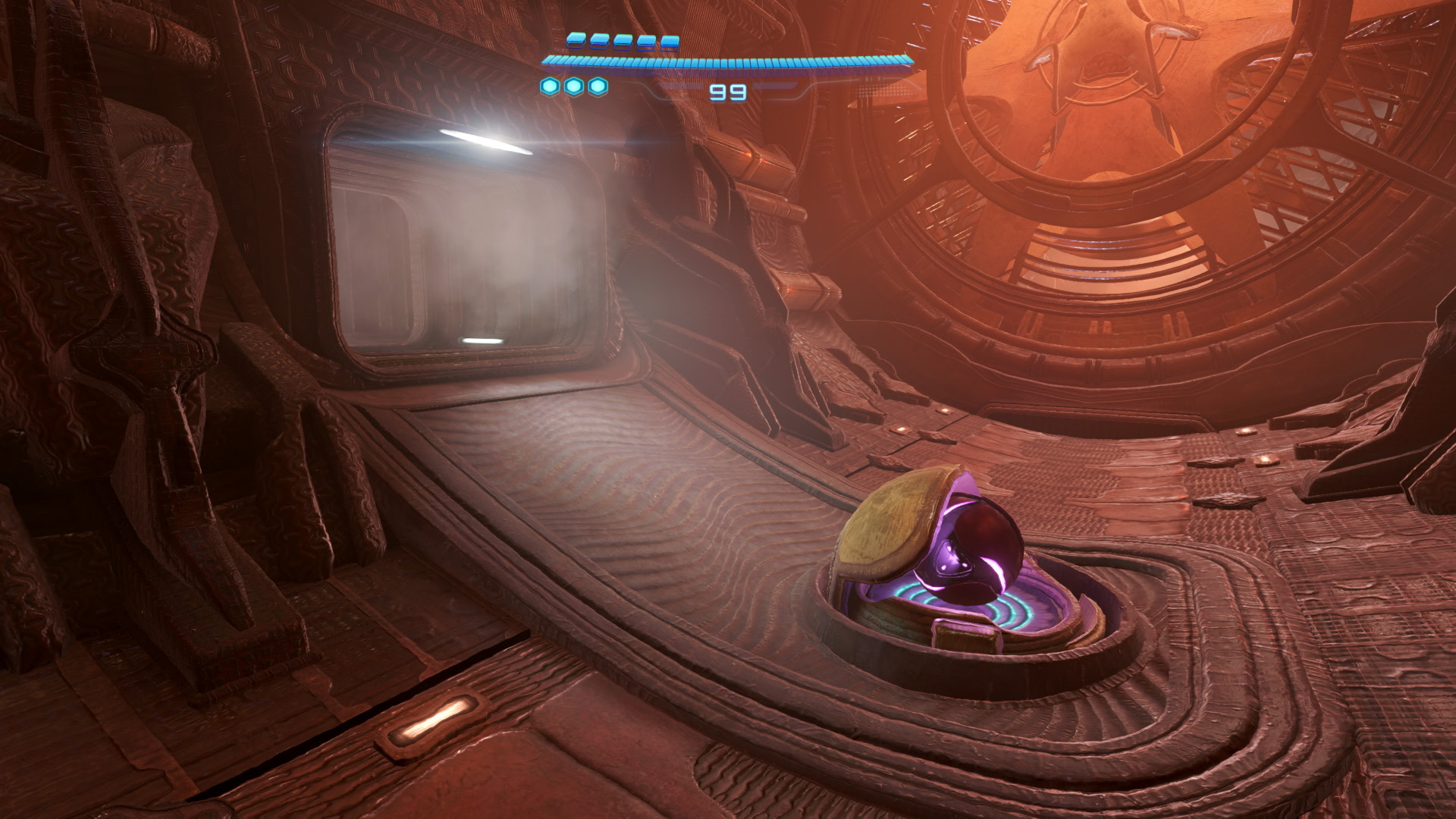
Really, a few of the game's biggest flaws are things it has in common with the original games. They always have some arbitrary backtracking fetch quest at the end. They always have a generic plot. Likewise, yes, it can be a little tedious having to cross through the desert every time you want to backtrack to one area from another. You know what other game had a similar problem? Metroid Prime 1! Everyone's favorite! The masterpiece! Do you remember how many times you have to cross through Magmoor Caverns to get from one area to another? A lot! A lot of times! And honestly, I'll take the desert over Magmoor, because at least on that short bike ride I can take a different route and maybe find something new, rather than being forced to take the same path through Magmoor over and over again.
Those radio interruptions, though. Boy, are they annoying. It kind of discourages you from exploring the desert, because whenever you do Myles will assume you're lost every few minutes and pester you to open up your map so it can laboriously pan over and show you where the next objective marker is. It takes the fun out of wondering where you should go next when Myles straight up just tells you the second the game loses faith in your ability to figure it out on your own. I'm unsure whether or not turning off "tutorials" fixes this, because I didn't want to also disable the input tutorials whenever I got a new ability.
This is especially egregious when the game has another, far superior method of giving the player hints. In each area you can find a deactivated scout drone, which can be powered on with the Electric Shot to scan the area and mark unobtained item locations on your map. This is completely optional, you need to find and remember the locations of these drones, and you can't even do it until the final third of the game, so it doesn't detract from the fun of exploring and marking your map on your own for most of your playtime. It's just there if you really need it to find the items you might have missed or forgotten about near the end.
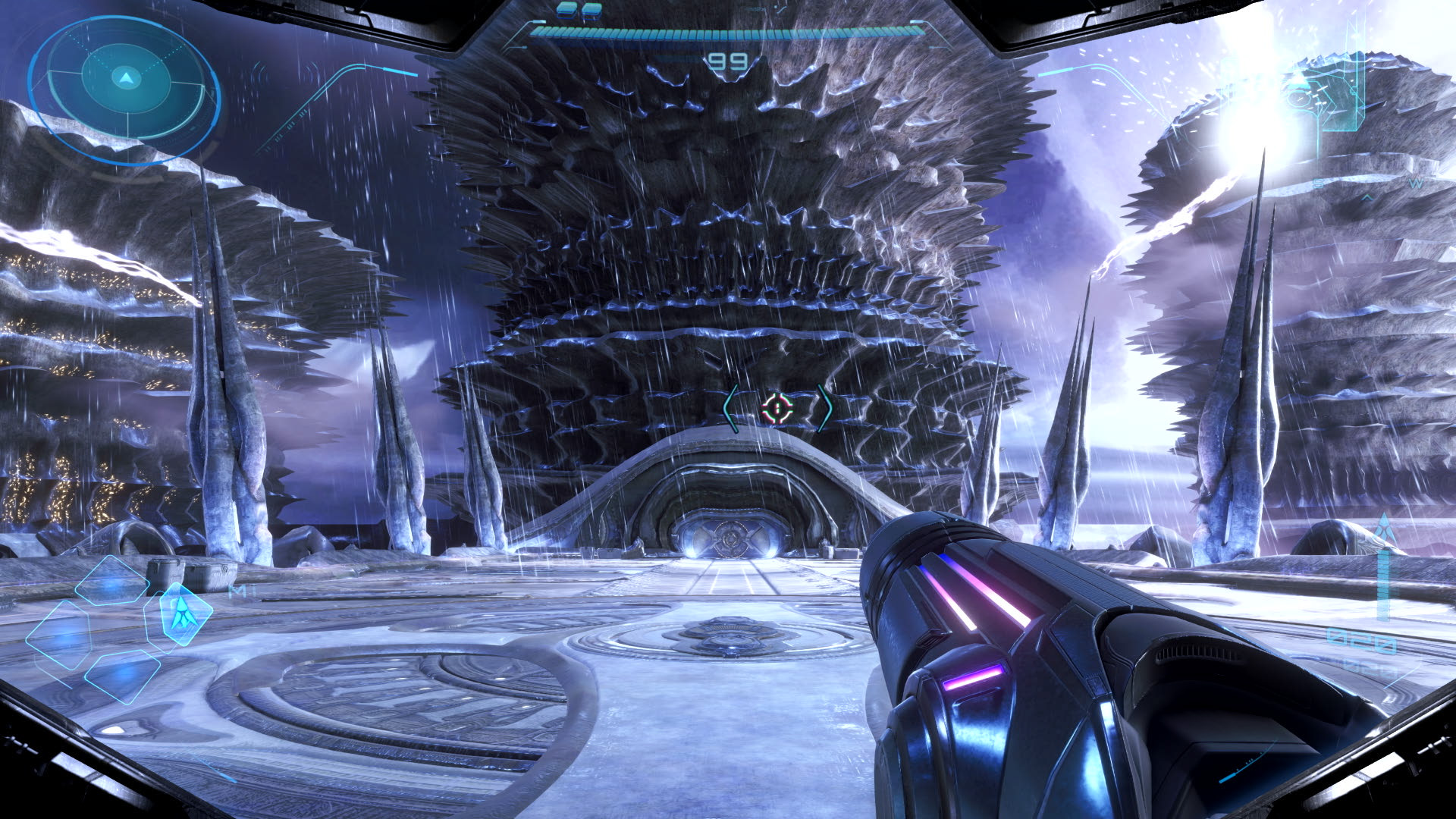
All these hints and the handholding from the marines leads us to the big question: is Metroid Prime 4 too linear? And, I mean, yes, it's definitely more linear than I generally like my Metroidvanias to be. But I also don't think it's that much more linear than the old games.
Unless you're doing some crazy speedrun skips or something, every Metroid Prime game has a linear sequence of upgrades you have to acquire by going to the right locations in the right order, with varying amounts of hints and guidance from game to game. I think it's just that the previous games were generally better about disguising how linear they are, with a bit more room to poke around in each area, and no marine companions reinforcing where you're supposed to go. In all of these games, it's generally your second, third, or fourth time through a zone, when the critical path is no longer guiding you along and you have access to more shortcuts and side rooms, that you can really appreciate their nonlinearity. The same is true of Prime 4. I think it's only the aforementioned late game mine area that really lets me down in this regard, since it still felt like a linear corridor meant to house a specific sequence of set pieces even on my second visit. Most of the others were better.
And I think, ultimately, that's the thing. This game has its annoyances and some sections that are weaker than others, but a good 70-80% of the time? It just feels like the Metroid Prime I know and love.
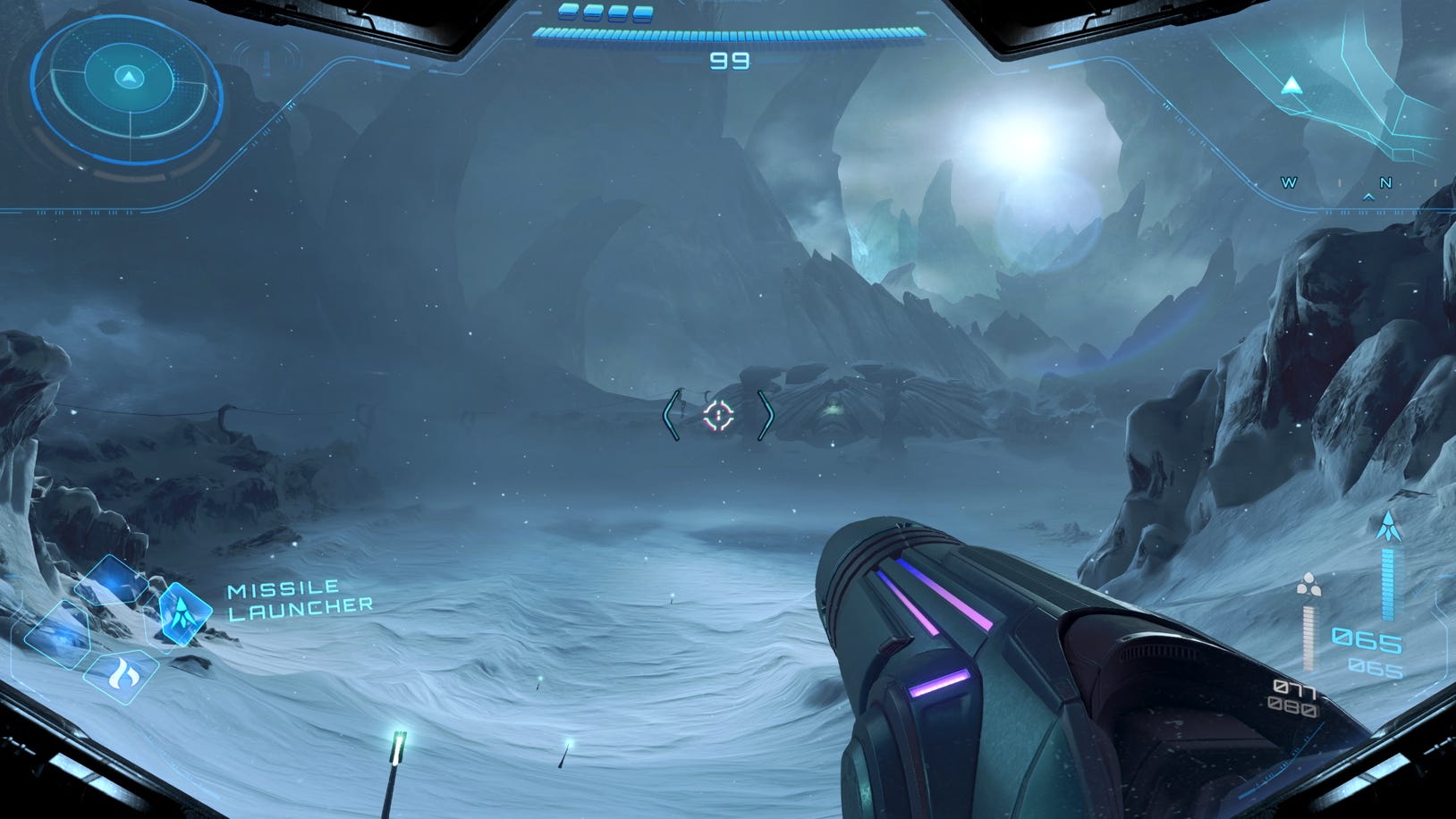
They didn't radically alter the gameplay to make it more action-packed or add parrying or whatever. They didn't tack on a skill tree you have to level up or side quests or crafting or Soulslike elements or racing challenges where you have to drive through checkpoints in the desert. This remains a game about locking on to enemies and circle strafing around them and hitting their weak points, and it has some of the best boss fights in the series, especially the ones against Sylux. It's about downtime where you can scan everything in a room to learn about the world and solve puzzles. It's about gaining upgrades and returning to previous areas to grab more goodies you couldn't reach before. It's about luxuriating in the verisimilitude of the world, one that's downright gorgeous in 4K on the Switch 2. Navigating an abandoned medical research facility in the snowy mountains and turning the power on at the end, which in turn thaws out all the monsters inside as you have to fight your way out? That's classic Metroid Prime. They didn't even add fast travel! I'm sure a lot of people are mad about this, but I have nothing but respect for whoever stuck to their guns and said a game about becoming intimately familiar with the map across repeated treks through each area shouldn't have fast travel. They were right. That friction is entirely intentional.
If anything, more than messing with the formula with NPCs or a hub area, the game's greatest sin might be that it plays it a little too safe. Most of the upgrades are the ones returning players will expect like the missiles and the Spider Ball and the Grapple Beam and whatnot, just with the word "psychic" slapped on the front to make them sound new. There are very few mechanical surprises aside from the fact that the Morph Ball can now slingshot off of its own type of grapple points (this is very fun), you can move some things around telekinetically with the Psychic Visor, and you can do a slow-mo charged shot that you directly control the trajectory of. The areas, too, are mostly familiar biomes. The jungle area, the ice area, the lava area, the mines. They aren't exactly the same as the ones we've seen before, and, again, they look incredible, but you've seen places like these before. The main one that stands out is Volt Forge, a towering alien factory in the middle of a perpetual thunderstorm where you follow the process of your bike being assembled. And also you have to take driver's ed. This is funny to me.
There's also the fact that most of the Lamorn architecture scattered around Viewros is incredibly yonic. That's a new one for the series. Maybe it's the Giger influence coming out.
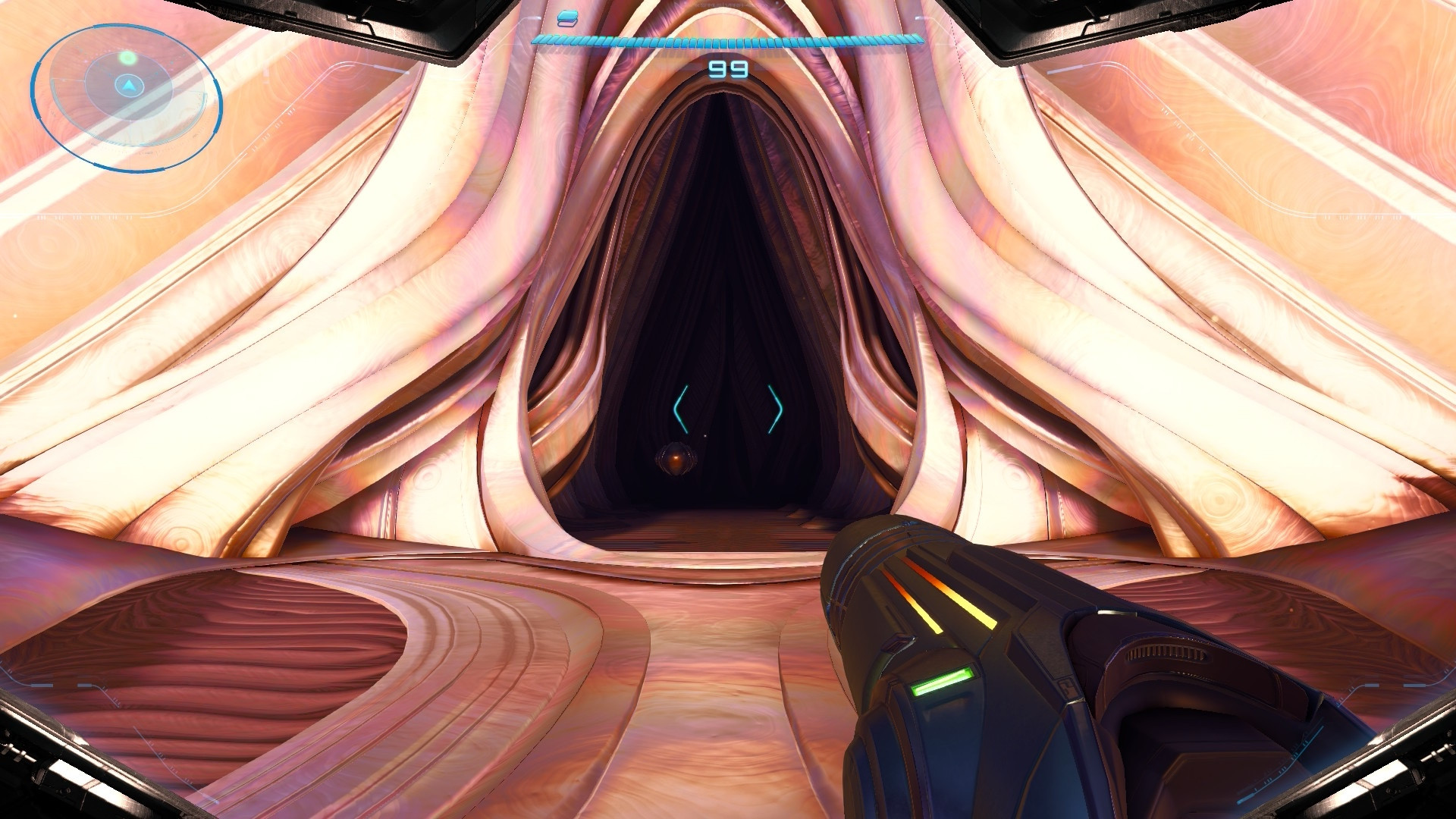
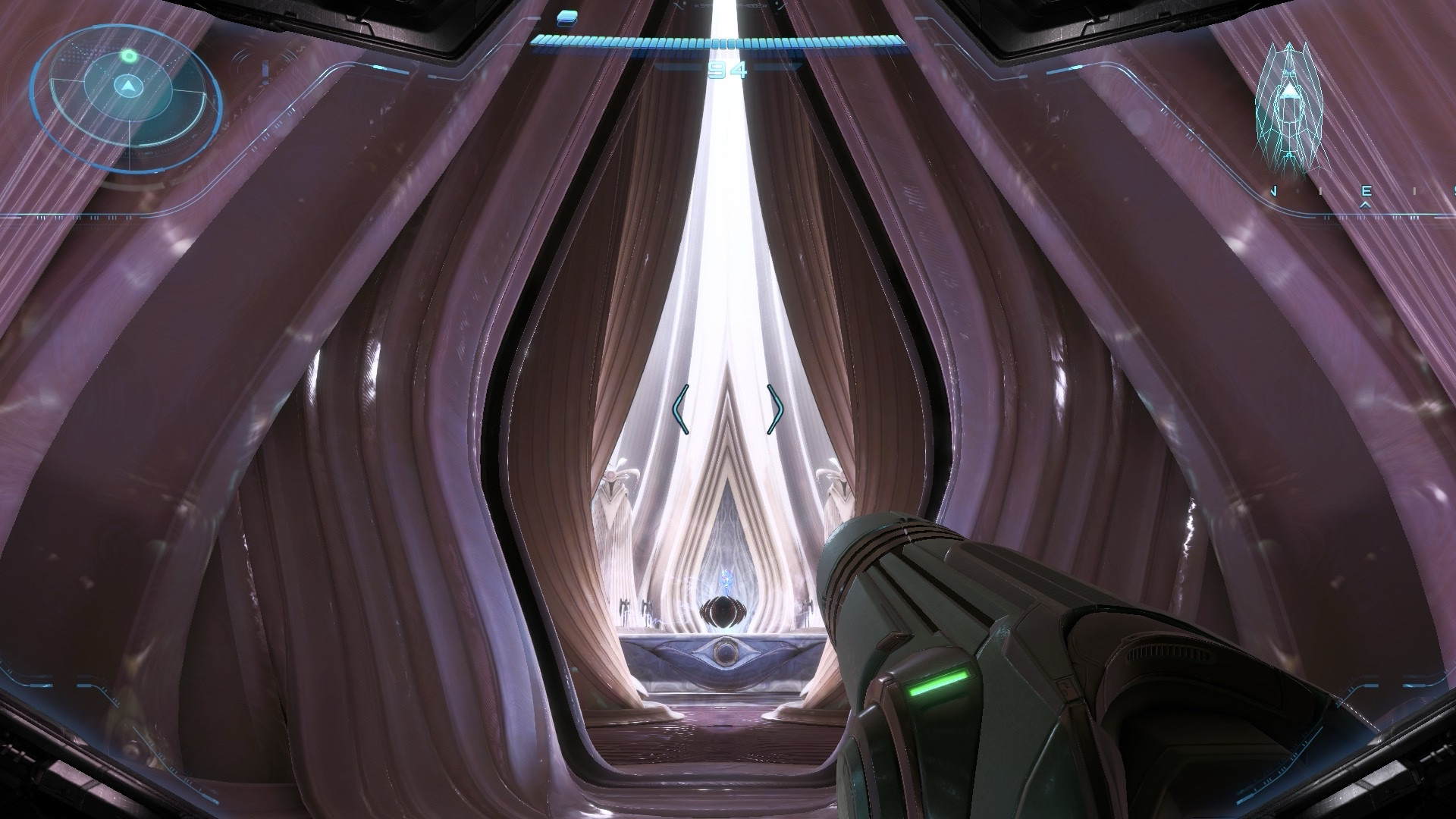
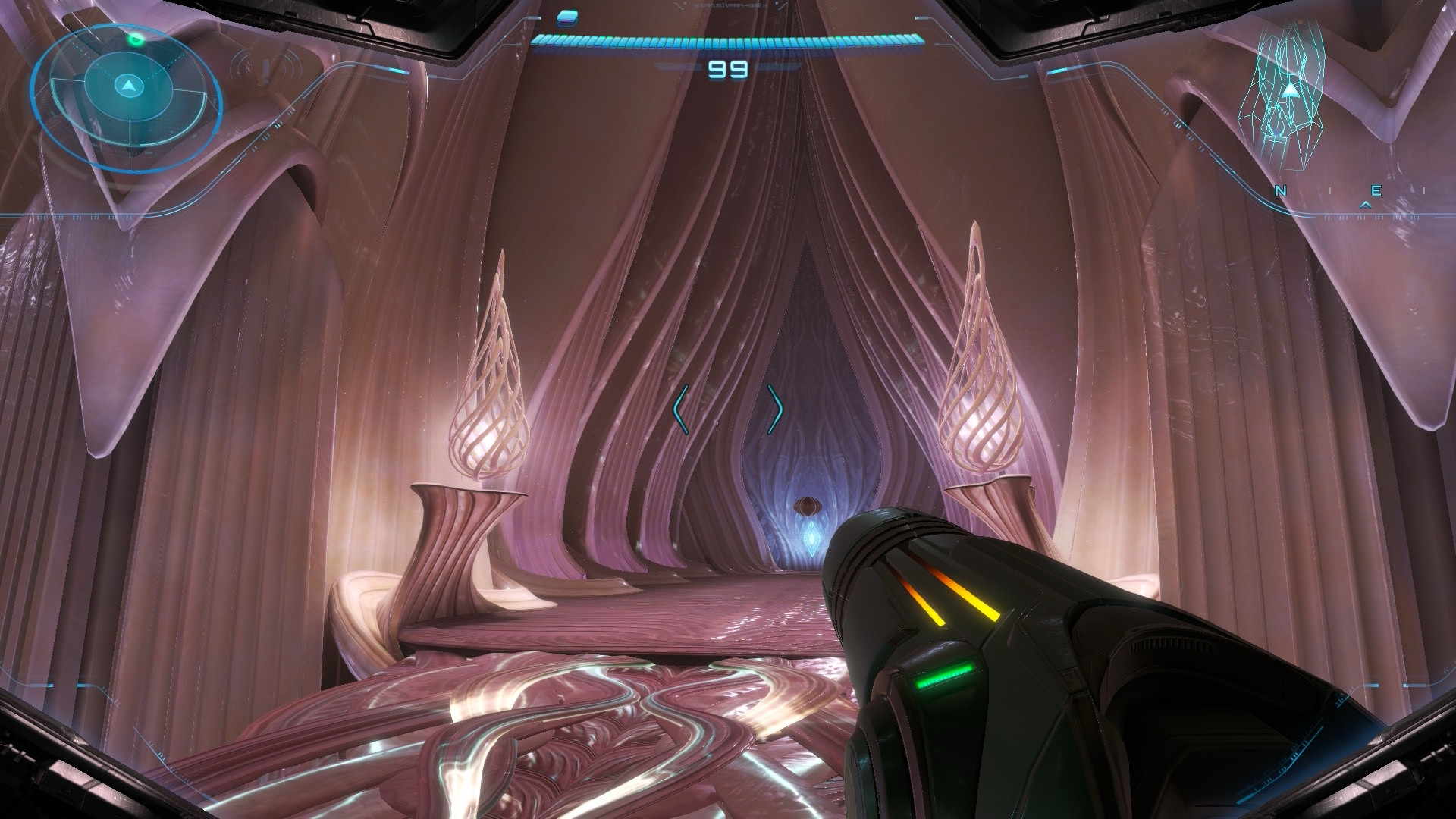
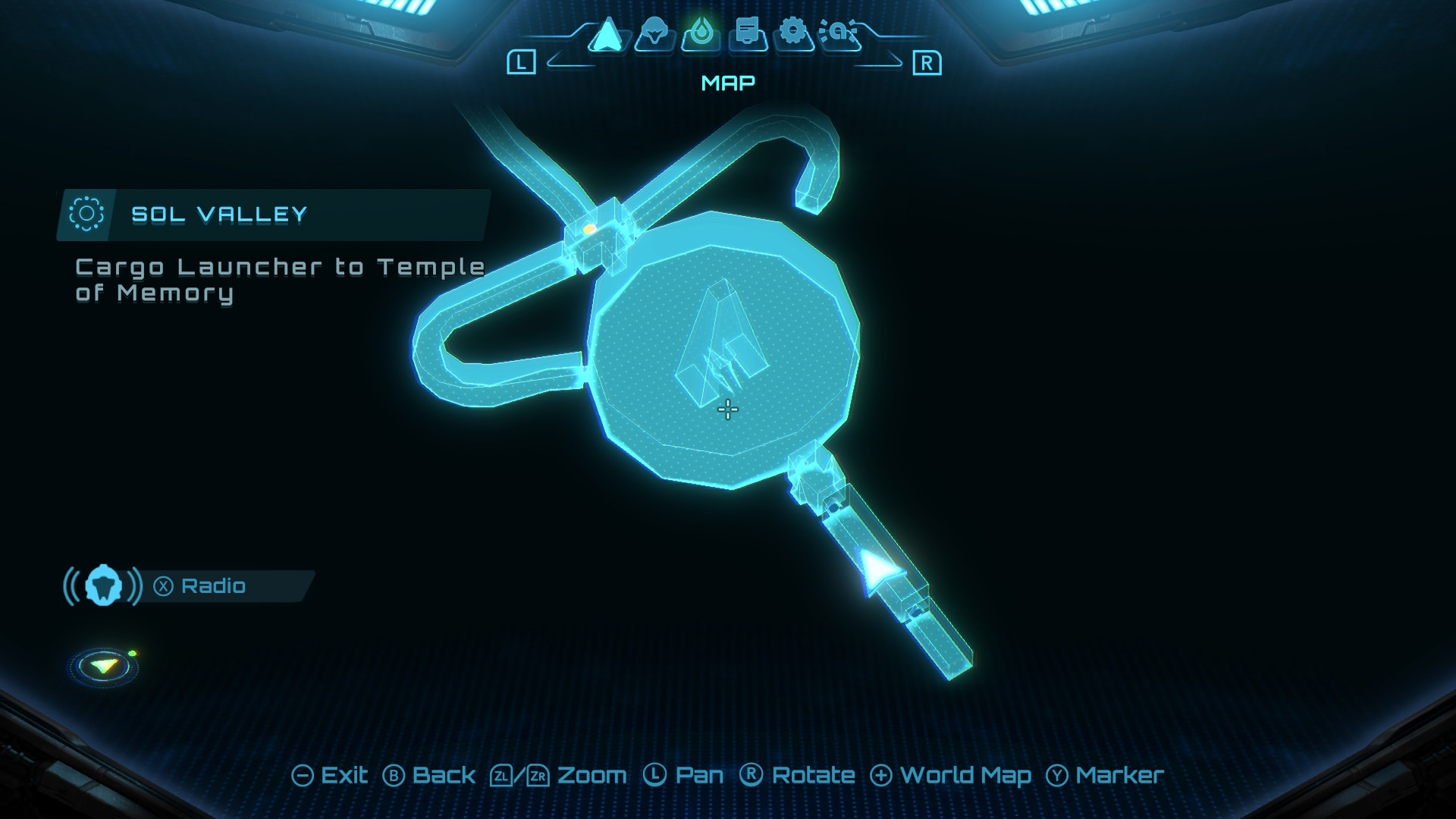
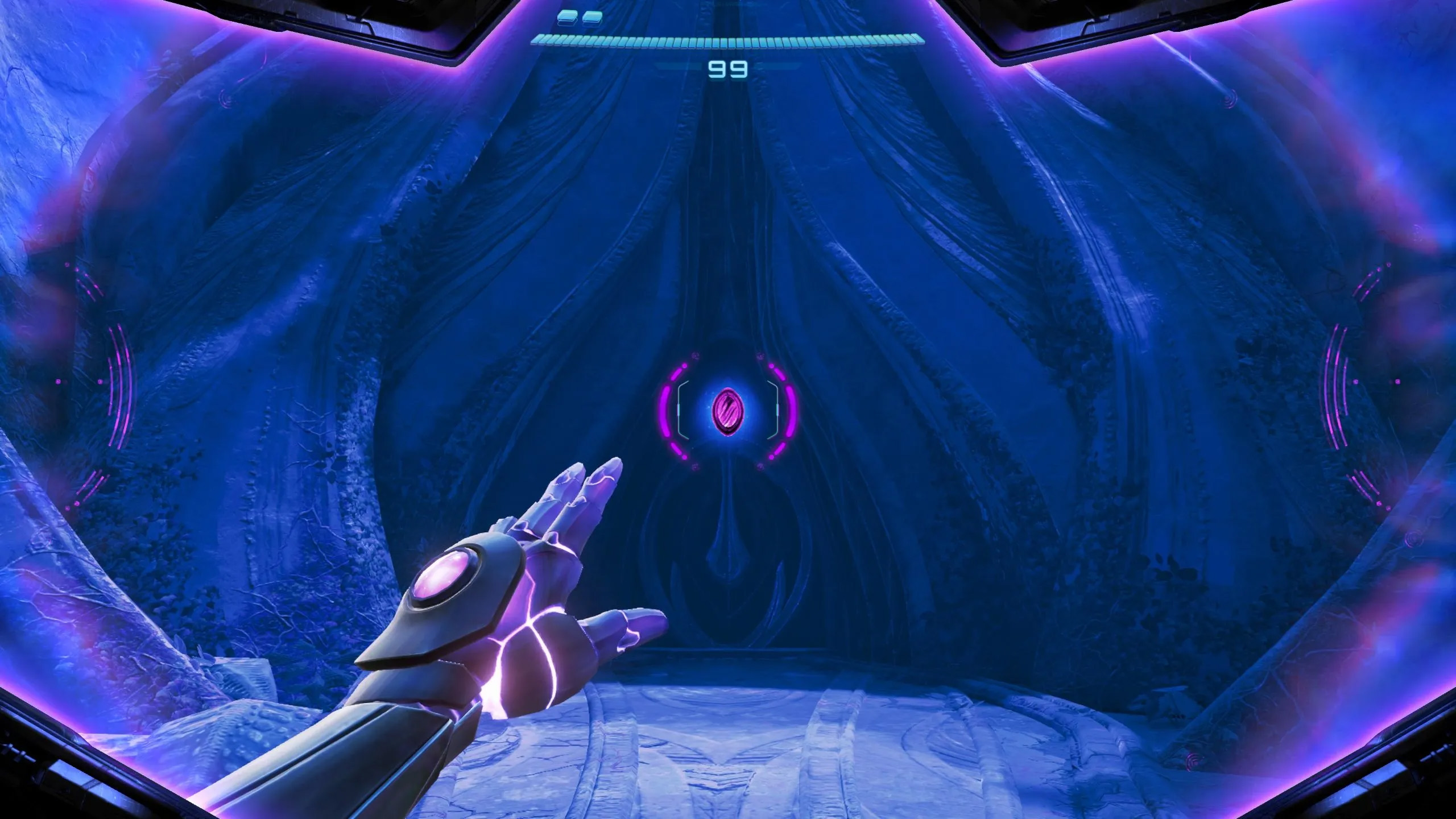
I'll also point out that the second boss is literally named "Carvex," at least one scan reveals a note about a plant's ovaries, and the psychic doors have you grabbing a round nub that's... look, the doors have a clitoris.
...What was I talking about?
Basically, aside from a bit of silly bullshit and a little too much hand holding, this is a very familiar and safe new Metroid Prime game. For better or worse, it's probably almost the exact game they would've made if it had come out in like 2010 as opposed to 2025. In many ways it continues the more hint-filled, more story- and set piece-driven trajectory of Metroid Prime 3, albeit with the motion controls made completely optional. (You can also use mouse mode on Switch 2. I didn't even try that because I found the regular button and stick controls with gyro aiming more than good enough. But I hear the mouse controls are good.)
For many, this lack of ambition will be a disappointment. For me, though? Well, we just don't get a lot of games like this these days. 3D Metroidvanias, non-open world 3D action adventure games, thinky singleplayer first person shooters, you name it. It's not the mythical masterpiece it was hyped up as for all those years, but it's also not the unmitigated disaster I was worried it would be. The marine NPCs and the big desert hub didn't completely overshadow how strong the core of this series is, and getting another one after all these years really hit the spot.
Now here's hoping Nintendo learns the right lessons from this one and it doesn't take another 18 years to get Metroid Prime 5.
Also Prime 2 is still the best one Nintendo please put that one on Switch okay bye
Comments