
Thoughts on Scott Pilgrim EX

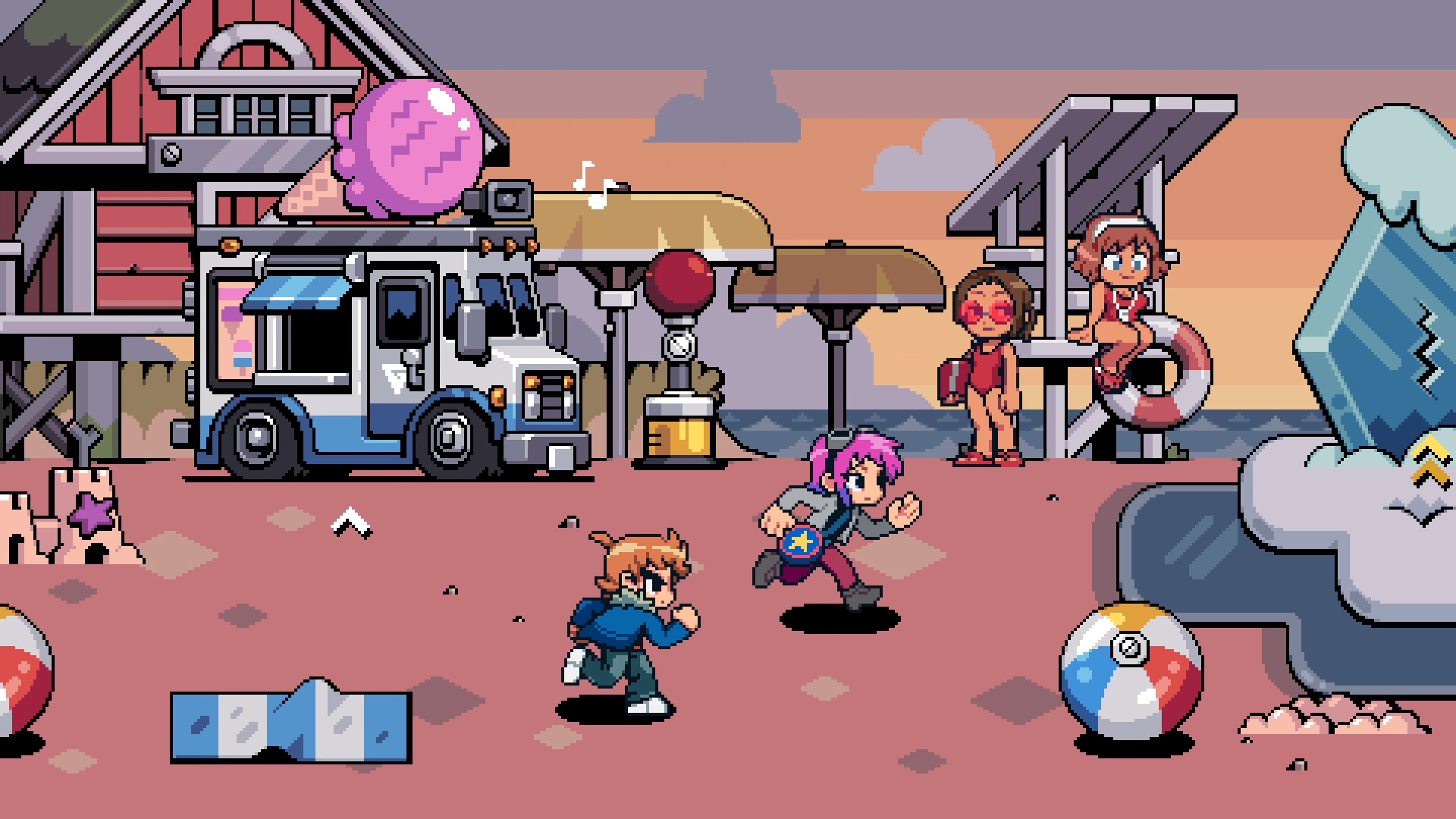
This review will avoid any major spoilers.
Scott Pilgrim EX is an interesting one. It sets out to do things a little differently than its cult classic predecessor in almost every regard. They could've merely gotten the band back together to do a straightforward sequel, making up for all the bugs and balance issues that arose from having to rush the first game out to release it alongside the movie. But they didn't. Instead EX looks different, it sounds different, it's structured differently, and the roster of playable characters is entirely different aside from the obligatory Scott and Ramona. I think this mostly works out and makes for a creatively worthwhile followup that does new things with the franchise, though there are some pacing issues that keep me from being completely crazy about it.
The big structural difference is that the game leans fully into the source material's River City Ransom inspirations and sets itself in one interconnected map of Toronto rather than discrete levels. This is a welcome change in theory. I did enjoy running around town and finding some secrets in areas I'd already been through and talking to NPCs and whatnot, which the game had more room for due to its more open structure and action RPG trappings. It feels more cohesive than the original game's half-measure fusion of linear levels with RCR RPG mechanics for sure, especially since they wisely removed the requirement to level up to unlock your full moveset.
The problem is that the game's story progresses via a series of missions that mostly consist of running to a location marked on your map, opening up a portal to a small new side area that's usually only one or two new rooms, beating a few waves of enemies followed by a boss in the same room, and then receiving a key item to open up the next portal somewhere else and repeat the process. I had fun with all of those missions, and I enjoyed the chaotic combat that emphasizes the game's wide variety of throwable objects, and there's a lot of enemy variety, and even without full-sized levels it adds up to about three or four hours in length for a single playthrough, which is pretty normal for the genre. I didn't even mind the backtracking, because the map isn't huge and it's super quick to get across town. But it didn't hit the same as having a full level preceding each boss. The big fights feel a bit anticlimactic when there's so little buildup to them.
The leveling system also means that a lot of the game can be a breeze if you end up a little overleveled, though by the end you'll hit the stat caps and be forced to play a bit more strategically. (Or just spam assists, I guess.) I played on normal, so I might recommend genre diehards jump straight to hard mode. There's a lot going on with the combat system, so it's probably worth trying the difficulty that pushes you to actually engage with the dodges and parries and counters and cancels and whatnot. This might make your victories feel more satisfying.
I do get why they didn't structure it more traditionally, though. Again, River City Ransom is baked into Scott Pilgrim's DNA, but also this team's already done licensed beat-'em-ups several times now. On top of the original game and the incredible Teenage Mutant Ninja Turtles: Shredder's Revenge, Tribute just released the very good Marvel Cosmic Invasion a few months ago, not to mention the surprisingly good GBA TMNT movie tie-in game several of them worked on that landed them the Scott Pilgrim gig in the first place. So I don't blame them for wanting to experiment, even if I probably prefer more traditional takes on the genre. It's cool to see them try new things.
(Oh, and also, Ubisoft had nothing to do with this one, if you're worried about being forced to log in with a Ubisoft account to play online or whatever. That's a mark in EX's favor. As is the fact that I never had some kind of crazy glitch where I fell through the floor and got stuck on the wrong collision plane and had to restart a level.)
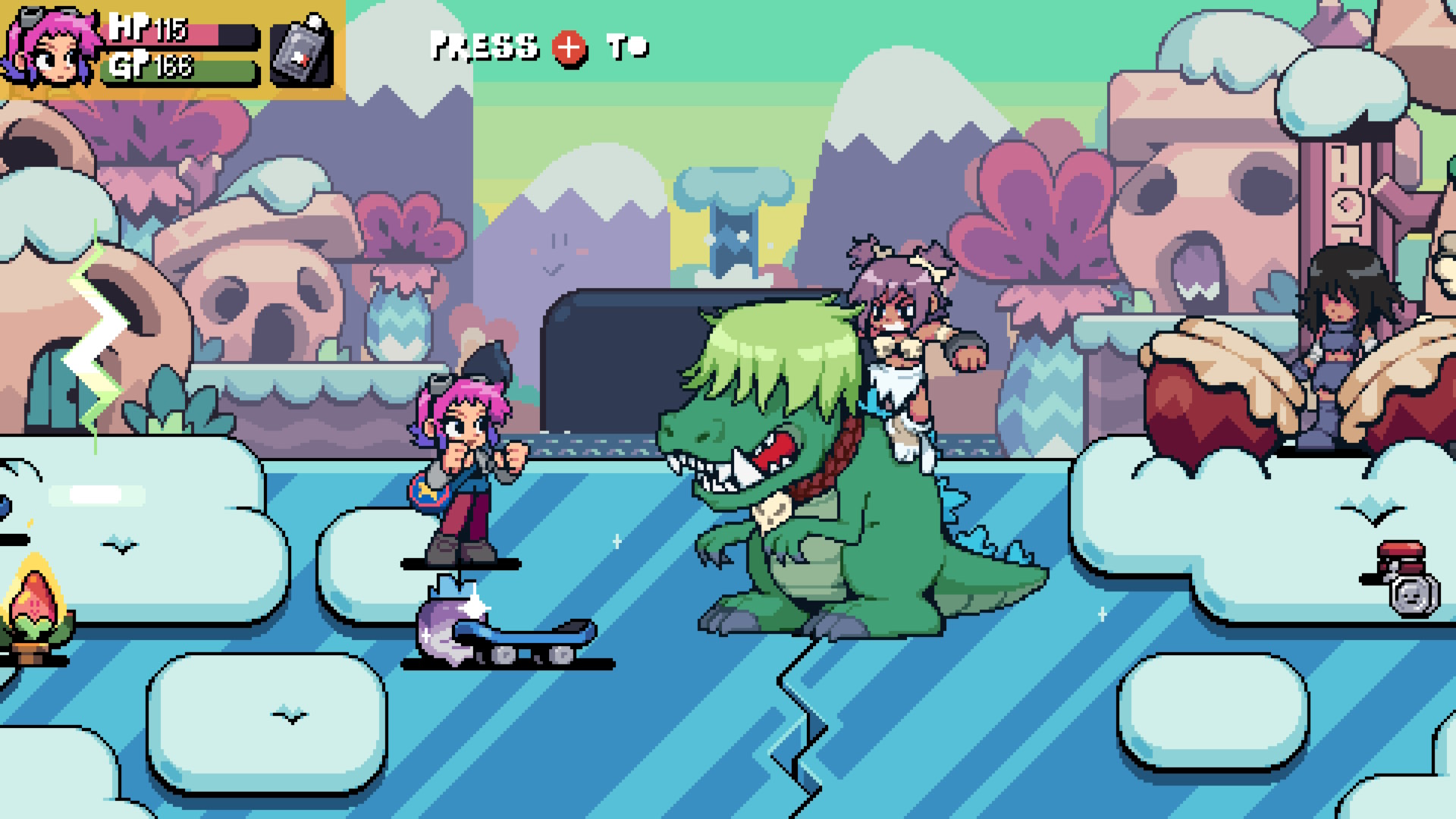
The story written by Bryan Lee O'Malley is also a bit underwhelming. I didn't expect much, but it's really just an excuse to have you do a bunch of wacky fights where the usual cast is thrust into different time periods and video game pastiches to put a fun new spin on things. Prehistoric catgirl Roxie and dinosaur Todd, gothic fantasy Envy, Metal Scott, etc.
The story is vaguely kind of sort of set after Scott Pilgrim Takes Off (the excellent Netflix anime that pulled a Rebuild of Evangelion and took the story in a completely different direction), since Knives is in the band now and Scott and Ramona are fighting alongside the reformed Evil Exes, who make up the bulk of the playable roster in place of Scott's friends. But the continuity isn't important here, nor does the game take itself seriously. There was a Nirvanna the Band joke in there, though. That made me laugh. So did the inexplicable presence of Cat Wallace, a cat you can find with Wallace's face that gives you gameplay tips and says "nyaa." It lacks the bite of the graphic novels and their deconstruction of Scott's main character syndrome and refusal to grow up, but it's decently funny in a self-aware sort of way, with jokes like Wallace breaking the fourth wall to read the game's walkthrough to tell you where to go next. It gets the job done. Those curious for more context can also find a prologue comic O'Malley published online, which explains why Scott already knows Metal Scott at the start of the game.
But as expected, the presentation is an absolute treat throughout. The character sprite work remains some of the best I've ever seen, and they have a lot of fun injecting personality into all of those wacky alternate universe boss fights and their lavishly fluid animations. Dare I say it, I might even like the character sprites here better than the originals!
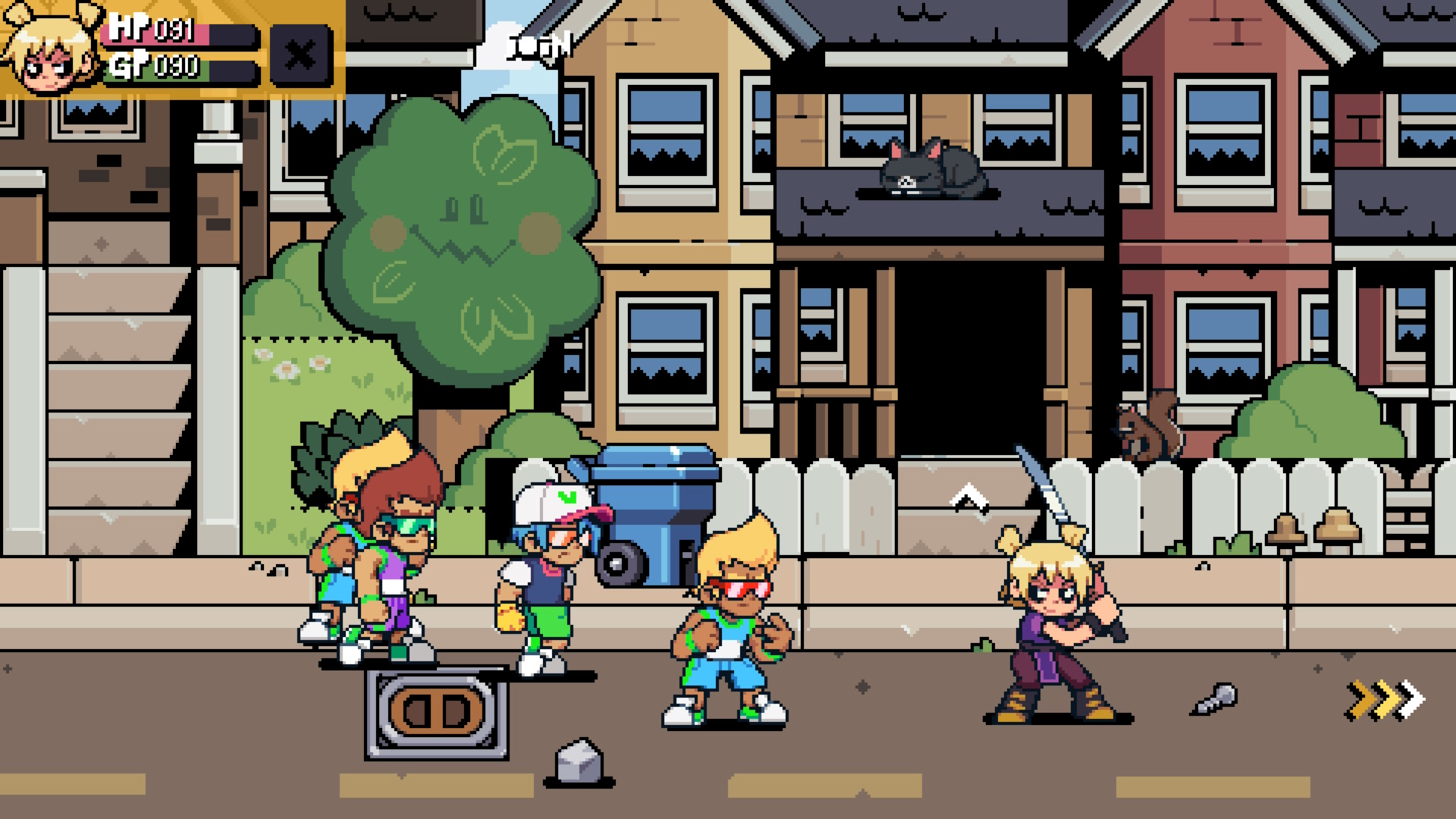
The backgrounds, though, are totally different in a way that really intrigues me. The goal was clearly to evoke the stylistic quirks of the tile-based graphics of the NES, with background elements using limited colors and typically adhering to a grid rather than worrying about realistic perspective. Buildings feel more like flat cardboard cutouts arranged on a stage than real objects. Surface textures are simplified down to the most basic geometric patterns they can get away with to still convey what it's supposed to be. Negative space and edges where two objects meet are often filled in with pure black shadows. As a pixel art nerd this is a super unique and striking way to modernize the charm of 8-bit pixel art, embracing the retro idiosyncrasies that we'd normally try to avoid in a modern production. And it looks even better in motion thanks to the multiple layers of parallax scrolling and how much animated life and detail everything has. Trees swaying in the wind, cats and squirrels running around neighborhoods, enemies jumping out from manholes, things like that. It's a bold choice because a lot of people will look at it and just not get what they're going for, but I think it rules.
The new soundtrack from Anamanaguchi follows a similar ethos, giving fans some of what they expect while also trying a bunch of new stuff. There are, of course, a handful of new tracks that blend high energy NES chiptune with four-piece live rock in classic 'Guchi fashion, but the band also experiments with a huge range of other classic video game sounds and musical genres that they otherwise might not have had an excuse to try out as a band. There was a little of that in the original game, but they take it so much further here, with some noisy Genesis rock that I have to assume was influenced by the soundtrack of Sonic Spinball acting as a bold statement of intent in the game's opening. If the original game's soundtrack was a classic Anamanaguchi album stretched out to fill a whole video game, EX's fully embraces their love of video game soundtracks. There are some tracks evoking the SNES and PlayStation eras, some more ambient area themes that are kind of shoegazey to me, a wild drum 'n' bass boss track, and the final boss theme brings theme full circle by homaging Undertale's "Hopes and Dreams," which itself was arranged as chiptune rock to homage Anamanaguchi. Beautiful. I'd love to hear the band break down all their references here. A little Turtles in Time, some Symphony of the Night, I think I even heard a little Cave Story in there somewhere? Even if you don't play the game, you've gotta give the OST a listen.
And so, at the end of the day, Scott Pilgrim EX is a good if oddly paced beat-'em-up with killer presentation and a story that leads to a lot of fun scenarios but aspires to do little beyond that. We now have two different games in this series with very high highs and their own frustrating flaws. In a way I suppose this makes them interesting companion pieces to each other, rather than letting the new game completely replace the original by being the same thing but better, in the same way that the movie and the anime and the original game are companions to the graphic novels since none of them tell the exact same story. I did enjoy my time with it, though, to the point that I started a hard mode New Game+ playthrough right after rolling credits to check out more of the characters. Its quirks mostly feel like a result of the team's creative goals this time and a desire to do something different, rather than being the result of Ubisoft mismanagement, and I have to respect it for that. If you go in with an open mind rather than expecting an exact retread of the original game that will make you feel like it's 2010 again, there's a lot to like here.
And hey, if that empty space on the character select screen is a hint that DLC is on the way, I'll gladly check that out.
You should also read:
Scattered thoughts on Ghost Trick
A few thoughts on Ghost Trick: Phantom Detective that I posted on Cohost while playing the remaster, now preserved here on this blog.
Continue reading...
Some thoughts on Zelda and "objectively good/bad" game design
Using Tears of the Kingdom as an example of some things that irk me in game design discourse.
Continue reading...
Scattered thoughts on the Alan Wake series (and Control)
A bunch of informal posts I made on Cohost as I played through this wild series, all preserved in one place.
Continue reading...
Comments