Quick thoughts on The Amazing Digital Circus and its finale

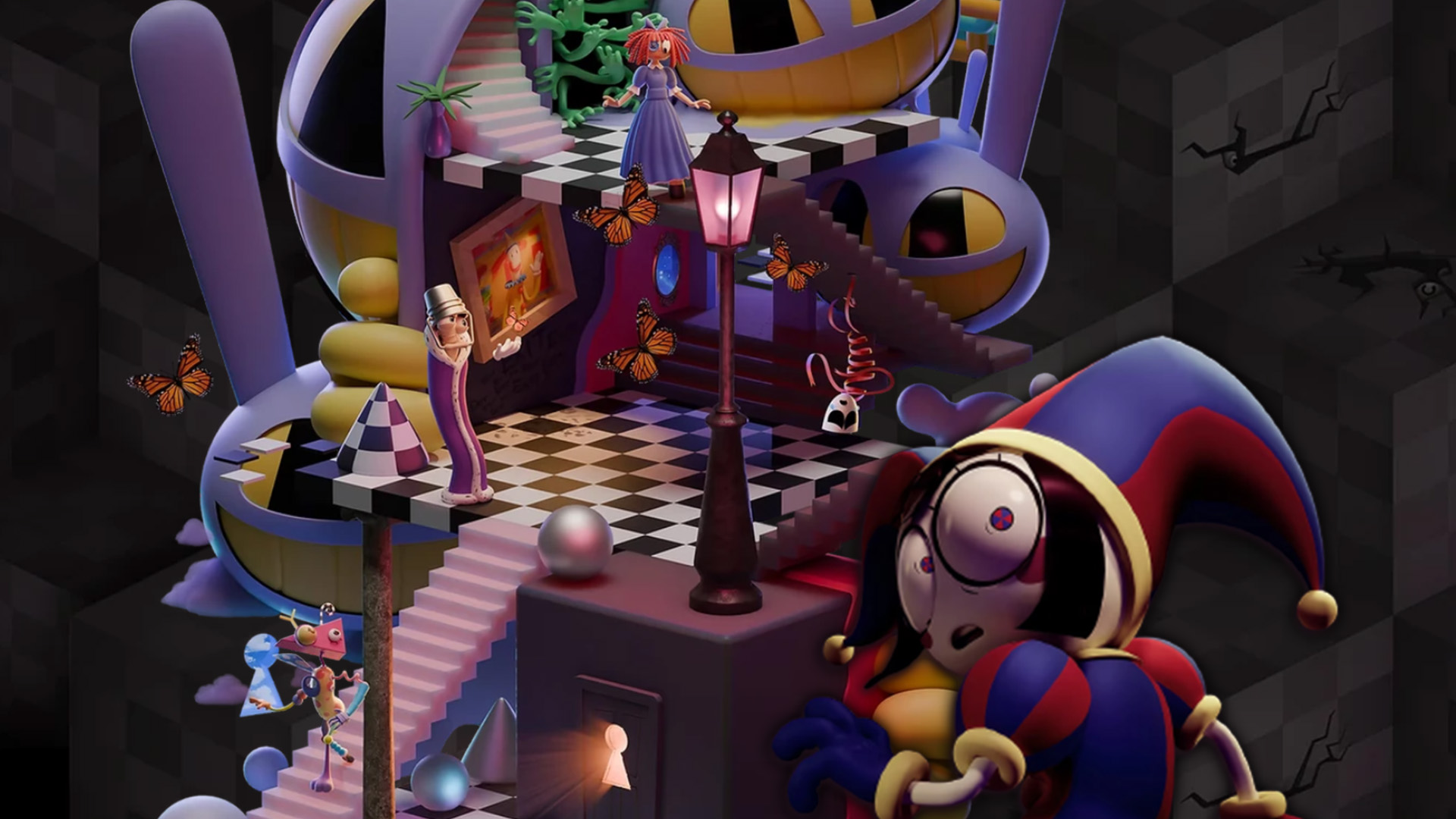
For most of its run, I planned to write an in-depth piece about The Amazing Digital Circus when it was finished. Then the show's fandom went insane near the finish line, and this made me lose the energy to write a long, formal review. (Plus, I've already done three other huge blog posts that crossed the 10,000 word mark this year and need a break.)
I've shared thoughts on the show and its ending elsewhere, though, so in place of a proper review here's a lightly edited Ponett Gazette archive of those posts, all in one convenient place.
Thoughts going into the finale
The following is taken from a Tumblr post where I was asked if I'd seen The Amazing Digital Circus and if I had plans to review it, posted before I'd seen the finale. It goes into more detail on why I scrapped plans for a longform review.
I have watched TADC and mostly enjoyed it. The middle episodes dragged a bit as it settled into being more of a hang out show (though it was still funny and well-animated throughout), but the last couple have really picked up and leaned more into the psychological torment that hooked me early on. The stuff like Pomni spending a whole episode bonding with Gummigoo, only for Caine to snap his fingers and erase him from existence at the end. I didn’t see the finale in theaters, so I’m waiting for the YouTube release.
For a while I really thought I was going to do a review to both express praise for it and also get into some of my quibbles with the show. The over-reliance on scenes where two characters sit down and tell each other their feelings are valid, which feels odd for a series about a bunch of strangers trapped in a VR torture labyrinth that was initially pitched as a psychological horror series inspired by I Have No Mouth and I Must Scream. The stuff I talked about in my original Hazbin review where these big viral indie cartoons feel like they have to be fandom-ready and have lots of marketable characters they can make a mountain of merch out of (in this case even advertising new merch drops based on each episode within the credits of the episodes themselves), because aggressive merchandising is basically the only way to fund a production like this—which isn’t really a problem with the show itself, more the system it exists within. These things don’t ruin my enjoyment of the show, but they are on my mind.
The problem is that TADC (and, honestly, Glitch shows as a whole) have become miserable to talk about online. A large portion of that young, obsessive fanbase that the show had to attract in order to fund itself has turned on the show and its creators, unable to handle any real conflict or tension in the narrative or their ships not being canon or whatever, and now they just wanna turn Gooseworx into a lolcow and threaten her with violence.
And meanwhile the people who already hated the show are taking those same mild criticisms I had about the merch-driven production model and the “therapyspeak” writing (I hate how the term “therapyspeak” gets applied to basically any example of characters talking about their feelings now, especially if it’s a thing women like, but it’s at least somewhat applicable here) and expressing them in the most obnoxious, belligerent ways possible. I think that’s the real kicker for me. The Hellaverse shows have always been surrounded by fandom discourse and controversy, but I felt like setting the Vivziepop callouts aside and focusing more on Hazbin’s pacing and structural issues gave me my own angle to talk about it in a worthwhile way. But the nitpicks I have of TADC (again, along with many things I like about the show!) are already being widely discussed in a million hyperbolic posts debating whether or not the show is Milennial Humor Tumblrcore Theorybait Therapyspeak Validcore Merchslop or whatever buzzwords 20-year-olds like to throw around this week to completely discredit it. In the face of that, I just don’t know if I have the energy to join into that shitshow.
Thoughts on the finale
The following is mirrrored from my Letterboxd review of the finale, written the day of its YouTube premiere right after I finished watching.
I had my complaints about TADC as it was coming out. While it initially seemed like the other shoe was going to drop and it'd fully become a VR psychological horror series inspired by I Have No Mouth and I Must Scream, where the cast is at the mercy of a mercurial AI god and they can all abstract into horrific monsters at any time, for most of the series it instead turned into more of a low stakes hangout dramedy show focused on one-on-one scenes where characters sit down and talk about their feelings. Now that it's all out, though, the finale puts it all into perspective and nicely wraps up the more sentimental character study it actually wanted to be.
The character who steals the show is obviously Jax. I'm sorry to all the fandom-brained teens mad about this, but you're out of your fucking mind if you didn't think Jax was obviously the heart of the show all along. Like I do not know what show you were watching if you thought fucking Gangle or whoever would be more important in the finale and you hate that the narrative cares about someone who's mean instead of just the other characters who are nice. Jax was the only character who seemed realistically fucked up by being trapped in a VR simulation, the one who raised questions about whether or not any of this was real or if it mattered, the one who injected some much-needed conflict in the group rather than being able to perfectly talk things out every time. Jax being so toxic made the show SO much more interesting!
And so a large chunk of the finale is devoted to finally elaborating on why Jax is like that, all but confirming something I'd seen others pick up on based on hints dropped throughout the show: that "he" is actually a closeted trans woman driven by intense, overwhelming self-loathing, burying her true feelings under a layer of ironic detachment out of shame and pushing away anyone who might get close enough to learn the truth. It's a messy story complicated by the fact that neither the real or digital Jax gets a clear cut happy ending, but it's also by far the most raw and personal thing in the whole series. The "Isn't She Lovely" needle drop is going to go down in history.
I can nitpick some choices made in the finale, like some of the heart-to-heart scenes that didn't do much for me (though the one early on with Pomni and Ragatha was very sweet), or how Caine comes back to life too easily, or how other than Jax's ambiguous fate(s) the ending is a little too neat and tidy. But none of that really matters to me all that much when the emotional core hits so hard. The most popular cartoon on the planet right now managed to sneak a story about how agonizing and alienating dysphoria can be and how personal connections and freedom of self-expression will save us into theaters, and it outperformed the new Star Wars. You've gotta love it.
Thoughts on Jax
The following is taken from another Tumblr post responding to a question about what I think about Jax in terms of trans representation, and the nastier side of the audience response.
As I grow older I think that the lens of “representation” can be a very limiting way to view queer fiction, especially things drawing from a queer creator’s own lived experiences, and Jax’s story is a great example of why.
By some rubrics, Jax is “bad transfem representation.” She’s a fucked up, maladjusted person who never actually even transitions, who pushes away and hurts most of the people close to her, and whose story ends tragically with something that partially evokes suicide. (Though the abstractions are still, you know, alive, and they seem to still be in there somewhere, so I don’t like reading it as a 1:1 metaphor. And also obviously Jax’s real world counterpart is still alive and seems to be doing better lol.) Jax isn’t an aspirational character for trans women watching the show or someone who makes trans women look good to cis audiences. She’s unflattering and suffers a downfall of her own making and only realizes that she’s still capable of being loved after it’s too late. Thus, “bad representation.”
The tragedy of Jax’s story is something deeply personal, a cautionary tale about the ugly side of dysphoria and internalized misogyny and bad parent-child relationships and what happens when you repress yourself into a jaded, irony-poisoned mess rather than letting yourself be vulnerable in front of other people. It’s a pain that a lot of us can relate to, because real people don’t always mirror “good representation,” and seeing that pain expressed in a work of art like this helps us process those feelings and know that we aren’t alone. The ugliness isn’t a mistake, it’s the point.
Yes, I also love cute and fun and hopeful and sappy stories about queer characters that make me feel warm and fuzzy inside, which is closer to how most of the other characters’ stories end in TADC, living happily ever after in a version of the circus where they get to live life how they want to live. Neither is the singular “right” way to tell queer stories, because we need more of ALL kinds of queer stories, because art is subjective and different things will speak to different people. And it’s beautiful that this is a story reached such a wide audience and was able to speak to so many people. I hope Jax put things in perspective for some folks.
Unfortunately, there are a lot of people out there who care more about the wellbeing of fictional characters than the treatment of their real world creators, and this is how you get shit like people harassing and misgendering actual real trans woman Gooseworx and calling her a raging misogynist and all sorts of other heinous shit just because they didn’t like the way she wrote her fictional cartoon trans woman Jax. People are insane about cartoons and are extra shitty to visible trans women online, what else is new?